
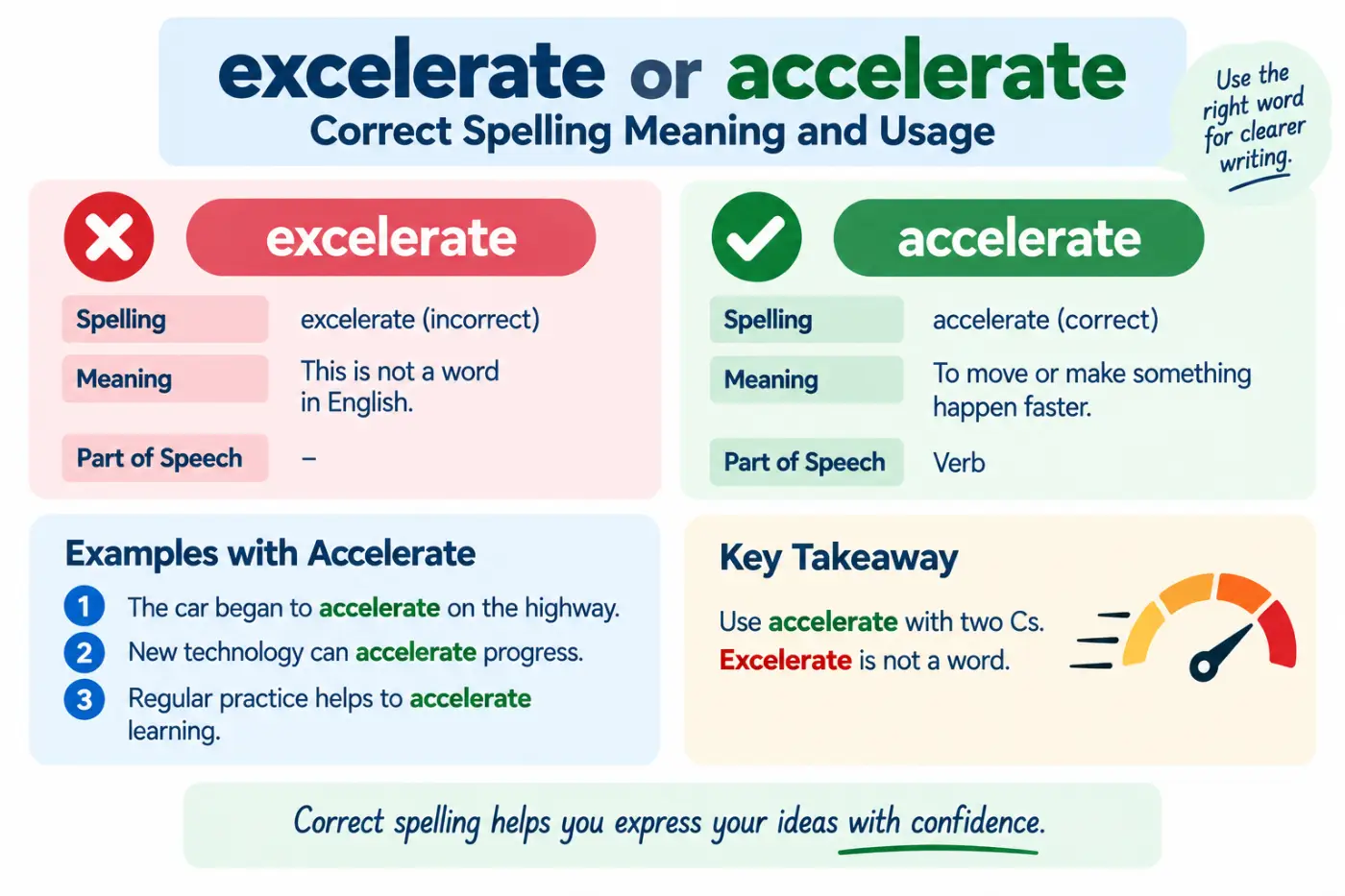
Excelerate or accelerate can be confusing because both forms look and sound close when you say them quickly. The correct standard English spelling is accelerate. Excelerate is generally a misspelling of the verb and should not be used in standard English writing. The difference is small on the page but matters in school work professional writing and published content.
The confusion often comes from pronunciation. The first part of accelerate sounds like ek or ak in natural speech and the middle sounds like sel. That can make the spelling feel less obvious. People may also connect the word with acceleration and other related terms without remembering exactly how the verb is spelled. Cambridge lists accelerate as a verb meaning to move more quickly or to make something happen faster or sooner.
In this guide you’ll learn the difference between the two forms their meanings pronunciation grammar spelling pattern word history and natural usage. You’ll also see common mistakes related words and examples from everyday conversation school work business communication journalism and formal writing. By the end you’ll have a simple way to remember the correct form.
Quick Definition
Accelerate is the standard English verb meaning to become faster or to make something happen faster or sooner. Excelerate is generally a spelling error rather than a standard alternative form. You can use accelerate for physical movement such as a car gaining speed and for processes such as growth development or change.
Quick Answer
The correct form is accelerate. Excelerate is not the standard spelling of the verb.
Accelerate can describe something becoming faster or someone causing an activity or process to happen more quickly. For example you can say The car began to accelerate or We need to accelerate the project.
Comparison Table Excelerate or Accelerate
| Form | Meaning | Part of Speech | Origin | Usage Frequency | Formality | Common Contexts | Example |
|---|---|---|---|---|---|---|---|
| Accelerate | To become faster or make something happen faster | Verb | From Latin accelerare through the history of English | Very common | Neutral and formal | Driving science business education news and general writing | The car began to accelerate. |
| Excelerate | No standard meaning as the spelling of this verb | Nonstandard spelling | Usually a misspelling of accelerate | Uncommon as a standard form | Not appropriate for standard formal writing | Typing errors spelling mistakes and informal errors | Excelerate should be corrected to accelerate. |
Meaning and Definition
Meaning of the Incorrect Form
Excelerate is generally a misspelling of accelerate. It does not function as the standard spelling of the English verb that means to become faster or make something happen faster.
You may encounter this form in online writing because people often spell words according to how they sound. A person who has heard accelerate many times may remember the general sound but not the exact sequence of letters. The mistake becomes especially easy when typing quickly.
It helps to separate recognition from correctness. A reader may understand what someone means when they see excelerate in a sentence. Context can make the intended word obvious. However understanding a misspelling does not make that spelling standard.
If you are writing an essay email report resume application article or school assignment use accelerate.
Meaning of Accelerate
Accelerate is a verb that means to move faster or to cause something to move or happen faster. Cambridge gives both physical and broader uses. A vehicle can accelerate when its speed increases. A process can also accelerate when it begins happening at a faster rate.
For example:
The driver accelerated to pass the truck.
The company accelerated production before the holiday season.
The first sentence describes physical speed. The second describes the rate of an activity.
This wider meaning is one reason the word appears in many fields. You can find it in science business education economics technology journalism and everyday conversation. The basic idea stays the same. Something gains speed or a process moves forward at a faster rate.
Key Differences Explained
- Spelling. Accelerate is the standard spelling. The first part contains the letters a c c e l. Excelerate changes that pattern and is generally treated as a spelling error.
- Meaning. Accelerate has an established meaning. It can mean to become faster or to make something happen faster. Excelerate does not carry that standard dictionary meaning.
- Grammar. Accelerate is a verb. You can use it as an action performed by a subject or as an action affecting an object.
- Pronunciation. The two forms can sound similar to someone who is listening quickly. This similarity can contribute to the spelling confusion.
- Formality. Accelerate is suitable for casual speech and formal writing. The misspelled form should be corrected before publication or submission.
- Context. Accelerate can describe vehicles physical objects business activity scientific processes growth change and many other forms of increasing speed.
- Regional usage. Standard American English uses accelerate. British Canadian and Australian English also use accelerate as the standard spelling.
- Word family. Accelerate belongs to a larger family that includes acceleration accelerator accelerated and accelerating. Learning the family makes the spelling easier to remember.
Which Form Is Correct?
Accelerate is the correct standard form. Major English dictionaries list it as a verb. Cambridge describes it as a word used when a person or object moves more quickly or when someone makes something happen faster or sooner.
The spelling also makes sense when you look at related words. Acceleration uses the same opening pattern and refers to an increase in speed or rate. Accelerator refers to something that causes acceleration. These related forms reinforce the spelling pattern.
There is also a useful word origin behind the spelling. Accelerate comes from Latin accelerare which meant to hasten or quicken. The English verb developed from that Latin word family. Etymological records trace its English use back to the sixteenth century.
So if you are unsure while writing remember the related words acceleration and accelerator. They both begin with accel. That gives you a strong spelling clue.
Sentence Examples
Here are natural examples that show how accelerate works in different settings.
- The driver began to accelerate as the road opened up.
- We need to accelerate the hiring process before the new project starts.
- The runner accelerated during the final part of the race.
- New technology can accelerate the way people share information.
- The company plans to accelerate production next month.
- The teacher used a new activity to accelerate the students’ progress.
- The plane began to accelerate along the runway.
- Heavy rain can accelerate soil erosion in some areas.
- The team hopes to accelerate the development of the new product.
- The economy began to accelerate after a long period of slow growth.
The incorrect spelling may appear in sentences such as these:
- The driver began to excelerate.
- We need to excelerate the process.
- The company wants to excelerate production.
- The plane started to excelerate.
- New technology may excelerate development.
In each case the intended word is accelerate. These examples are useful only for spotting the error. They should not be copied as standard spelling.
Common Mistakes and Misspellings
Excelerate instead of Accelerate
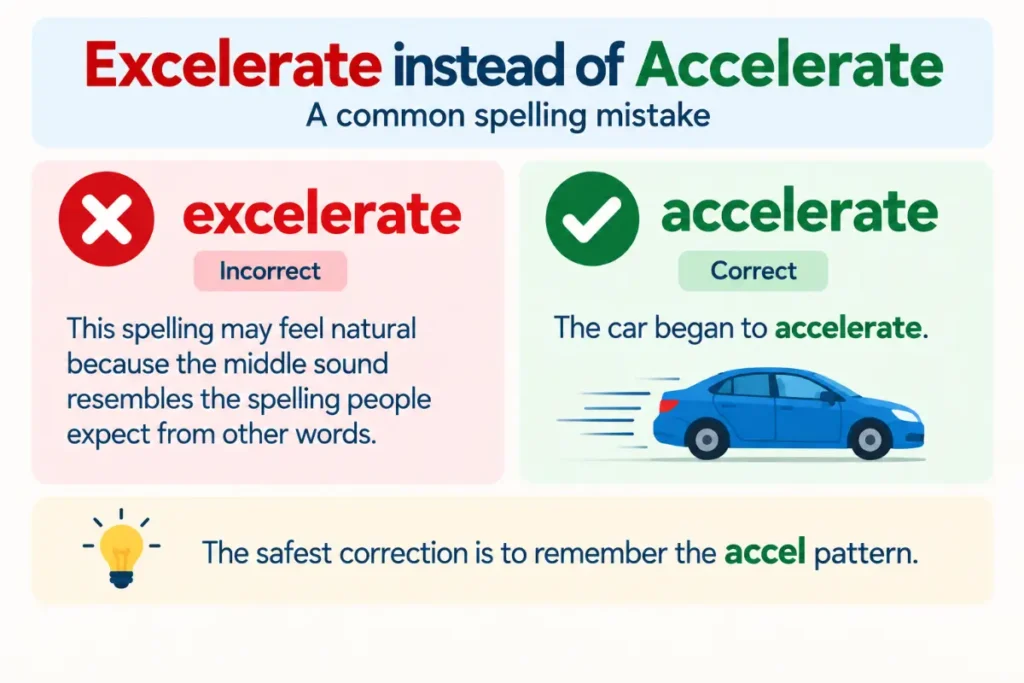
This is the main mistake behind the comparison. The spelling may feel natural because the middle sound resembles the spelling people expect from other words. The safest correction is to remember the accel pattern.
Correct: The car began to accelerate.
Incorrect: The car began to excelerate.
Accelerate confused with acceleration
Accelerate is a verb while acceleration is a noun. You can say The car will accelerate. You can also say The car has strong acceleration.
The difference is grammatical rather than merely spelling based.
Accelerate confused with accelerator
Accelerator is a noun. It can refer to something that causes or controls acceleration. In a vehicle it commonly refers to the pedal used to increase engine power and speed.
Correct: Press the accelerator gently.
Correct: The vehicle began to accelerate.
Accelerate used when speed does not actually increase
The word often suggests an increase in speed or rate. Saying that something accelerates usually implies that its movement or progress becomes faster.
For example The car accelerated means its speed increased. In a broader context The project accelerated means the project began moving forward more quickly.
Confusing accelerate with hurry
Hurry and accelerate can overlap but they are not always interchangeable. Hurry usually describes a person doing something quickly or urgently. Accelerate focuses more directly on increasing speed or rate.
You can hurry to class.
You can accelerate the process.
The two expressions describe related ideas but work differently in sentences.
Pronunciation Guide
The US pronunciation is commonly represented as /ekˈseləreɪt/. Cambridge gives this American pronunciation along with a British pronunciation that begins with a slightly different unstressed vowel.
A simple pronunciation guide for American English is:
ek SEL uh rate
The main stress falls on the second syllable.
You can think of the word as four sound groups:
ek + sel + uh + rate
The first vowel can vary slightly in natural speech. The middle sound is often reduced. That is normal English pronunciation and does not change the spelling.
One common pronunciation mistake is giving every vowel the same strong sound. Native speakers usually make the middle syllables lighter than the stressed syllable.
Another issue is spelling from sound. Because the opening sound can resemble different letter patterns a listener may guess the spelling incorrectly. That is one reason excelerate appears in informal writing.
A useful learning method is to say accelerate slowly while looking at the written form. Then say it at normal speed. This connects the sound with the spelling instead of relying on sound alone.
Etymology and Word Origin
The history of accelerate explains why its spelling looks the way it does.
The word comes from Latin accelerare which meant to hasten or quicken. Etymological records trace the English verb to the sixteenth century. The Latin formation included ad meaning toward or to and celerare meaning to hasten. The deeper root celer carried the idea of being swift.
English later developed both physical and broader meanings. The physical sense concerns something moving faster. The broader sense applies the same idea to events and processes.
That is why we can talk about a car accelerating and also about change accelerating. The surface context changes but the central idea remains an increase in speed or rate.
The noun acceleration comes from the same family. It refers to an increase in speed or the rate at which something happens. Cambridge also uses acceleration for the rate at which something moves more quickly or happens faster.
The related noun accelerator developed from the same Latin source. Its historical use first referred broadly to something that hastens and later developed specialized meanings including the vehicle control.
Knowing this word family gives you a practical spelling advantage. The shared accel pattern appears across the major related forms.
Regional Usage
American English
American English uses accelerate as the standard spelling. It appears in everyday conversation as well as education business science journalism and technical writing. The American pronunciation commonly begins with an /ek/ sound and has the main stress on the second syllable.
For example:
The car accelerated quickly.
The company wants to accelerate growth.
The word is completely normal in both casual and formal American English.
British English
British English also uses accelerate as the standard spelling. The meaning is essentially the same as in American English. The main difference you may notice is pronunciation rather than spelling. Cambridge gives the British pronunciation as /əkˈsel.ə.reɪt/.
There is no standard British spelling change that turns accelerate into excelerate.
Australian English
Australian English follows the same standard spelling. Accelerate can describe physical movement as well as faster progress or change. The spelling remains accelerate in normal Australian English.
For example:
The driver accelerated onto the highway.
The program aims to accelerate economic growth.
Canadian English
Canadian English also uses accelerate as the standard form. There is no meaningful regional spelling difference between accelerate and the American form.
Canadian writers can use the word naturally in academic professional journalistic and everyday contexts.
Across these major English varieties the spelling remains consistent. The pronunciation may vary slightly but the written form does not change to excelerate.
Grammar Rules and Part of Speech
Accelerate is a verb. It can be used without a direct object when the subject itself becomes faster.
For example:
The car accelerated.
The plane accelerated.
The runner accelerated.
In these sentences the subject performs the action and becomes faster.
The verb can also be transitive. That means it can take a direct object when someone or something causes another process to become faster.
For example:
The company accelerated production.
The new system accelerated the process.
The treatment accelerated growth.
This distinction is useful because it helps you build accurate sentences.
Intransitive Use
An intransitive use does not require a direct object.
The car accelerated.
The economy accelerated.
The pace accelerated.
Here the subject itself becomes faster or progresses at a faster rate.
Transitive Use
A transitive use takes an object.
The company accelerated production.
The new software accelerated the process.
The teacher accelerated the lesson.
Here something causes another action or process to happen faster.
Common Sentence Patterns
One useful pattern is:
Subject + accelerate.
The car accelerated.
Another is:
Subject + accelerate + object.
The company accelerated production.
You can also use the word with phrases that explain the degree or direction of change.
The vehicle accelerated rapidly.
The team accelerated its efforts.
The project accelerated after the new funding arrived.
Punctuation
Accelerate itself does not require special punctuation. Punctuation depends on the structure of the complete sentence.
For example:
The driver accelerated and moved into the left lane.
The project accelerated after the team received approval.
You should not add a comma simply because accelerate appears in the sentence.
Formal and Informal Usage
Accelerate works well in both formal and informal English. In casual speech you might say:
The car accelerated fast.
In more formal writing you might write:
The vehicle accelerated rapidly after entering the highway.
The word itself is not overly formal. It is a normal English verb that fits many levels of communication.
Real Life Usage Examples
Daily Conversation
In everyday conversation the word often describes cars sports movement or changes that happen quickly.
The car started to accelerate when the light turned green.
The runner accelerated near the finish line.
These uses are easy to understand because the idea of speed is visible.
Email and Workplace Communication
In workplace communication the broader meaning is common.
We need to accelerate the review process.
The team is working to accelerate delivery before the deadline.
Here the word does not mean someone is physically moving faster. It means the work is progressing at a faster rate.
Academic Writing
Academic writing often uses accelerate when describing rates of change.
Higher temperatures can accelerate the chemical reaction.
The researchers observed that the process began to accelerate over time.
The word fits academic writing because it describes change precisely without unnecessary wording.
News and Journalism
Journalists often use accelerate to describe trends or developments.
The decline accelerated during the final quarter.
Officials said the construction schedule could accelerate after approval.
In these examples the word describes a change in the rate of an event.
Literature and Storytelling
Writers can use the word to create a sense of rising movement or urgency.
The horse accelerated as the storm approached.
Her thoughts seemed to accelerate as the deadline drew closer.
The word works especially well when a story moves from a calm pace into faster action.
Related and Confused Terms
Acceleration
Acceleration is the noun form. It refers to an increase in speed or rate. In physics it has a more specific technical meaning involving the change in velocity over time. Cambridge also identifies this scientific use.
Accelerator
An accelerator is something that causes acceleration. In everyday American English it can also mean the vehicle control used to increase engine power.
Accelerated
Accelerated is commonly used as a past tense form or adjective.
The program accelerated quickly.
The students followed an accelerated course.
Accelerating
Accelerating is the present participle and can also function as an adjective.
The accelerating vehicle moved away from the intersection.
Speed Up
Speed up is a common phrasal expression with a similar meaning.
Please speed up the process.
Accelerate often sounds slightly more precise or formal in professional and academic writing.
Quicken
Quicken can mean become faster or make something faster. It can sound more literary or less common in everyday American speech.
The pace quickened.
Hasten
Hasten means to make something happen sooner or move more quickly. It is useful in formal or literary contexts.
The decision hastened the process.
Slow Down
Slow down is an opposite expression. It means to reduce speed or make something happen more slowly.
The driver slowed down near the school.
These related terms help show the semantic field around accelerate. The central idea is a change toward greater speed or a faster rate.
Expert Editor Insight
An experienced editor would usually treat excelerate as a straightforward spelling error and correct it without changing the meaning of the sentence. The confusion is understandable because pronunciation does not always reveal English spelling clearly. Professional editors also look at the word family because acceleration and accelerator make the standard spelling easier to recognize. Spellcheck tools can flag the nonstandard form but good editing still requires understanding the sentence. A useful habit is to remember the shared opening in accelerate acceleration and accelerator. If you remember accel you have a strong visual cue for the correct spelling.
Conclusion
Excelerate or accelerate has a clear answer. Accelerate is the standard English spelling while excelerate is generally a misspelling. The correct verb means to become faster or to make something happen faster or sooner. It can describe a vehicle gaining speed as well as a process such as production growth or development moving at a faster rate.
The easiest way to remember the spelling is to connect it with acceleration and accelerator. All three words share the useful accel pattern. That visual connection is much easier to remember than trying to memorize every letter separately. The word also works naturally in American English and other major varieties of English.
When you see the choice again remember one simple pattern: accel comes before erate. Write accelerate for standard English. That small spelling check can keep your essays emails reports and professional writing clean and accurate.
FAQs
Is excelerate a real English word?
Excelerate is generally not the standard English spelling of the verb meaning to become faster or make something happen faster. In ordinary writing it is best treated as a misspelling of accelerate. A reader may understand it from context but recognition does not make it standard. Use accelerate in school assignments professional documents published writing and other formal contexts.
What does accelerate mean?
Accelerate means to become faster or to make something happen faster or sooner. It can describe physical movement such as a car increasing speed. It can also describe a process such as growth production development or change happening at a faster rate. The word is a verb and works in both everyday and formal English.
Which is correct accelerate or excelerate?
Accelerate is the standard spelling. Excelerate is generally a misspelling caused by confusion between pronunciation and written form. The correct word begins with accel and shares this spelling pattern with acceleration and accelerator. If you are writing an essay email report or article choose accelerate.
How do you pronounce accelerate?
In American English accelerate is commonly pronounced /ekˈseləreɪt/. A simple guide is ek SEL uh rate. The strongest stress falls on the second syllable. The middle vowel can sound weak in natural speech. That reduced sound may contribute to spelling errors because the spoken word does not clearly reveal every letter.
Can accelerate be used for things other than cars?
Yes. Accelerate has a broad meaning. You can use it for physical objects such as cars planes and runners. You can also use it for processes and changes. For example a company can accelerate production and a new method can accelerate research. The common idea is that something becomes faster or happens at a faster rate.
What is a synonym for accelerate?
Useful synonyms include speed up quicken hasten advance rapidly and increase the rate of. The best choice depends on the sentence. Speed up sounds very natural in everyday conversation. Hasten can sound more formal. Quicken often has a literary feel. Accelerate works across casual professional academic scientific and journalistic contexts.
Why do people spell accelerate incorrectly?
The main reason is likely the gap between pronunciation and spelling. English does not always give you enough sound information to predict every letter. The opening sound in accelerate can also encourage people to guess a different spelling. Fast typing and familiarity with similar words can add to the confusion. Remembering the accel pattern is a useful solution.
Is accelerate appropriate in formal writing?
Yes. Accelerate is completely appropriate in formal writing. It appears naturally in academic work business communication scientific discussions reports journalism and professional documents. It can describe physical speed as well as faster progress or change. For example a report might say that a new method accelerated the process. The word is clear precise and widely understood.
