
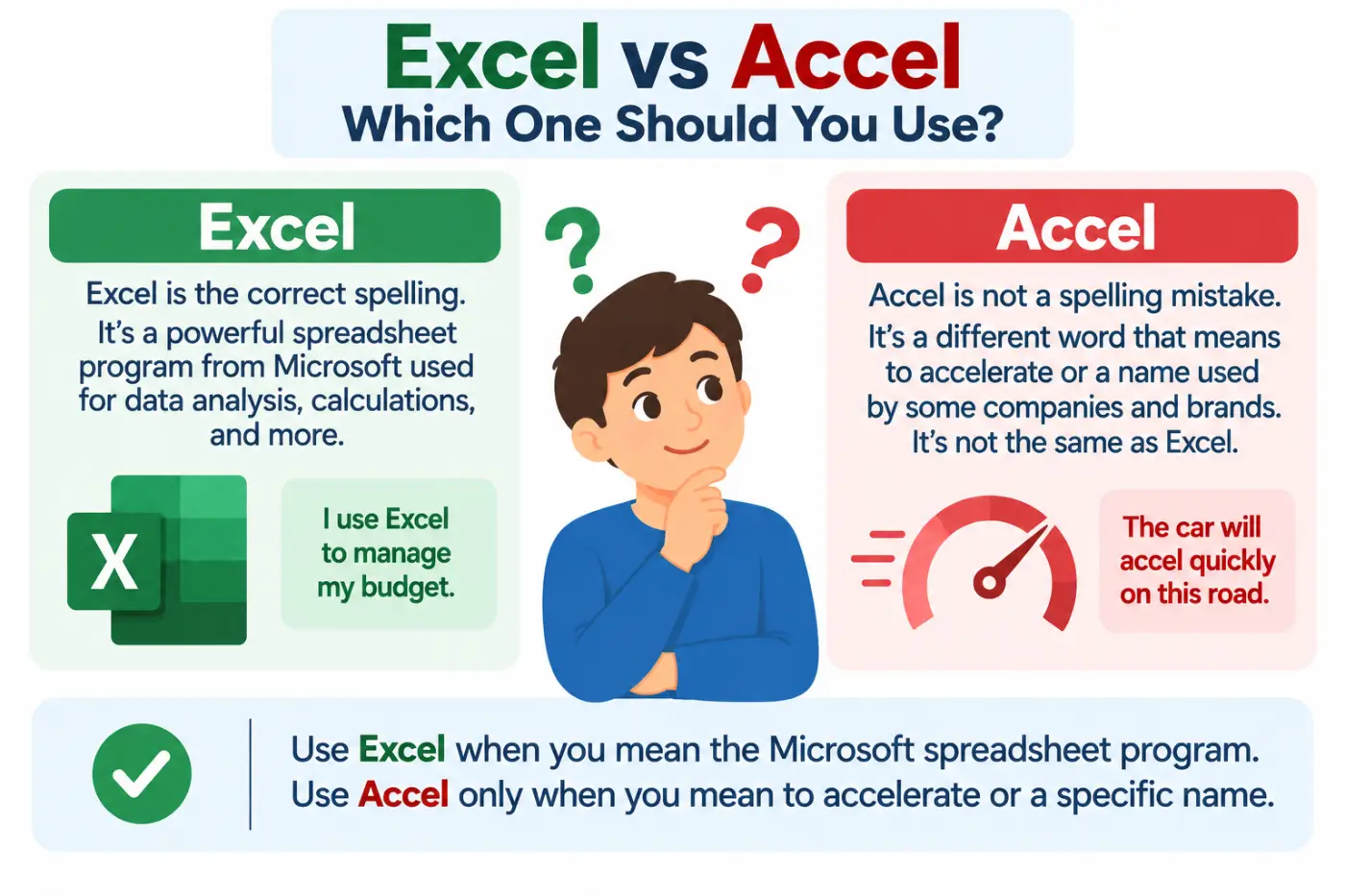
If you’re unsure about excel vs accel, the answer depends on what you’re trying to say. Excel is the standard English word when you mean to do something extremely well or perform better than others. Accel can appear as an abbreviation in specialized writing, especially in music, where it represents accelerando.
The confusion makes sense because both forms begin with the same letters and share a similar sound. People may also encounter shortened forms such as accel in technical notes, software labels, automotive discussions, or other specialized settings. That can make the shorter form look like an ordinary English word when it actually has a much narrower role.
In this guide, you’ll learn how the two forms differ in spelling, meaning, grammar, pronunciation, and context. You’ll also see natural examples, common mistakes, regional usage, word origins, and practical editing tips. By the end, you’ll know exactly when to use the full English word and when the shortened form can make sense.
Quick Definition
Excel is a standard English verb meaning to be extremely good at something, perform very well, or surpass others. Accel is primarily a shortened or abbreviated form used in specialized contexts. In music, accel. is a written abbreviation for accelerando, which tells performers to gradually increase speed.
Quick Answer
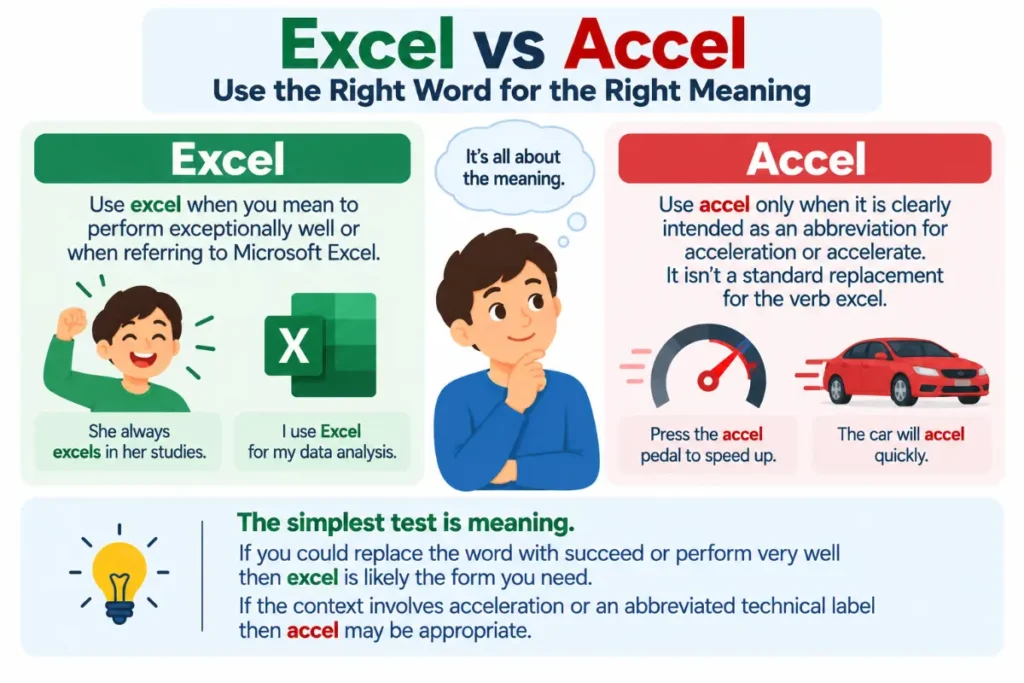
Use excel when you mean to perform very well or be exceptionally good at something.
Use accel only when the context specifically calls for a shortened form such as accel. for accelerando. In ordinary English writing, replacing excel with accel changes the meaning rather than simply creating a different spelling.
Comparison Table
| Form | Meaning | Part of Speech | Origin | Usage Frequency | Formality | Common Contexts | Example |
|---|---|---|---|---|---|---|---|
| Excel | To perform extremely well or surpass others | Verb | From Latin through Old French and Middle English | Very common | Standard | School, work, sports, academic writing, everyday English | She excels in mathematics. |
| Accel. | A written abbreviation for accelerando | Adverbial musical marking | From Italian accelerando | Specialized | Technical | Music scores and musical directions | The score marks accel. before the final section. |
| Accel | A shortened form that may appear in specialized or informal contexts | Context dependent | Shortened from a longer technical term | Limited | Informal or specialized | Technical notes and shorthand | The technician used accel as a short label. |
Meaning and Definition
Meaning of Excel
Excel is a standard English verb. It means to be very good at something, to perform at a high level, or to surpass others in ability or achievement.
For example:
She excels in science.
This sentence means that she performs extremely well in science. You can use the verb with several common patterns. English speakers often say someone excels in a subject, excels at an activity, or simply excels.
The word can describe academic ability, professional performance, sports, artistic skill, leadership, communication, problem solving, or almost any area where people can perform well.
Consider these examples.
He excels at public speaking.
Maria excels in mathematics.
The young athlete excels at swimming.
The team excels under pressure.
The verb can also appear in the phrase excel yourself. This means doing something better than you normally do. Cambridge gives this as an established use of the verb.
Excel can also be transitive in some contexts, meaning it can take a direct object.
She excels her classmates in speed.
This construction is grammatically possible, but modern everyday English more often uses excel in or excel at when describing an area of skill.
Meaning of Accel
Accel is not simply an alternative spelling of excel. Its meaning depends on the context.
The clearest established dictionary use is accel. as a written abbreviation for accelerando. Cambridge identifies it as a specialized musical term. Accelerando is an Italian musical term that tells performers to gradually increase the speed of the music.
For example, a music score might contain an instruction such as:
The music becomes faster after the accel. marking.
In this setting, accel. has nothing to do with being excellent or highly skilled.
The form can also appear as shorthand in specialized environments. Technical users sometimes shorten longer words in notes, labels, diagrams, or software interfaces. The exact meaning depends on the field.
That distinction matters. A shortened form can be useful inside a specialized system without becoming a normal substitute for a standard English word.
If you are writing an essay, email, school assignment, resume, report, or general article and you mean to say someone performs very well, use excel.
Key Differences Explained
- Spelling. Excel and accel have different spellings because they represent different word histories and meanings. Excel is the standard English verb. Accel is mainly a shortened form.
- Meaning. Excel means to perform extremely well or surpass others. Accel commonly represents accelerando in musical notation.
- Grammar. Excel functions as a verb. Accel. in the musical sense functions as a specialized written marking rather than an ordinary everyday verb.
- Pronunciation. Excel is commonly pronounced /ɪkˈsel/. Accel can have different spoken forms depending on what it abbreviates and how the speaker uses it.
- Formality. Excel belongs to standard English and works in both formal and informal writing. Accel is much more context dependent.
- Context. Excel works naturally in school, work, sports, conversation, journalism, and academic writing. Accel. is strongly associated with specialized notation and shorthand.
- Regional usage. There is no major American versus British spelling difference for the standard verb excel. The specialized abbreviation also does not become a standard everyday English word simply because of regional usage.
- Standard usage. If your sentence means someone is very good at something, excel is the form you need. If your context involves musical notation and increasing tempo, accel. may be appropriate.
Which Form Is Correct?
Excel is the correct form when you want the standard English verb meaning to perform very well or surpass others.
Oxford lists excel as a verb meaning to be very good at something and provides common patterns such as excel in and excel at. Cambridge also identifies excel as a standard verb and gives the pronunciation /ɪkˈsel/.
Accell would not be the correct replacement either. The spelling and meaning must match the word you intend to use.
The most useful test is to ask yourself what your sentence means.
If you mean:
Be very good at something.
Use excel.
If you mean:
Gradually increase the speed of a piece of music.
The specialized abbreviation accel. may be appropriate.
This is more than a spelling issue. It is a meaning issue. Changing one form to the other can change the entire sentence.
Sentence Examples
Here are natural examples using the standard verb.
- She excels in mathematics and science.
- My brother excels at solving difficult problems.
- The student began to excel after developing a better study routine.
- Our team excels when the pressure is high.
- He hopes to excel in his new position.
- The young artist excels at creating realistic portraits.
- Good teachers help students discover the subjects in which they can excel.
- She has always excelled in written communication.
- The company succeeds because its employees excel at customer service.
- After years of practice, he finally began to excel at the sport.
Now consider examples involving the specialized abbreviation.
- The composer placed accel. before the final musical passage.
- The performer followed the accel. marking and gradually increased the tempo.
These examples show why context matters. The standard verb and the musical abbreviation belong to different semantic fields.
Common Mistakes and Misspellings
Using Accel When You Mean Excel
This is the main confusion behind the comparison. A writer may see accel in a technical context and assume it is simply a shorter spelling of excel.
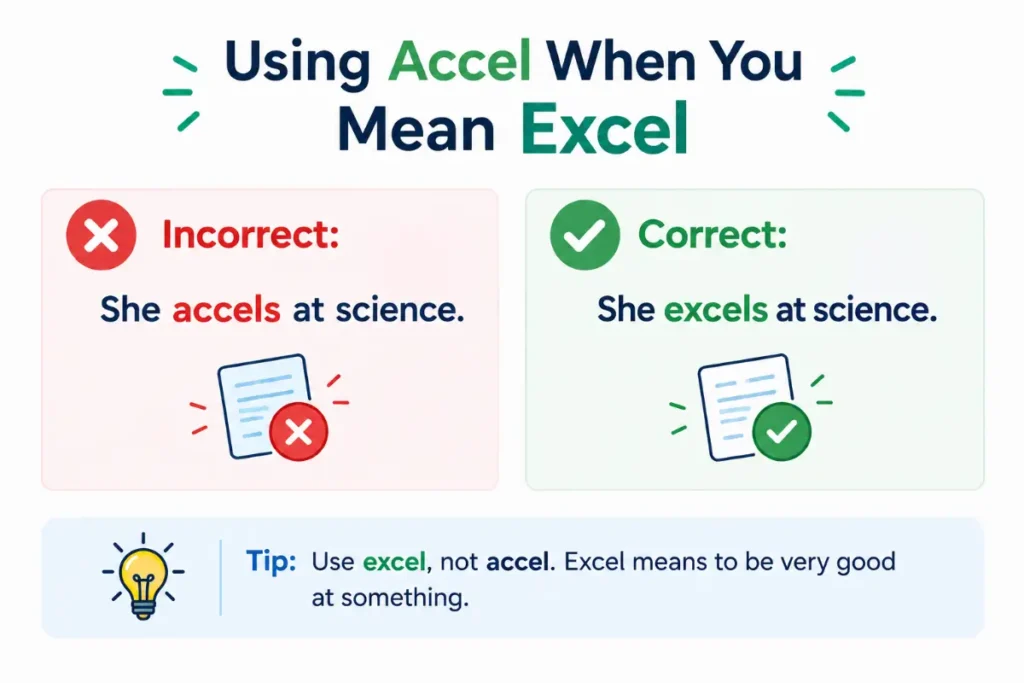
Incorrect:
She accel in mathematics.
Correct:
She excels in mathematics.
The verb needs its normal grammatical ending when the subject is she. Excel becomes excels in the present tense.
Writing Accell
Accell is not the standard spelling of the verb.
Incorrect:
He accells at football.
Correct:
He excels at football.
The correct form uses one c and one x before the final el sound.
Writing Excell
Excell is another common spelling mistake.
Incorrect:
She excell at science.
Correct:
She excels at science.
The past tense and present participle can create extra confusion because the word changes spelling in those forms.
Excel becomes excelled in the past tense and excelling in the present participle.
Confusing Meaning With Acceleration
Someone may assume accel is related to excel because the forms look similar. In fact, the established abbreviation accel. is associated with accelerando and increasing musical speed.
The meanings are therefore far apart.
Excel relates to achievement.
Accel. relates to acceleration in a specialized context.
Dropping the Final S
Writers sometimes forget the third person singular ending.
Incorrect:
She excel in English.
Correct:
She excels in English.
The base verb is excel, but a singular subject such as he, she, or it normally takes excels in the simple present.
Pronunciation Guide
Excel is pronounced /ɪkˈsel/ in standard American English. Cambridge and Oxford both give this pronunciation.
A simple pronunciation guide is:
ik SELL
The stress falls on the second syllable.
The word has two basic sound parts.
- ik
- SELL
The x represents a sound similar to k followed by s. The final part sounds like sell.
A common mistake is to pronounce the first syllable too strongly. In natural American English, the main stress falls on sell.
Another mistake is to pronounce the word as if it were related to excellent. Although excel and excellent share historical roots, their modern pronunciation patterns are different.
The abbreviation accel. does not have one universal pronunciation in ordinary speech because speakers may pronounce the abbreviation itself or say the full word it represents. In music, the full term is accelerando.
Etymology and Word Origin
Excel has a long history.
The word comes into English through Middle English excellen and Old French exceller. These forms trace back to Latin excellere, meaning to rise up, surpass, or be outstanding. Collins connects the English verb with the Latin root and gives the basic historical sense of rising or surpassing.
This history explains why modern English uses excel for exceptional performance. The idea of rising above or surpassing others remains visible in the modern meaning.
The word also belongs to a larger family that includes excellence and excellent.
That connection can help with vocabulary development. If you understand that excel describes outstanding performance, excellence describes the quality of being excellent, and excellent describes something of very high quality, the family becomes easier to remember.
Accel. has a different history in its established specialized use. It is an abbreviation of accelerando. Accelerando comes from Italian and relates to increasing speed.
So although the two forms look similar, their histories point in different directions.
Regional Usage
American English
American English uses excel as a standard verb. It appears naturally in school, business, sports, academic writing, professional communication, and everyday speech. Cambridge gives the American pronunciation /ɪkˈsel/ and defines the verb in terms of performing very well or being highly skilled.
The abbreviation accel. can also appear in American specialized writing. In music, it represents accelerando.
British English
British English also uses excel as the standard verb. The spelling does not change to accel when the meaning is perform extremely well. British dictionaries give the same core meaning and common patterns such as excel in and excel at.
The specialized musical abbreviation remains accel. rather than a British spelling of excel.
Australian English
Australian English follows the same standard spelling for the verb. A person who performs very well excels at something. There is no established Australian spelling rule that changes excel to accel.
Specialized musical writing can use accel. in the same way as other English varieties because the abbreviation comes from musical terminology rather than a regional spelling difference.
Canadian English
Canadian English also uses excel as the standard verb. The spelling remains the same when describing strong performance or achievement.
Canadian writers may encounter accel. in specialized fields, especially music. That usage does not make it an ordinary alternative to the verb excel.
Across these major English varieties, the central distinction stays stable. Excel is the standard verb. Accel. has specialized abbreviation uses.
Grammar Rules and Part of Speech
Excel is a verb. It normally describes a person, group, or thing that performs very well.
One of the most common patterns is:
Subject + excel + in + area
Examples include:
She excels in mathematics.
He excels in leadership.
The school excels in science education.
Another common pattern is:
Subject + excel + at + activity
Examples include:
She excels at writing.
He excels at basketball.
They excel at solving complex problems.
Both in and at are natural. The choice depends on the noun or activity that follows.
Excel can also stand alone.
The team continues to excel.
The students excelled.
The company has excelled.
In the simple present, remember subject agreement.
I excel.
You excel.
He excels.
She excels.
They excel.
For the past tense, use excelled.
She excelled in school.
For the present participle, use excelling.
He is excelling in his new role.
The spelling change is worth remembering because words ending in a single consonant after a stressed short vowel often double that final consonant before certain endings. Excel becomes excelled and excelling.
That is another reason writers sometimes make mistakes with this word. The base form looks simple, but its inflected forms require attention.
Punctuation is straightforward because excel is an ordinary verb. You don’t need special punctuation around it.
For example:
She excels at public speaking.
There is no comma after excels.
Real Life Usage Examples
Daily Conversation
In everyday speech, excel often sounds natural when you want to praise someone’s ability.
She really excels at explaining difficult ideas.
My sister excels in science but struggles with history.
The word sounds slightly more formal than simply saying someone is very good at something, but it remains common in normal conversation.
Email And Workplace Communication
Professional writing often uses excel when describing strengths.
Our support team excels at responding quickly to customer questions.
Employees who excel in communication often help projects run more smoothly.
In a workplace email, excel can sound positive without becoming exaggerated. It focuses on a clear area of performance.
Academic Writing
Academic writing frequently uses the word when discussing achievement or ability.
Students who excel in mathematics often develop strong problem solving skills.
The research team excelled at collecting detailed observations.
Writers should still use the word carefully. Academic writing benefits from precise descriptions rather than praise that lacks evidence.
News And Journalism
Journalists may use excel when describing an athlete, performer, team, or professional.
The young player excels at defending against fast attacks.
The school has produced several students who excel in science competitions.
The word works well because it communicates strong performance in a compact form.
Literature And Storytelling
In storytelling, excel can help describe a character’s natural talent.
From an early age, Maya excelled at painting.
His ability to remember tiny details became the skill at which he excelled most.
Writers can use the word to establish character strengths without repeating phrases such as very talented or extremely good.
Related And Confused Terms
Several words are closely related to excel. Knowing their differences can make your writing more precise.
- Excellence. This is a noun describing outstanding quality or performance. For example, The school is known for academic excellence.
- Excellent. This is an adjective meaning extremely good or of very high quality. For example, She did an excellent job.
- Outperform. This verb means to perform better than someone or something else. It focuses strongly on comparison.
- Surpass. This means to do better than a person, standard, result, or expectation.
- Succeed. This means to achieve a desired result. Someone can succeed without necessarily excelling.
- Thrive. This means to grow, develop, or perform well under particular conditions.
- Accelerate. This means to become faster or make something move faster. It is closely related to the meaning behind accelerando, which is why accel. can appear as its specialized abbreviation.
- Accelerando. This is a musical term meaning gradually increasing in speed. Accel. is a written abbreviation for it.
These words overlap in some situations, but they are not interchangeable. Excel focuses on exceptional performance. Accelerate focuses on speed or rate of change.
Expert Editor Insight
An experienced editor would treat this as a meaning and context problem rather than simply a spelling problem. If the sentence describes strong performance, the standard verb is excel. If the text comes from a music score and uses accel. as a marking, the shortened form has a specialized purpose. Professional editors also check verb agreement because errors such as She excel in math are grammatical even though the reader can understand the intended meaning. Spellcheck tools may catch many spelling errors, but context still matters because specialized abbreviations can appear valid in the right setting.
Conclusion
The key distinction in excel vs accel is meaning rather than simple spelling. Excel is the standard English verb used when someone performs extremely well, shows strong ability, or surpasses others. Accel. has a much narrower role and is commonly recognized as a written abbreviation for accelerando in musical notation.
For normal writing, choose excel when you are talking about achievement or skill. Use patterns such as excel in mathematics and excel at sports. Remember that the third person singular form is excels, the past form is excelled, and the present participle is excelling.
A useful editing trick is to connect the word with excellence and excellent. All three belong to the same word family. If your sentence means perform exceptionally well, excel is the form you want.
FAQs
Is accel a correct English word?
Accel. is an established abbreviation for accelerando in musical terminology. Cambridge lists it as a specialized written abbreviation. In other settings, accel may appear as shorthand or a shortened technical label, but it is not the standard replacement for the English verb excel. If you mean perform very well, use excel.
What does excel mean?
Excel is a verb meaning to be extremely good at something or to perform better than others. You can say someone excels in mathematics or excels at basketball. The word works in everyday speech, professional writing, academic work, journalism, and many other contexts. Its pronunciation is commonly given as /ɪkˈsel/.
Is accel short for accelerate?
Accel. can be used as shorthand for different technical terms depending on context, so the surrounding material matters. In established dictionary usage, accel. is specifically listed as a written abbreviation for accelerando in music. Some technical environments may use similar shorthand for acceleration or accelerate. It should therefore be interpreted according to the field in which it appears.
How do you pronounce excel?
Excel is commonly pronounced /ɪkˈsel/. An easy guide is ik SELL. The second syllable receives the main stress. The word sounds similar to the phrase ending with sell. Avoid adding an extra syllable or stressing the first part too strongly. The same pronunciation is used across major English varieties with only normal accent differences.
Can excel be used in formal writing?
Yes. Excel is a standard English verb and works well in formal writing. You can use it in academic papers, reports, resumes, professional emails, and business documents. For example, Students who excel in mathematics often develop strong analytical skills. The word is concise and clear, although a more specific verb may be better when precise evidence is available.
What is a synonym for excel?
Useful synonyms include outperform, surpass, exceed, thrive, succeed, and be outstanding. Each carries a slightly different meaning. Outperform emphasizes doing better than another person or group. Surpass emphasizes going beyond a person, level, or standard. Succeed focuses on reaching a desired result. Excel emphasizes unusually strong performance or ability in a particular area.
Why do people confuse excel and accel?
The forms look similar and share several letters, so visual similarity can create confusion. The problem becomes stronger when people encounter accel. in technical material without knowing what it abbreviates. Someone may then assume it is a shortened spelling of excel. The meanings are different, though. Excel relates to outstanding performance while accel. has specialized meanings tied to acceleration or accelerando.
Is excel appropriate for American English?
Yes. Excel is a standard American English verb. It is common in education, work, sports, professional communication, and general conversation. American dictionaries and learner dictionaries recognize the verb and its common patterns such as excel in and excel at. The spelling does not change to accel when used in American English.
