
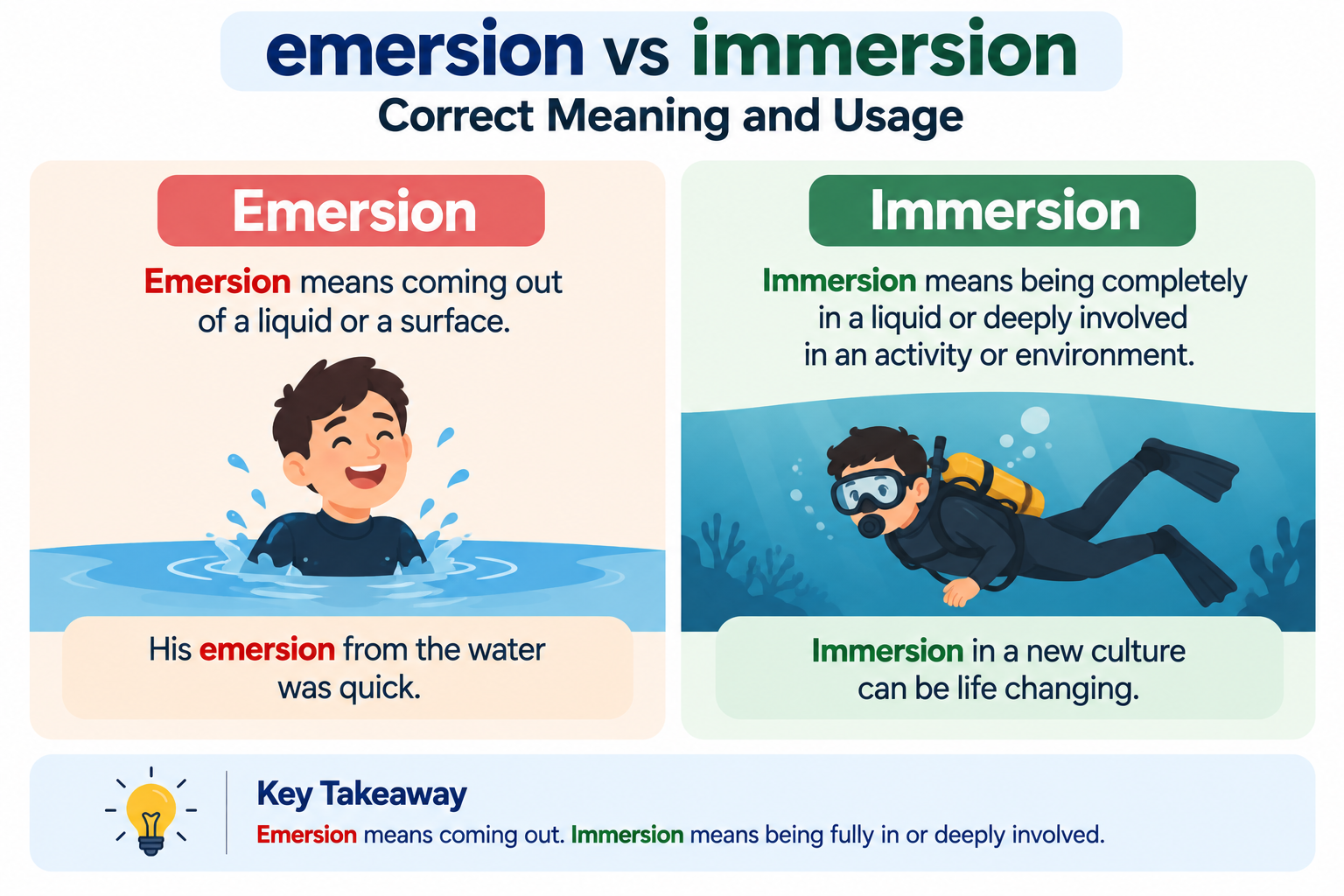
If you’re comparing emersion vs immersion, the first thing to know is that both words are real English words. They aren’t simply two spellings of the same term. Emersion refers to the act of emerging or coming out from something that has covered or concealed you, while immersion refers to being put into something or becoming deeply involved in an activity, environment, or subject.
The confusion is understandable because the words look almost identical and share the same ending. Their prefixes change the direction of the meaning. The prefix in emersion is connected with coming out, while the prefix in immersion carries the idea of going into or being placed within something.
That small difference creates two very different concepts. You may encounter emersion in astronomy, optics, technical writing, or discussions of something emerging from concealment. Immersion is much more common and appears in everyday speech, education, technology, science, religion, and many other fields. This guide explains the meanings, pronunciation, origins, grammar, differences, and natural examples so you can choose the right word with confidence.
Quick Definition
Emersion means the act of emerging from something or becoming visible after being hidden or covered. Immersion means placing something into a liquid or surrounding environment, or becoming deeply involved in an experience or subject. Both are legitimate nouns, but they describe opposite directions or different kinds of involvement.
Quick Answer
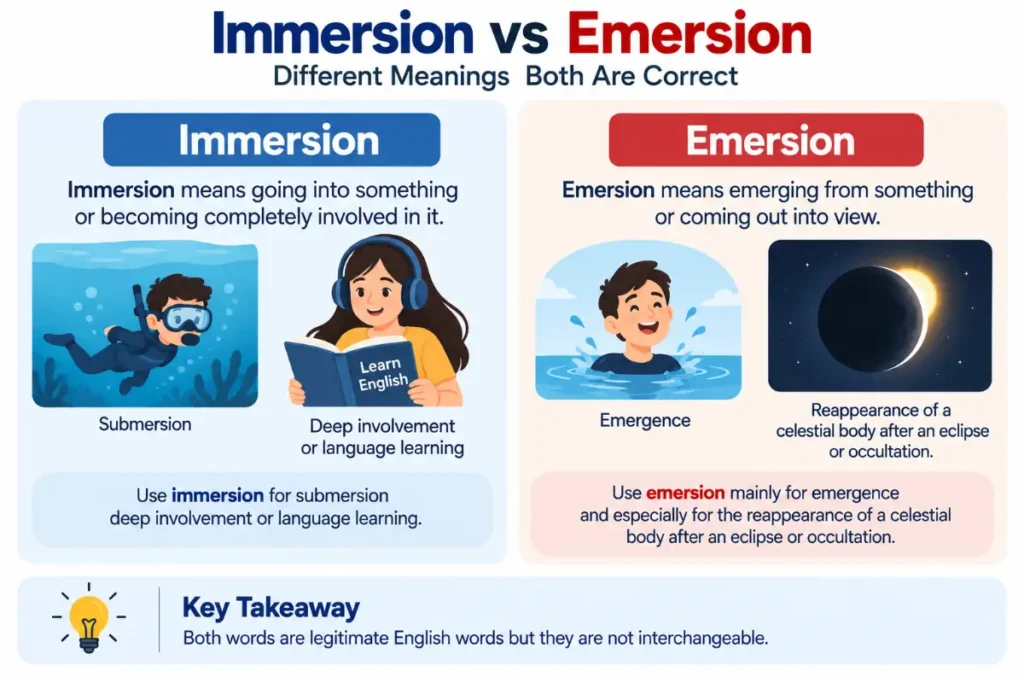
Emersion and immersion are both correct English words, but they have different meanings.
Emersion describes emergence or coming out from concealment or submersion. Immersion describes going into something, being submerged, or becoming deeply absorbed in an activity or environment. Immersion is far more common in everyday English, while emersion tends to appear in specialized contexts.
Comparison Table
| Form | Meaning | Part of Speech | Origin | Usage Frequency | Formality | Common Contexts | Example |
|---|---|---|---|---|---|---|---|
| Emersion | The act of emerging or becoming visible after being hidden or covered | Noun | Latin roots related to emerging | Uncommon | Formal or technical | Astronomy, optics, technical descriptions | The emersion of the star was observed at the predicted time. |
| Immersion | The act of putting something into a substance or becoming deeply involved in something | Noun | Latin roots related to dipping or plunging into | Very common | Neutral to formal | Education, water, technology, religion, science, culture | Language immersion helped the students develop fluency. |
Meaning and Definition
Meaning of Emersion
Emersion is a legitimate noun, but it’s not a word most people use in everyday conversation.
Its central idea is emerging from something. It can describe something becoming visible after being hidden, covered, submerged, or otherwise obscured.
Imagine a celestial body disappearing behind another object and then becoming visible again. The point at which it becomes visible again can be described as an emersion. This specialized use is particularly relevant in astronomy.
The word can also describe a physical emergence from water or another covering. The exact meaning depends on context, but the basic concept remains the same: something moves out of a state of concealment or submersion.
For example:
The emersion of the moon from behind the planet was carefully observed.
Here the word describes the return to visibility.
Emersion can therefore be understood as a movement outward or a return to visibility. That meaning contrasts strongly with immersion.
Because the word is uncommon, many readers may assume it’s a typo when they encounter it. In a technical context, though, it can be the precise word an expert intends to use.
Meaning of Immersion
Immersion is much more familiar.
Its most literal meaning is the act of putting something into a liquid or other substance.
For example:
The immersion of the object in water changed its temperature.
The word also has a broader figurative meaning. Someone can become deeply involved in an activity, language, culture, subject, or experience.
For example:
The students learned Spanish through complete immersion in the language.
Nobody needs to be physically underwater in this sentence. The learners are surrounded by Spanish and use it extensively as part of their learning environment.
That figurative meaning is now extremely common. You might hear about cultural immersion, language immersion, immersive learning, virtual reality immersion, or immersion in a new environment.
The central idea remains the same: something or someone is surrounded by or placed deeply within something else.
The Main Difference
The easiest way to understand these words is to think about direction.
Emersion means coming out.
Immersion means going in.
That simple contrast will solve most cases.
Imagine a swimmer underwater. When the swimmer goes beneath the surface, that action involves immersion. When the swimmer rises and comes back out of the water, that movement can be described as emersion.
The same basic contrast can apply to visibility. If an object becomes hidden, it may later undergo emersion when it becomes visible again.
The two words look similar because they share a historical word family. Their different prefixes help distinguish their meanings.
Direction of Meaning
Emersion points outward or upward from concealment.
Immersion points inward or downward into something.
This directional difference is the most useful memory tool.
Physical Meaning
Emersion can describe emergence from water, darkness, concealment, or another covering.
Immersion can describe being placed into water, liquid, or another surrounding medium.
Figurative Meaning
Immersion has a very common figurative sense involving deep involvement.
Emersion has a much narrower figurative range and is usually encountered in technical or specialized contexts.
Frequency
Immersion is a common modern English word. Emersion is considerably less common.
This difference in frequency matters because readers are much more likely to encounter immersion in ordinary writing. That makes it easier to mistake emersion for an error.
Is Emersion a Real Word?
Yes. Emersion is a real English word.
It isn’t simply a misspelling of immersion. It has its own meaning and appears in established technical vocabulary.
Its use is especially noticeable in astronomy. When a celestial object emerges from behind another object or from an occultation, the event can be described using the term emersion.
For example:
Astronomers recorded the emersion of the star after the occultation ended.
The word can also appear in descriptions of emergence from water or another covering.
Still, you shouldn’t use emersion as a fancy replacement for immersion. They don’t mean the same thing.
If you mean deep involvement in a subject, use immersion.
If you mean something emerging or becoming visible after being hidden, emersion may be the appropriate technical term.
That distinction is the key.
Is Immersion the More Common Word?
Yes. Immersion is much more common in general English.
You’ll encounter it in ordinary conversation as well as education, science, technology, religion, sports, medicine, art, and business.
Someone can immerse themselves in a book. A child can learn French through immersion. A camera can be tested for water resistance after immersion. A person can experience cultural immersion while living in another country.
The word has developed a wide range of uses because the underlying idea is easy to extend metaphorically.
If you’re unsure which word belongs in a sentence, ask yourself what you mean.
Are you describing going into something or becoming deeply involved? Choose immersion.
Are you describing coming out or becoming visible after being hidden? Consider emersion.
Key Differences Explained
- Meaning. Emersion describes emergence from concealment or submersion. Immersion describes entering something physically or becoming deeply involved.
- Direction. Emersion moves out. Immersion moves in.
- Frequency. Immersion is common. Emersion is relatively uncommon.
- Context. Emersion often appears in technical contexts. Immersion appears across everyday and specialized English.
- Physical use. Immersion can describe placing an object in water or another substance. Emersion can describe its subsequent emergence.
- Figurative use. Immersion commonly describes deep involvement in language, culture, study, entertainment, or an experience.
- Pronunciation. The prefixes create a noticeable difference in the first syllable even though the rest of each word sounds similar.
- Grammar. Both forms are nouns and can refer to an action, process, or event.
- Spelling. The main difference is the first vowel and consonant sequence. Emersion begins with e while immersion begins with im.
- Standard usage. Both are legitimate. The right choice depends entirely on the meaning you intend.
Which Form Should You Use?
Neither word is universally correct or incorrect. The correct choice depends on your intended meaning.
Use immersion for entering a liquid or environment, or for becoming deeply involved in something.
Use emersion for emerging from concealment or becoming visible after being hidden or submerged.
Consider these two sentences.
The immersion of the equipment in water lasted five minutes.
The equipment went into the water.
The emersion of the equipment from the water marked the end of the test.
The equipment came out.
The distinction becomes even clearer in astronomy.
The star disappeared during the event and later underwent emersion.
The word describes the point at which it became visible again.
Professional editors look at meaning first. They don’t automatically replace an uncommon word simply because a more common word looks similar. That’s an important habit with vocabulary comparisons. An unusual word can be correct when the context supports it.
Sentence Examples
Here are natural examples using immersion.
- The children learned French through full language immersion.
- He spent the afternoon in complete immersion in his new book.
- The device can survive brief immersion in fresh water.
- Cultural immersion helped the students understand local traditions.
- She believes immersion is the fastest way to become comfortable with a new language.
- The virtual reality game creates a strong sense of immersion.
- The researcher studied how immersion affected the material.
- After moving abroad, he experienced total immersion in a new culture.
- The teacher uses immersion activities to encourage students to speak naturally.
- I lost track of time because I was so deeply immersed in the story.
Here are examples using emersion.
- The astronomers recorded the emersion of the star.
- The telescope captured the moment of emersion.
- Observers waited for the emersion after the period of concealment.
- The emersion marked the return of the object to view.
- The timing of the emersion matched the predicted event.
These examples show why context matters. The first group deals with entering something or becoming deeply involved. The second group deals with emerging or becoming visible again.
Common Mistakes and Confusions
Treating Emersion as a Misspelling
One common mistake is assuming that emersion must be wrong because immersion is more familiar.That conclusion isn’t accurate. Emersion is a legitimate word with a narrower meaning.The better approach is to check the context before correcting it.
Using Immersion for Emergence
Another mistake occurs when someone wants to describe something coming out but chooses immersion.
For example:
Incorrect meaning: The object underwent immersion when it became visible again.
If the intended meaning is emergence from concealment, emersion is the better term.
Using Emersion for Deep Involvement
This is the opposite problem.
Incorrect: Her emersion in Spanish helped her become fluent.
Correct: Her immersion in Spanish helped her become fluent.
Deep involvement calls for immersion.
Confusing Emergence With Emersion
Emergence is a much more common word than emersion and has a broad meaning involving coming into view, becoming known, or developing.
For example:
The emergence of new technology changed the industry.
Emersion is narrower and often refers to emerging from a specific state of concealment or submersion.
Assuming Similar Spelling Means Similar Meaning
English contains many word pairs that share endings but differ because of prefixes. Looking only at spelling can lead you astray.
The first part of each word carries useful semantic information. Learning the prefix can therefore help you understand the difference.
Pronunciation Guide
The two words are similar in sound but their beginnings differ.
Emersion
Emersion is commonly pronounced approximately:
ih MUR shun
A common IPA representation is /ɪˈmɝːʒən/ in American English.
The stress falls on the second syllable.
The word can be divided roughly as:
e MERS ion
The middle sound resembles the sound in words such as version and conversion.
Because the word is uncommon, some speakers may hesitate when they first encounter it.
Immersion
Immersion is commonly pronounced approximately:
ih MUR shun
A common American English IPA representation is /ɪˈmɝːʒən/.
Interestingly, the pronunciation of emersion and immersion can be extremely similar in many varieties of English. In ordinary speech the distinction may be difficult to hear.
That makes spelling and context especially important.
The beginning of immersion is spelled with im while emersion begins with em. The words may sound almost identical, but their meanings can point in opposite directions.
This is a good example of why English learners shouldn’t rely only on sound when choosing between visually similar words.
Etymology and Word Origin
The history of both words helps explain their relationship.
Emersion ultimately traces back to Latin emersio, associated with emerging or coming out. It is related to the Latin verb emergere, meaning to rise out or emerge.
Immersion comes from Latin immersio, associated with putting into or plunging into something. It is related to the Latin verb immergere, meaning to dip into or plunge into.
The prefixes are especially revealing.
The Latin element associated with e in this word family carries the sense of moving out or forth.
The element im is related to the idea of moving into or within.
Both words entered English through the historical development of Latin based vocabulary. Their shared ending reflects their relationship as nouns describing processes or actions.
This history gives us a useful memory device.
Think of emersion as movement out.
Think of immersion as movement in.
The historical roots aren’t merely interesting background. They explain why two words that look so similar can carry contrasting meanings.
Regional Usage
American English
Both words exist in American English, but their frequency differs greatly.
Immersion is common and appears in education, technology, science, entertainment, religion, travel, and everyday conversation.
Emersion is much less common. American readers are most likely to encounter it in technical writing, astronomy, or specialized descriptions of emergence.
There is no American spelling change that turns one into the other. The distinction is semantic rather than regional.
British English
British English also recognizes both forms.
Immersion is widely used in ordinary and formal writing. Emersion remains a specialized word and may appear in technical contexts.
The basic meanings stay the same. A British writer using emersion in an astronomical context is using a legitimate technical term rather than a regional spelling variant.
Australian English
Australian English follows the same broad distinction.
Immersion is common in everyday language and specialized fields. Emersion exists but has limited everyday use.
There is no established Australian variant that changes the basic meanings of these words.
Canadian English
Canadian English also uses immersion as the familiar general term and emersion as a more specialized term.
The distinction remains consistent with other major varieties of English. Canadian writers should select the word according to meaning rather than regional spelling.
Grammar Rules and Part of Speech
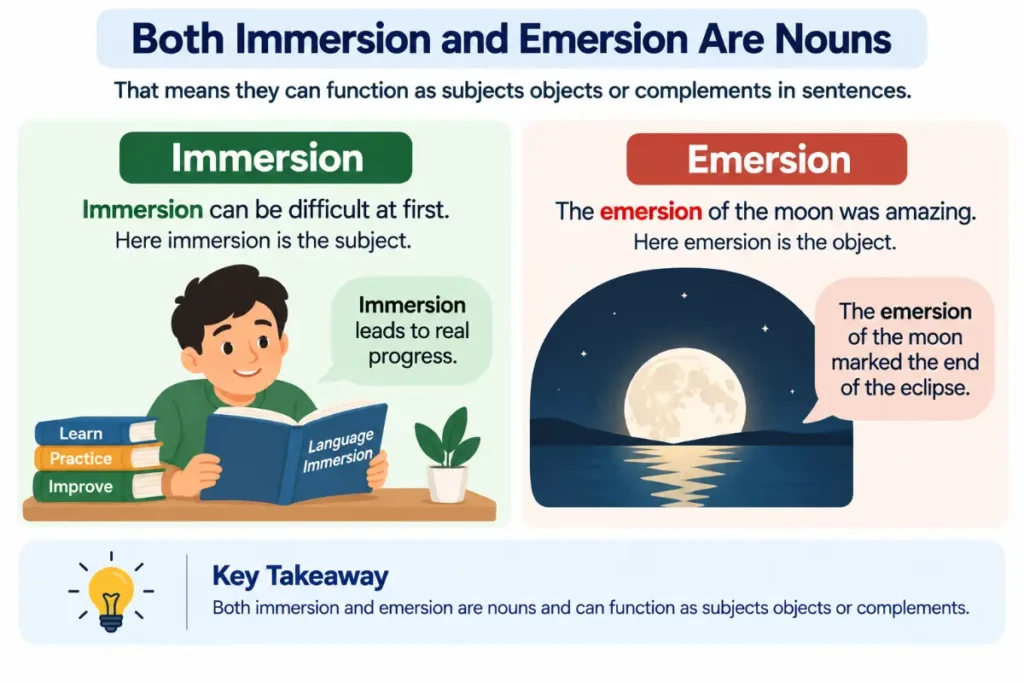
Both words are nouns.
They name actions, processes, or events rather than describing people or objects directly.
Immersion can be used with several common grammatical patterns.
Immersion in something
She enjoys immersion in historical fiction.
Immersion into something
The immersion into the new culture happened gradually.
The first pattern is generally more natural when describing deep involvement.
Immersion can also follow verbs such as experience, achieve, provide, encourage, promote, and create.
The program provides immersion in Spanish.
The game creates a strong sense of immersion.
Emersion is less flexible in everyday writing because its meaning is more specialized.
You may see constructions such as:
the emersion of the star
the emersion of the object
the moment of emersion
The noun usually refers to the event or process of something emerging.
Plural Forms
The plural of immersion is immersions.
The plural of emersion is emersions.
Both follow the normal English plural pattern for nouns ending in a consonant sound followed by an s sound.
Adjective Forms
Immersion has a closely related adjective in immersive.
For example:
The museum offers an immersive experience.
The related noun immersion describes the process while immersive describes something designed to create that deep involvement.
Emersion has fewer common related forms in everyday English because the underlying concept is more specialized.
Punctuation
Neither noun requires unusual punctuation.
Use normal sentence punctuation based on the structure of the sentence.
For example:
The students benefited from language immersion.
The astronomers carefully measured the emersion.
No special punctuation is required simply because these words are technical or uncommon.
Real Life Usage Examples
Daily Conversation
Immersion is far more likely to appear in normal conversation.
I learned Spanish through immersion.
The movie gave me total immersion in the story.
These sentences sound natural because immersion has become a familiar word outside its literal physical meaning.
Emersion is unlikely to appear in ordinary conversation unless the discussion involves a specialized subject.
Workplace Communication
Immersion can describe training or deep involvement.
The new employees spent a week in customer service immersion.
The training program gives participants hands on immersion in the workflow.
Emersion may appear in technical workplace documents.
The report records the emersion time for each observed object.
The specialized context makes the uncommon word appropriate.
Academic Writing
Immersion is common in education and research.
Language immersion can give students frequent exposure to natural speech.
The study examined how cultural immersion affected student engagement.
Emersion may appear in astronomy or scientific writing.
The researchers recorded the predicted time of emersion.
The observation focused on the object’s reappearance after occultation.
News and Journalism
Immersion can appear in stories about education, technology, travel, and entertainment.
The school introduced a new language immersion program.
The exhibit uses sound and light to create a sense of immersion.
Emersion is more likely to appear in specialized science reporting.
Observers waited for the star’s emersion after the occultation.
The event ended with the predicted emersion of the celestial object.
Literature and Storytelling
Immersion is useful when describing a reader’s experience.
The novel pulled her into complete immersion in its fictional world.
The quiet setting allowed him to become fully immersed in the story.
Emersion is less common in literary writing unless an author deliberately wants to describe physical or symbolic emergence.
For instance:
The swimmer’s slow emersion from the dark water revealed his face.
That sentence uses the word in a literal and vivid way.
Immersion in Education
One of the most familiar modern uses of immersion appears in education.
Language immersion means learning or using a language through extensive exposure to that language. Instead of treating the language only as an academic subject, the learner encounters it throughout the learning environment.
For example, a Spanish immersion program may teach several subjects in Spanish. Students hear and use Spanish during regular classroom activities rather than limiting it to a short language lesson.
The term can also apply to cultural learning.
A student living with a host family in another country may experience cultural immersion. The learner encounters local customs, food, language, routines, and social practices directly.
The word works well here because the learner is surrounded by the subject.
That is the figurative extension of the original physical idea. Instead of placing a body into water, we place ourselves deeply within an experience or environment.
Immersion in Technology
Technology has given immersion another common meaning.
Virtual reality often aims to create a strong feeling of immersion. The user feels surrounded by a digital environment rather than simply looking at a flat screen.
Video games can also create immersion through sound, visuals, storytelling, interaction, and world design.
For example:
The game’s detailed environment creates a powerful sense of immersion.
This doesn’t mean the player is physically placed inside the game. The word describes the feeling of being deeply absorbed in the experience.
That figurative meaning is now common enough that readers usually understand it immediately.
Immersion in Water
The literal physical meaning remains important.
If an object goes below the surface of water, it undergoes immersion.
For example:
The equipment was tested after immersion in water.
This usage appears in science, engineering, manufacturing, sports, medicine, and everyday descriptions.
You may also see phrases such as water immersion, full immersion, partial immersion, and immersion testing.
Here the word has a direct physical meaning rather than a figurative one.
Emersion in Astronomy
Astronomy provides one of the clearest specialized uses of emersion.
An astronomical object can become hidden when another object passes in front of it from an observer’s point of view. This type of event can be called an occultation.
When the hidden object becomes visible again, the event can be described as its emersion.
This gives the word a precise technical role.
The contrast can be remembered as a simple sequence.
An object becomes hidden.
The object remains concealed.
The object becomes visible again.
That final stage is the point associated with emersion.
The word therefore fits naturally into technical discussions of astronomical observations.
Emersion and Emergence
Emersion and emergence are related in meaning but aren’t identical.
Emergence is the broader and more common word. It can describe something coming into view, developing, appearing, becoming known, or rising from a previous state.
For example:
The emergence of new ideas changed the discussion.
The bird’s emergence from the nest surprised us.
Emersion is narrower. It specifically focuses on emerging from a condition of being submerged, hidden, or covered, particularly in specialized usage.
That means you shouldn’t replace every occurrence of emergence with emersion.
If you’re talking about a new trend appearing, use emergence.
If you’re describing an object becoming visible after concealment in an appropriate technical context, emersion may be the precise choice.
Related and Confused Terms
Emergence
Emergence means the act of appearing, becoming known, developing, or coming into view. It is broader than emersion and much more common.
Immersive
Immersive is an adjective related to immersion. It describes something that surrounds or deeply involves a person.
The museum offers an immersive experience.
Submersion
Submersion means the act of placing something completely under water or another substance. It overlaps with the physical sense of immersion.
Absorption
Absorption can describe becoming deeply interested in something or taking in a substance. In figurative contexts it can overlap with immersion.
Involvement
Involvement means taking part in something or being connected to it. It can sometimes express a similar idea to figurative immersion but usually sounds less intense.
Engagement
Engagement describes active attention, participation, or interest. It is related to immersion but doesn’t necessarily imply being completely surrounded by an experience.
Occultation
Occultation refers to an astronomical event in which one object passes in front of another and hides it from an observer’s view. Emersion can describe the point when the hidden object becomes visible again.
Submerge
Submerge is a verb meaning to put something under water or another substance. It is closely connected to the literal physical sense of immersion.
These terms help map the vocabulary around the two words. Still, they aren’t interchangeable in every sentence.

Expert Editor Insight
A professional editor shouldn’t automatically change emersion to immersion just because the latter is more familiar. Context determines correctness. If the sentence describes deep involvement, language learning, water exposure, or a surrounding experience, immersion is usually the intended noun. If it describes something emerging from concealment or becoming visible again in a specialized setting, emersion can be exactly right. Spelling tools may flag uncommon vocabulary because they work heavily from established word lists, so an unusual word deserves a context check rather than an automatic correction. A useful editing trick is to ask one question: Is the subject going in or coming out? That usually reveals the correct choice quickly.
Conclusion
Emersion vs immersion becomes much easier once you focus on direction and meaning. Emersion describes emerging or becoming visible after concealment or submersion, while immersion describes going into something physically or becoming deeply involved in an experience, subject, language, or environment. Both are legitimate English nouns, so neither should automatically be treated as a spelling mistake.
In everyday American English, immersion is far more common. You’ll see it in education, technology, science, conversation, and professional writing. Emersion appears mainly in specialized contexts where the idea of emergence from concealment needs a precise term.
For an easy memory trick, think in means immersion and out means emersion. If something is going in, choose immersion. If something is coming out, emersion may be the word you need.
FAQs
Is emersion a real English word?
Yes. Emersion is a legitimate English noun. It refers to the act or process of emerging from concealment, submersion, or another covering. It’s much less common than immersion and often appears in specialized contexts such as astronomy. Because readers encounter immersion far more often, they may assume emersion is a typo, but the two words have distinct meanings.
What is the difference between emersion and immersion?
The basic difference is direction. Emersion refers to coming out or becoming visible after being hidden or submerged. Immersion refers to going into something, being submerged, or becoming deeply involved in an activity or environment. The words look similar because they share historical roots, but their prefixes help distinguish the meanings.
Is immersion the correct word for deep involvement?
Yes. Immersion is the natural word for deep involvement in a subject, activity, language, culture, or experience. For example, language immersion means learning through extensive exposure and use of the language. You can also describe yourself as being immersed in a book, project, game, or creative activity when you become deeply absorbed in it.
How do you pronounce emersion?
Emersion is commonly pronounced approximately ih MUR shun, with the main stress on the second syllable. A common American English IPA representation is /ɪˈmɝːʒən/. Its pronunciation is very similar to immersion in many varieties of English. Because the words can sound alike, context and spelling are especially useful when identifying which word a speaker means.
How do you pronounce immersion?
Immersion is commonly pronounced approximately ih MUR shun. A common American English IPA representation is /ɪˈmɝːʒən/. The strongest stress falls on the second syllable. Interestingly, emersion and immersion can sound almost identical in ordinary speech. That similarity explains part of the confusion between them and makes it useful to learn their meanings rather than relying only on pronunciation.
Can emersion and emergence mean the same thing?
They can overlap in some contexts, but they aren’t exact synonyms. Emergence is a much broader word that can describe appearing, developing, becoming known, or coming into view. Emersion is narrower and often describes emerging from concealment or submersion. In specialized contexts, such as astronomy, emersion can provide a more precise description.
Is immersion appropriate in formal writing?
Yes. Immersion is completely appropriate in formal writing. It is widely used in academic papers, educational discussions, technical documents, professional reports, and journalism. Its meaning is well established across many fields. The key is to use it for the right idea. Choose it for physical submersion or deep involvement rather than using it simply because it resembles emersion.
Which word should I use for language learning?
Use immersion. Language immersion describes a learning approach in which students receive extensive exposure to and use of the target language. For example, a Spanish immersion program may use Spanish throughout much of the school day. Emersion isn’t the appropriate term for this educational concept. The distinction is simple because language learners become surrounded by the language rather than emerging from it.
