
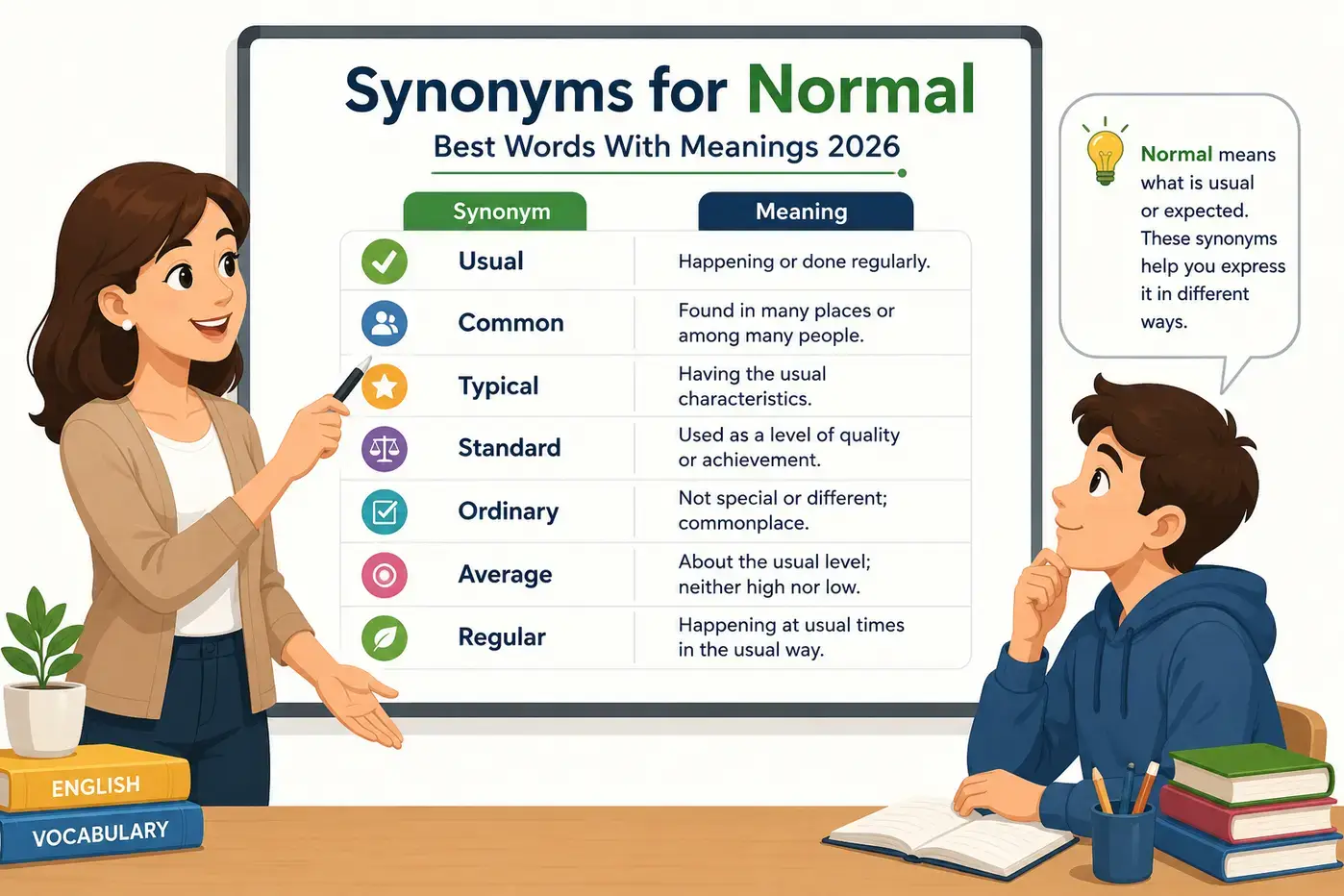
You’re writing an email, polishing a resume, finishing a school essay, or sending a text when one word starts to sound repetitive. You write normal again and again until it feels flat. At that point, you start searching for synonyms for normal that fit the tone without changing your meaning.
The good news is that English gives you plenty of choices. Some alternatives sound friendly and casual. Others work better in business writing, academic papers, or professional emails. The trick is picking the word that matches the situation instead of using the first synonym you find.
This guide explains where the word normal comes from, what it really means, how it differs from similar words, and which alternatives work best in everyday conversations, essays, resumes, emails, and professional writing.
Short Answer
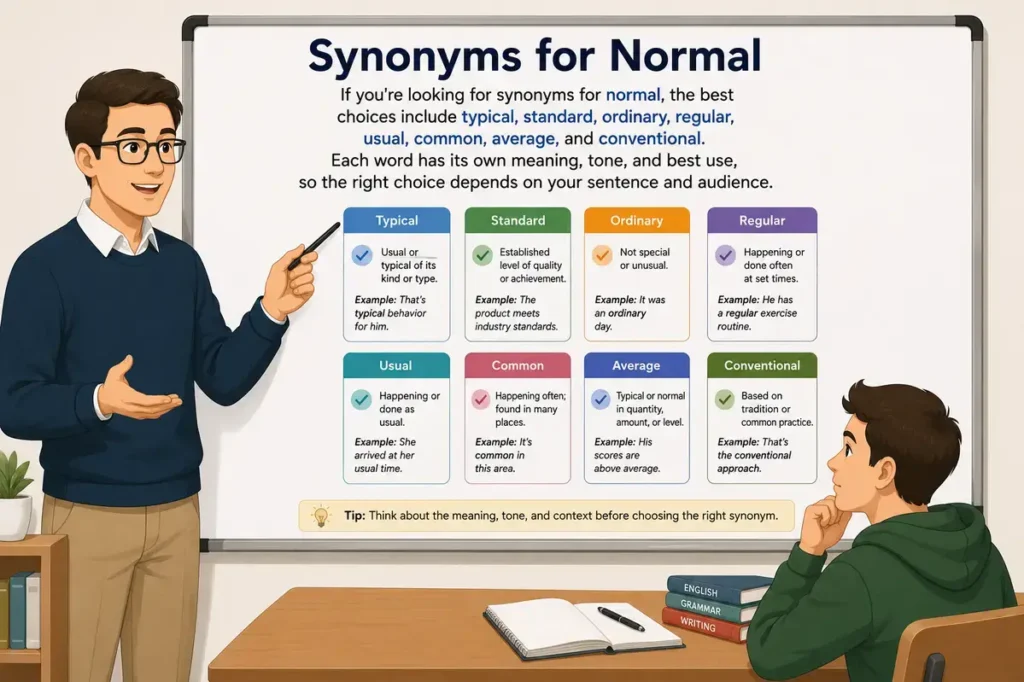
If you’re looking for synonyms for normal, the best choices include typical, standard, ordinary, regular, usual, common, average, and conventional. Each word has its own meaning, tone, and best use, so the right choice depends on your sentence and audience.
What Does Normal Mean?
The word normal describes something that follows the usual pattern or happens in the expected way. It often refers to people, events, behaviors, conditions, or situations that don’t seem unusual or surprising. In everyday English, people use normal to describe things that are common or expected.
For example:
- It’s normal to feel nervous before an interview.
- The traffic returned to normal after the accident.
- She wanted life to feel normal again.
The meaning can change slightly depending on the context. In everyday conversation, normal usually means expected or not unusual. In statistics, normal can refer to the normal distribution, a specific mathematical pattern. Understanding these differences helps you choose better synonyms for normal instead of replacing the word blindly.
Where Did the Word Normal Come From?
Many people use the word every day without knowing its history. The word normal comes from the Latin word norma, which meant a carpenter’s square. Builders used this tool to create straight lines and right angles. Because it represented correctness and consistency, the meaning gradually expanded to describe something that follows an accepted standard. Later, the word entered French as normal before becoming part of English during the seventeenth century. Over time, its meaning shifted from “made according to a rule” to “usual,” “expected,” or “typical.” Today, people use it across almost every field, including education, medicine, psychology, business, science, sports, and everyday conversation. Knowing this history explains why many alternatives for normal focus on ideas like standard, expected, regular, or typical.
What Are the Best Synonyms for Normal?
| Word | Meaning | Tone | Example |
|---|---|---|---|
| Typical | Usual example | Neutral | It was a typical Monday morning. |
| Usual | Common for someone | Neutral | I’ll order my usual coffee. |
| Standard | Accepted rule or level | Formal | It meets standard requirements. |
| Ordinary | Not special | Neutral | It was an ordinary day. |
| Regular | Happens often | Neutral | She attends regular meetings. |
| Common | Seen often | Neutral | This is a common mistake. |
| Average | Middle level | Neutral | His grades are average. |
| Conventional | Based on tradition | Formal | They chose a conventional design. |
| Expected | Predicted outcome | Neutral | The results were expected. |
| Familiar | Well known | Neutral | Her voice sounded familiar. |
These words all relate to normal, but each one highlights a different idea.
For example, typical focuses on something that represents a group.
Standard emphasizes rules or accepted quality.
Regular highlights repetition or consistency.
Ordinary simply means not special.
Conventional points to customs or traditions.
Choosing the right alternative makes your writing sound more natural and more precise.
Which Synonyms Mean Almost the Same Thing?
Some words can replace normal in many situations with almost no change in meaning. These are the safest choices for everyday writing.
| Synonym | Best Used For | Example |
|---|---|---|
| Typical | General descriptions | That’s a typical response. |
| Usual | Daily habits | She took her usual route home. |
| Ordinary | Everyday situations | It seemed like an ordinary afternoon. |
| Standard | Rules and quality | The work meets standard requirements. |
| Regular | Schedules and routines | He has regular checkups. |
| Common | Things seen often | This problem is very common. |
| Expected | Predictable events | The delay was expected. |
| Conventional | Traditional approaches | They preferred a conventional solution. |
These words work well because they keep the original meaning while matching different writing styles.
Which Alternatives Sound More Formal?
Professional writing often benefits from replacing normal with a more precise word.
These choices fit reports, business emails, academic papers, and official documents.
| Word | Best Context | Example |
|---|---|---|
| Standard | Business and technical writing | The machine operates under standard conditions. |
| Conventional | Academic writing | Researchers used conventional methods. |
| Established | Policies and procedures | The company follows established guidelines. |
| Accepted | Professional communication | This is the accepted practice. |
| Customary | Legal or formal writing | It is customary to provide written notice. |
| Routine | Medical and business writing | The patient underwent routine testing. |
| Typical | Reports and analysis | This represents a typical customer profile. |
| Average | Statistics and research | Average income increased this year. |
These words often sound more polished because they explain how something is normal instead of simply saying it is.
Which Synonyms Sound More Casual?
When you’re chatting with friends, texting, or writing conversational content, simpler words usually sound better.
| Word | Tone | Example |
|---|---|---|
| Everyday | Casual | These are everyday challenges. |
| Regular | Friendly | He’s a regular customer. |
| Plain | Casual | She likes plain shirts. |
| Nothing unusual | Very casual | The mechanic said there was nothing unusual. |
| Business as usual | Informal | Everyone returned to business as usual. |
| Run of the mill | Informal | It wasn’t a run of the mill performance. |
| Typical | Casual | That’s typical of him. |
| Usual | Casual | I’ll have the usual breakfast. |
These expressions help conversations sound natural without becoming too formal or too technical.
How Do You Choose the Right Synonym?
Many learners think every synonym can replace every other synonym. English doesn’t work that way. Ask yourself a few simple questions before choosing another word.
- Are you talking about something expected or something common?
- Is the situation formal or casual?
- Are you describing a person, an event, a habit, a rule, or a quality?
- Do you want to sound friendly, professional, or academic?
The answers usually point you toward the best choice. For example, a business report often sounds better with standard or established. A conversation with friends usually sounds more natural with usual, regular, or typical. A research paper might prefer average, conventional, or accepted. Choosing carefully makes your writing clearer and more believable while avoiding unnecessary repetition of the same word.
Synonyms for Normal From Mild to Strong
Not every synonym carries the same level of meaning. Some simply describe something expected. Others stress rules, traditions, or complete conformity. Choosing the right level helps your writing sound more accurate.
| Strength | Word | Best Use | Example |
|---|---|---|---|
| Very Mild | Familiar | Something already known | The routine felt familiar after a week. |
| Very Mild | Everyday | Daily life | These are everyday concerns. |
| Mild | Usual | Common habit | She followed her usual schedule. |
| Mild | Regular | Happens often | He makes regular visits. |
| Mild | Common | Seen frequently | This is a common issue. |
| Moderate | Typical | Represents most examples | It was a typical summer afternoon. |
| Moderate | Ordinary | Not special | They lived an ordinary life. |
| Moderate | Average | Around the middle | Her score was close to the average. |
| Moderate | Expected | Not surprising | The outcome was expected. |
| Strong | Standard | Meets a rule or requirement | The parts meet standard specifications. |
| Strong | Conventional | Follows tradition | They chose a conventional design. |
| Strong | Established | Long accepted | The company uses established procedures. |
| Very Strong | Customary | Traditional practice | It is customary to greet guests warmly. |
| Very Strong | Accepted | Officially recognized | This is the accepted method. |
As you move down the table, the words shift from describing something ordinary to emphasizing standards, rules, or accepted practices.
Which Part of Speech Do These Words Belong To?
Most synonyms for normal are adjectives because they describe people, objects, situations, or events. A few related words can work as nouns or adverbs in certain situations.
Adjectives
These are the most common alternatives.
| Word | Example |
|---|---|
| Typical | That’s a typical response. |
| Ordinary | It was an ordinary morning. |
| Regular | He is a regular customer. |
| Standard | The standard procedure worked well. |
| Common | This is a common mistake. |
| Conventional | They chose a conventional solution. |
| Average | The average student finished early. |
| Familiar | The neighborhood looked familiar. |
Nouns Related to the Idea of Normal
Sometimes you don’t need another adjective. You may need a noun instead.
| Noun | Example |
|---|---|
| Standard | The company raised its standards. |
| Norm | The behavior became the social norm. |
| Average | The average increased this year. |
| Routine | Morning exercise became his routine. |
| Convention | The decision followed convention. |
Adverbs
When describing actions instead of things, these words often fit better.
| Adverb | Example |
|---|---|
| Normally | We normally leave before eight. |
| Usually | She usually walks to work. |
| Commonly | This phrase is commonly used. |
| Typically | The store typically closes at nine. |
| Regularly | They regularly update the website. |
Understanding the part of speech helps you replace normal without creating awkward sentences.
Do Americans and British People Use Different Words?
Most synonyms for normal work in both American and British English. You rarely need to change them when writing for different audiences. There are still a few differences in preference.
| Meaning | American English | British English |
|---|---|---|
| Usual | Very common | Very common |
| Typical | Very common | Very common |
| Ordinary | Common | Slightly more common than in the US |
| Standard | Very common | Very common |
| Average | Very common | Very common |
| Regular | Very common | Very common |
| Conventional | Common | Common |
| Customary | Mostly formal | Slightly more common in formal writing |
British speakers sometimes use ordinary a little more often in everyday speech, while Americans may prefer regular, usual, or typical. The differences are small enough that readers from both countries will understand every word in this guide.
What’s the Best Word for a Resume?
A resume should sound professional and specific. In many cases, normal sounds too plain because employers expect stronger wording. Choose a synonym that reflects the exact situation.
| Instead of Normal | Better Choice |
|---|---|
| Normal procedures | Standard procedures |
| Normal responsibilities | Regular responsibilities |
| Normal operations | Daily operations |
| Normal practice | Established practice |
| Normal quality | Industry standard quality |
Examples:
- I followed standard operating procedures during every project.
- I completed routine quality inspections each morning.
- I maintained regular communication with clients.
- The team followed established company guidelines.
These words make your experience sound clearer without exaggerating it.
What’s the Best Word for an Essay?
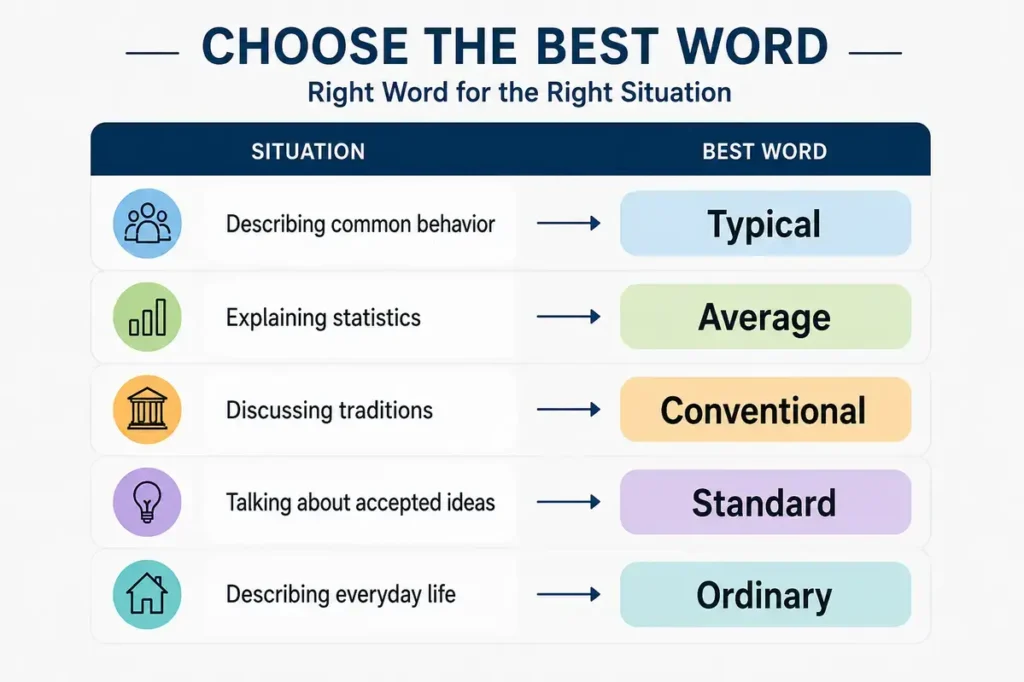
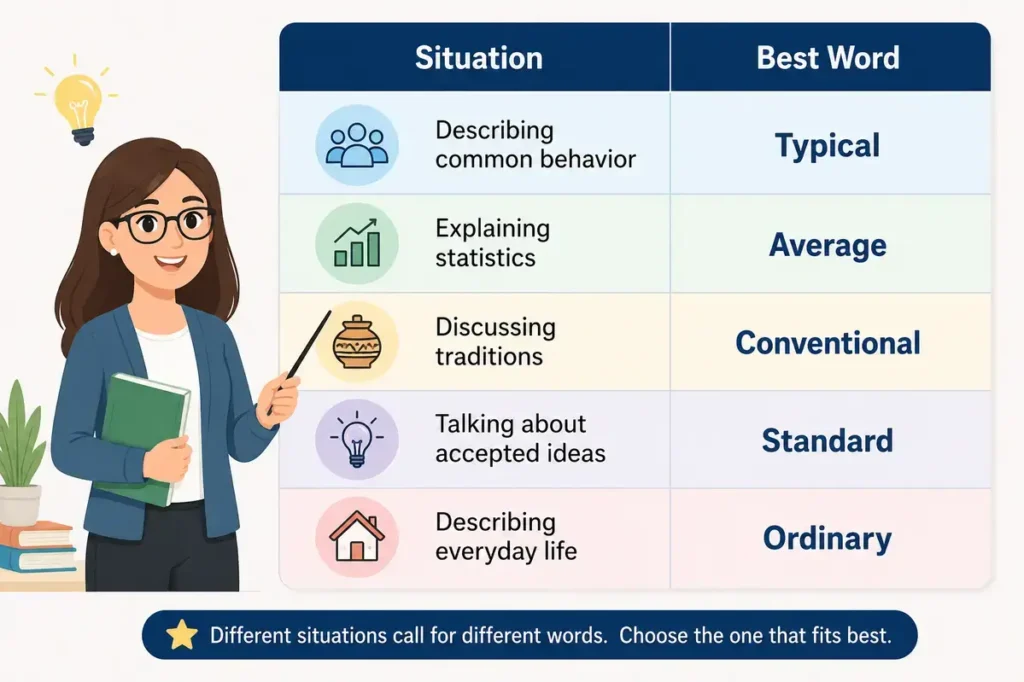
School essays often benefit from precise vocabulary. Repeating normal several times can make your writing feel repetitive. Better alternatives include:
| Situation | Best Word |
|---|---|
| Describing common behavior | Typical |
| Explaining statistics | Average |
| Discussing traditions | Conventional |
| Talking about accepted ideas | Standard |
| Describing everyday life | Ordinary |
Examples:
- This is a typical example of climate change.
- The results stayed within the average range.
- People followed conventional farming methods.
- The scientist used standard testing procedures.
These choices sound more natural in academic writing.
What’s the Best Word for Text Messages?
Texting usually calls for simple language. You don’t need formal vocabulary unless the conversation is serious. Good choices include:
| Situation | Best Choice |
|---|---|
| Friend asks how you are | Normal |
| Talking about daily life | Usual |
| Describing someone | Typical |
| Discussing routines | Regular |
| Saying nothing is wrong | Fine or normal |
Examples:
- Everything’s back to normal now.
- It was just a typical Monday.
- That’s pretty usual for him.
- My schedule is back to regular this week.
Simple language sounds more natural in casual conversations.
What’s the Best Word for an Email?
Emails can range from friendly to highly professional, so the best synonym depends on the audience.
Friendly Email
Use words like:
- usual
- regular
- typical
Example:
We have returned to our usual business hours.
Professional Email
Choose words such as:
- standard
- established
- routine
Example:
Please follow the standard approval process before submitting the report.
Customer Service Email
Use words that reassure the reader.
Examples:
- Operations have returned to normal.
- Shipping has resumed under regular schedules.
- Service is now operating as expected.
These choices sound calm, professional, and trustworthy.
What’s the Best Word When Speaking?
Conversation usually favors simple words over formal ones. If you’re talking with family or friends, these choices sound the most natural.
| Situation | Best Word |
|---|---|
| Everyday conversation | Normal |
| Casual story | Typical |
| Daily routine | Usual |
| Frequent activity | Regular |
| Nothing surprising | Ordinary |
Examples:
- That’s completely normal.
- It was a typical day at work.
- Everything went as usual.
- We had our regular meeting.
- It was just an ordinary afternoon.
Trying to replace normal with a formal word during casual speech can sound unnatural.
Real Life Examples Using Synonyms for Normal
Seeing words in real situations makes them easier to remember.
- The doctor said my test results were normal.
- Missing a few questions on your first quiz is typical.
- We returned to our usual schedule after the holiday.
- The company follows standard safety rules.
- Rain is common during the spring season.
- She enjoys an ordinary life in a small town.
- They completed their regular equipment inspection.
- The school uses established grading policies.
- His reaction was completely expected.
- Wearing jeans is common in many workplaces today.
- The restaurant served its usual lunch menu.
- The engineer followed conventional building practices.
- Morning traffic was heavier than average.
- Their family returned to normal after the move.
These examples show that each synonym works best in a different setting.
Typical vs Ordinary
These two words often appear together in lists of synonyms for normal, but they are not identical.
| Typical | Ordinary |
|---|---|
| Represents what usually happens | Means not special or remarkable |
| Often compares one example with many others | Focuses on a lack of uniqueness |
| Frequently used in reports | Frequently used in everyday conversation |
Examples:
- That’s a typical response from new students.
- It looked like an ordinary house from the outside.
A typical example represents a group. An ordinary example simply isn’t unusual.
Standard vs Regular
People often confuse these words because both can replace normal in some situations.
| Standard | Regular |
|---|---|
| Refers to rules or quality | Refers to frequency or routine |
| Common in business and technical writing | Common in everyday speech |
| Focuses on accepted requirements | Focuses on repeated actions |
Examples:
- The product meets standard safety requirements.
- She attends regular meetings every Monday.
If you’re talking about quality or official procedures, choose standard. If you’re talking about habits or schedules, choose regular.
Common Mistakes When Choosing a Synonym
Many writers replace normal with another word without thinking about the context. That often creates awkward or inaccurate sentences. Here are some of the most common mistakes.
Using Average When You Mean Typical
Incorrect:
That’s an average reaction.
Better:
That’s a typical reaction.
An average is usually based on numbers. A typical example represents what most people do.
Using Ordinary for Something Positive
Ordinary sometimes carries the idea of being plain or unremarkable.
Instead of saying:
She gave an ordinary performance.
If you simply mean expected, write:
- She gave her usual performance.
Using Standard for Everyday Habits
Incorrect:
- I had my standard breakfast.
Better I had my usual breakfast.
Standard usually refers to rules, measurements, or accepted quality rather than personal habits.
Replacing Every Normal With the Same Synonym
Repeating typical or ordinary throughout a piece of writing creates the same problem as repeating normal. Mix your vocabulary based on the situation instead of choosing one replacement for everything.
What Are the Opposites of Normal?
Sometimes the best way to understand a word is to compare it with its opposite. If normal describes something expected or ordinary, its antonyms describe things that stand out, surprise people, or fall outside the usual pattern.
| Antonym | Meaning | Example |
|---|---|---|
| Abnormal | Not typical or expected | The scan showed abnormal results. |
| Unusual | Different from what people expect | That was an unusual request. |
| Strange | Odd or difficult to explain | The house made a strange noise. |
| Odd | Different in a curious way | He wore an odd combination of colors. |
| Rare | Not seen very often | Snow is rare in this region. |
| Exceptional | Much better than average | She showed exceptional talent. |
| Extraordinary | Far beyond the ordinary | They had an extraordinary experience. |
| Irregular | Not following a pattern | The bus arrived at irregular times. |
| Unique | One of a kind | Every fingerprint is unique. |
| Uncommon | Not frequently seen | That’s an uncommon spelling. |
Choose the opposite that matches your meaning. For example, abnormal is common in medicine, while extraordinary usually has a positive meaning.
How Do You Choose the Best Synonym?
With so many synonyms for normal, it helps to follow a few simple rules.
Think About Your Audience
A text message to a friend and a business report should not sound the same. For casual writing, words like usual, typical, and regular often sound the most natural. For professional writing, standard, established, and conventional usually fit better.
Match the Exact Meaning
Ask yourself what you really want to say. If something happens often, use common. If something represents most examples, use typical.
Avoid Repeating the Same Word
Repeating one synonym over and over can make your writing sound dull.
Instead of writing this:
- It was a typical day.
- The weather was typical.
- His reaction was typical.
Try this:
- It was a typical day.
- The weather was ordinary for this season.
- His reaction was exactly what everyone expected.
Small changes like these make your writing smoother and more engaging.
Keep It Simple
A longer word is not always a better word. If usual says exactly what you mean, there is no reason to replace it with a more formal alternative. Clear writing is almost always stronger than complicated writing.
Quick Reference Table
If you need a fast answer, this table can help you choose the right word in seconds.
| If You Mean… | Best Word |
|---|---|
| Happens most of the time | Typical |
| Part of your daily routine | Usual |
| Happens regularly | Regular |
| Meets official rules | Standard |
| Seen often | Common |
| Not special | Ordinary |
| Around the middle | Average |
| Follows tradition | Conventional |
| Expected outcome | Expected |
| Long accepted practice | Established |
This quick guide covers the words people use most often in everyday English.
Which Synonym Should You Remember First?
If you’re learning English or simply want stronger writing, you don’t need to memorize every synonym today.
Start with these eight words:
- Typical
- Usual
- Standard
- Ordinary
- Regular
- Common
- Average
- Conventional
Together, these cover most situations where you might otherwise repeat normal. As your vocabulary grows, you can add words like established, customary, routine, and expected for more specific situations.
Conclusion
Learning synonyms for normal is about more than replacing one word with another. Each alternative carries a slightly different meaning, tone, or level of formality. Choosing the right one makes your writing clearer, more natural, and more engaging.
For everyday conversations, words like usual, typical, and regular work well. In business or academic writing, standard, established, and conventional often sound more precise. When you understand these small differences, you’ll write with greater confidence and avoid repeating the same word in every sentence.
The next time you search for synonyms for normal, think about your audience, your purpose, and the exact idea you want to express. The best synonym is the one that communicates your message clearly and naturally.
Frequently Asked Questions
What’s another way to say normal?
Some of the best alternatives are typical, usual, ordinary, regular, common, standard, and average. The right choice depends on your sentence and the tone you want.
What are the best synonyms for normal in professional writing?
The strongest synonyms for normal in business writing include standard, established, routine, accepted, and conventional. These words sound more precise than normal in reports, emails, and formal documents.
Is typical the same as normal?
Not exactly. Typical describes something that represents what usually happens, while normal describes something expected or within an accepted range. They overlap often, but they are not always interchangeable.
Can I use ordinary instead of normal?
Yes, but only when you mean something is not unusual or special. Ordinary can sometimes suggest that something is plain or unremarkable, so it may not fit every situation.
Which synonym is best for an essay?
Typical, standard, conventional, and average are all excellent choices, depending on the context. They often sound more precise than repeating normal throughout an essay.
What’s the difference between standard and regular?
Standard refers to an accepted rule, level, or quality. Regular refers to something that happens repeatedly or follows a routine.
What are the opposite words of normal?
Common antonyms include abnormal, unusual, strange, odd, rare, irregular, extraordinary, and unique. Choose the one that best matches your meaning.
