
Imbed vs embed can be confusing because the two forms differ by only one letter and sound the same in standard American English. The good news is that you do not have to memorize two completely different meanings. Both forms describe putting something firmly into something else or making something deeply established within a larger thing.
The real issue is usage. Embed is the spelling most readers expect, especially in professional writing, technology, academic work, websites, software documentation, and general American English. Imbed is not simply a careless typo. It is a recognized US variant, although it is much less common.
For most writers, the practical answer is simple. Use embed when you are choosing a spelling for a new piece of writing. If you find imbed in an existing document, do not automatically mark it as wrong. Understanding that distinction will help you write accurately without changing legitimate usage unnecessarily.
Quick Answer
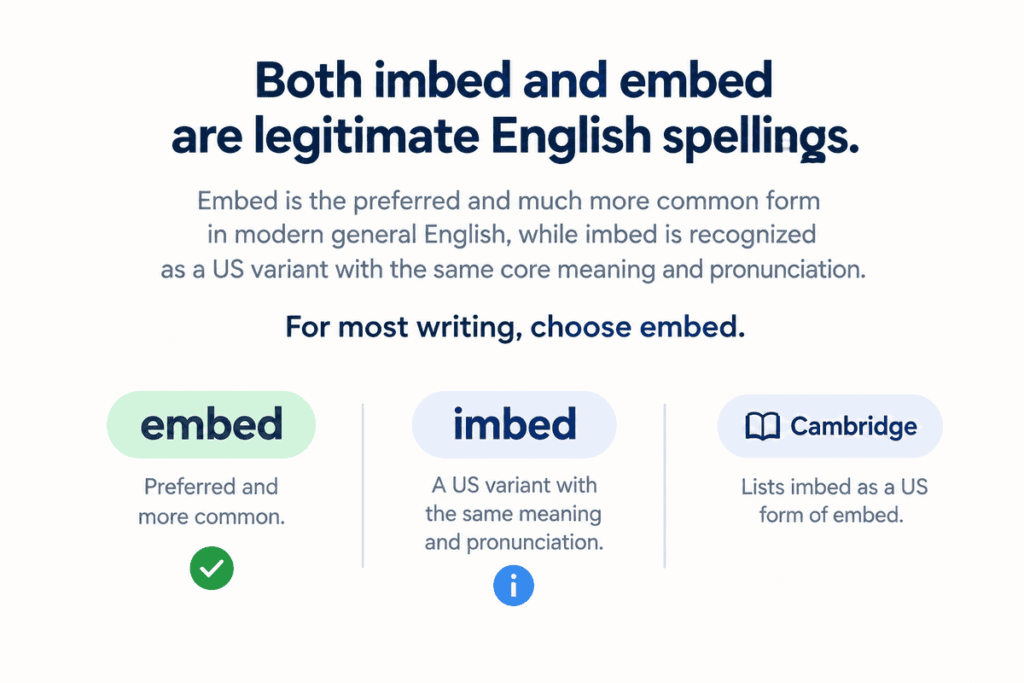
Both imbed and embed are legitimate English spellings. Embed is the preferred and much more common form in modern general English, while imbed is recognized as a US variant with the same core meaning and pronunciation. For most writing, choose embed. Cambridge lists imbed as a US form of embed.
Meaning And Definition
The verb embed means to fix something firmly into a substance or surrounding material. It can describe a physical object placed inside something, an idea that becomes firmly established, or digital material placed within a file, page, or message.
For example, a piece of glass can become embedded in a surface. A belief can become embedded in a culture. A video can be embedded on a website. These uses share one central idea. Something becomes fixed or placed within something larger.
Cambridge defines embed as a verb meaning to fix something firmly into a substance. It also gives business and technology uses in which text, sound, images, video, or electronic components are placed within another system or product.
Imbed carries the same basic meaning. Cambridge lists it as a US verb and directs readers to embed. That makes an important distinction. Imbed is not a random spelling error that should always be corrected. It is a recognized variant, but embed is the stronger default for most modern writing.
The verb works in literal and figurative contexts.
- A thorn was embedded in his finger.
- The memory became deeply embedded in her mind.
- The company embedded the new feature into its software.
- The writer embedded the idea into the story.
The physical examples involve an object inside another material. The figurative examples describe something that becomes firmly established in a mind, system, culture, or piece of writing.
Comparison Table
| Form | Meaning | Part of Speech | Origin | Usage Frequency | Formality | Common Contexts | Example |
|---|---|---|---|---|---|---|---|
| Embed | To fix or place something firmly within something else | Verb | Formed from em plus bed | More common | Standard and widely accepted | General writing, technology, science, media | Please embed the video in the page. |
| Imbed | Same core meaning as embed | Verb | Variant spelling | Less common | Standard but less common | US writing and established usage | The stone was imbedded in the wall. |
The table shows the most useful practical distinction. The two forms do not normally express different ideas. The main difference is familiarity and preference.
Key Differences Explained
Spelling
The spelling difference is simple.
Embed begins with e.
Imbed begins with i.
That single letter often causes the confusion because English has other words where an initial in sound or prefix changes to im before certain consonants. The spelling pattern can make imbed look completely natural even though embed is the form most readers expect.
Meaning
Both forms share the same core meaning.
They can describe putting something firmly inside another substance.
They can also describe making an idea, habit, belief, or feature firmly established within something larger.
There is no major everyday meaning difference that requires you to choose one form over the other.
Grammar
Both forms are verbs.
They can take a direct object.
The designer embedded the image in the report.
The technician embedded the sensor inside the device.
They can also appear in passive constructions.
The image was embedded in the report.
The sensor was embedded inside the device.
Pronunciation
The two forms have the same standard American pronunciation. Cambridge gives /ɪmˈbed/ for embed and the same pronunciation for imbed.
The strongest stress falls on the second syllable.
That means the spelling difference does not give you a reliable pronunciation clue.
Formality
Embed is the better choice for formal writing simply because it is more familiar and widely used.
Imbed is still legitimate. However, an uncommon spelling can make a reader pause even when it is technically correct.
That is why professional editors often prefer the familiar form when no specific reason exists to keep the variant.
Regional Usage
Cambridge specifically labels imbed as a US form. Embed has much broader use across major varieties of English.
For an international audience, embed is therefore the safer choice.
Digital Usage
Technology has made embed especially common.
People routinely embed videos, images, audio, charts, maps, documents, and other content into websites and digital files.
This has made embed one of the most familiar forms of the word in modern English.
Which Form Is Correct
Both forms are correct, but they are not equally common.
Embed is the best default choice.
Imbed is a legitimate US variant.
Cambridge treats imbed as a US form of embed rather than as a separate word with a different meaning. Both entries use the same pronunciation.
That means it would be inaccurate to say that imbed is always wrong.
At the same time, calling embed and imbed equally preferred would also be misleading. Embed is much more familiar to modern readers and appears naturally across general, professional, academic, technical, and digital writing.
If you are starting a new article, report, email, assignment, webpage, or technical document, use embed.
If you are editing an existing document that consistently uses imbed, you do not need to change it simply because another spelling exists.
The best editorial decision depends on consistency, audience, and style. For a fresh document with no special house style, embed is the clear practical choice.
Grammar And Part Of Speech
Both forms function as verbs.
The base form is used after modal verbs and in infinitives.
You can embed the image here.
The developer wants to embed the video.
The third person singular form adds s.
The software embeds the image automatically.
The present participle uses ing.
The system is embedding the content now.
The past tense and past participle use ed.
The editor embedded the chart yesterday.
The chart has been embedded in the report.
The spelling also involves a doubled b when the verb takes certain endings.
Embedded is correct.
Embedding is correct.
Embeded and embeding are incorrect spellings.
The same pattern applies to the less common variant.
Imbedded and imbedding can occur because they come from imbed.
Still, embedded and embedding are the forms most readers are accustomed to seeing.
Common Grammatical Patterns
The verb commonly appears in several useful structures.
Embed Something In Something
This pattern describes placing one thing inside another.
The developer embedded the video in the webpage.
The artist embedded the stone in the sculpture.
The teacher embedded the activity in the lesson.
Embed Something Into Something
This pattern can emphasize placement or movement into a larger object or system.
The engineer embedded the sensor into the device.
The company embedded security features into the software.
Both in and into can be natural depending on the context.
Be Embedded In Something
This passive pattern focuses on the thing that has been placed inside something else.
The image is embedded in the document.
The sensor is embedded in the casing.
The idea is deeply embedded in the culture.
Become Embedded In Something
This pattern is especially useful for figurative meanings.
The habit became embedded in the team’s routine.
The belief became deeply embedded in the community.
The tradition became embedded in local culture.
Pronunciation Guide
The standard American pronunciation is /ɪmˈbɛd/ for both forms. Cambridge gives this pronunciation for embed and imbed.
The word has two syllables.
The first syllable is unstressed.
The second syllable receives the main stress.
The vowel in the second syllable is the same vowel sound heard in bed.
The spelling can fool learners into expecting two different pronunciations. There is no standard pronunciation difference between the two forms.
A common pronunciation mistake is putting too much stress on the first syllable. Keep the stronger stress on the second syllable.
The related forms have additional syllables.
Embedded is commonly pronounced with three syllables.
Embedding is also commonly pronounced with three syllables.
The pronunciation remains closely connected to the base verb.
Etymology And Word Origin
The history of embed explains why the modern spelling makes sense.
The word dates from the late eighteenth century. Etymology sources trace it to em plus bed, with the original idea of placing something in a surrounding material like an object placed in a bed. The earliest use was connected with geology and fossils contained within rock.
The figurative meaning developed later. Instead of describing a physical object inside rock or another material, speakers began using the verb for ideas, qualities, customs, and other things that become firmly established.
The word eventually gained technical and digital meanings as well.
Today you can embed a video in a webpage, embed hardware in a product, or describe a belief as embedded in a culture.
The journalistic sense is another later development. An embedded journalist is a reporter who travels with and reports from within a military unit. Etymology sources date this particular sense to the early twenty first century.
The spelling imbed developed as a variant. Modern dictionaries recognize it, especially in US usage, but embed remains the dominant form.
Why The Spelling Causes Confusion
The confusion has a logical source.
English has many words in which a prefix changes its spelling before certain consonants. For example, in can appear as im before b, m, and p.
You can see this pattern in words such as impossible, imbalance, and immature.
Because embed begins with a sound that resembles the prefix in, some writers naturally expect imbed.
That spelling is not unreasonable. In fact, it has enough historical and dictionary support to be recognized as a real variant.
The problem comes from assuming that every logical spelling pattern has only one possible result in English.
English spelling does not always work like a mathematical formula. Historical forms often survive beside newer or more common forms.
That is exactly what happened here.
Imbed exists, but embed is the form most writers should choose when they want the familiar modern spelling.
Sentence Examples
Here are ten natural examples using the preferred form.
- Please embed the video near the end of the article.
This is a common digital publishing use. The video becomes part of the webpage.
- The technician embedded the sensor inside the device.
The sensor was physically placed within the device.
- A small piece of glass was embedded in his hand.
The glass became lodged beneath the surface.
- The teacher used repetition to embed the new concept in the students’ memory.
The meaning is figurative because the concept becomes firmly established in memory.
- You can embed the chart directly into the presentation.
The chart becomes part of the presentation rather than remaining separate.
- The company wants to embed safety checks into the production process.
The checks will become a built in part of the process.
- The author embedded historical details into the story.
The details were worked naturally into the larger story.
- The software allows users to embed images in their reports.
This is a common technical use.
- Years of practice had embedded the skill in her memory.
The skill had become deeply established through repeated practice.
- The journalist was embedded with the military unit.
This uses the specialized journalistic meaning of the word.
Examples With Imbed
Because imbed is a legitimate variant, it can appear in standard English.
- The mineral was imbedded in the rock.
- The device was imbedded in the outer casing.
- The memory remained deeply imbedded in his mind.
- The principle was imbedded in the larger theory.
- The company had imbedded security features into the system.
These sentences are understandable and grammatically valid. Still, most writers today would choose the corresponding forms with embed.
The difference is mainly one of preference and frequency rather than meaning.
Common Mistakes And Misspellings
Treating Imbed As Always Incorrect
This is the biggest mistake.
Imbed is recognized as a US variant of embed. Calling it an outright error in every situation ignores established dictionary usage.
Assuming The Two Forms Have Different Meanings
They normally do not.
Both forms describe placing something firmly inside something else or making something deeply established.
Writing Embeded
This is a genuine spelling error.
Incorrect: The video was embeded in the article.
Correct: The video was embedded in the article.
The final consonant is doubled before the ending.
Writing Embeding
This is also incorrect.
Incorrect: We are embeding the video now.
Correct: We are embedding the video now.
The doubled b remains before ing.
Changing Imbed Automatically
An editor should not change every occurrence of imbed without considering context.
If a source consistently uses imbed, the form may reflect a legitimate US preference or an established editorial style.
The better approach is to check consistency rather than correcting mechanically.
Real Life Usage Examples
Daily Conversation
The word is less common in casual speech than simpler expressions such as put in or place inside.
Still, it appears naturally when something becomes firmly stuck.
The splinter was embedded in my finger.
It also works well in figurative conversation.
That experience became deeply embedded in her memory.
Workplace Communication
Professional writing uses the word frequently.
Please embed the spreadsheet in the report.
This instruction tells a colleague to place the spreadsheet inside the report.
Another example is process design.
We need to embed these checks into the workflow.
Here the checks become a built in part of the process.
Academic Writing
Academic writers often use the word to describe ideas, methods, and concepts that form part of a larger system.
The theory is embedded in a broader model of language development.
The research method was embedded within the larger study design.
These uses are formal and precise.
News Writing
News writing uses the word in physical and journalistic contexts.
A piece of metal was embedded in the damaged vehicle.
The reporter was embedded with the military unit during the operation.
The second example uses the specialized journalistic meaning.
Literature And Storytelling
Writers often use embedded figuratively to create a sense of something deeply fixed.
Her childhood memories were embedded in the old house.
The image of the river was embedded in his memory.
The word can suggest that something is difficult to separate from its surrounding context.
Digital And Technical Usage
Technology has made embed especially visible in modern English.
You can embed a video on a webpage.
You can embed a chart in a report.
Developers can embed software components into larger systems.
These uses all share the same basic concept. Something is placed inside a larger digital environment so that it functions as part of that environment.
Cambridge specifically includes the digital meaning of placing text, sound, images, or video inside a computer file, email, or website. It also describes electronic equipment embedded within products.
The word is also common in the phrase embedded system.
An embedded system is a computing system designed to operate as part of a larger device or product.
This can include computers inside vehicles, appliances, medical equipment, industrial machines, and other products.
The technical meaning is therefore an extension of the older physical meaning. The system or component is placed inside a larger structure and becomes part of it.
Regional Usage
American English
Embed is the best general choice in American English.
Imbed is also recognized as a US variant. Cambridge specifically marks imbed as US.
For a broad American audience, embed will usually look more familiar. It is especially common in technology, publishing, software, journalism, and professional communication.
British English
Embed is the normal standard form in British English.
Imbed does not carry a major different meaning, but it is not the form most British writers would choose as a default.
Canadian English
Embed is the safer general form in Canadian English.
There is no major Canadian meaning difference that requires a separate spelling.
Australian English
Embed is also the practical standard choice in Australian English.
The regional pattern therefore gives writers a simple rule. Embed works comfortably across major varieties of English, while imbed has its clearest dictionary recognition as a US variant.
Formal And Informal Usage
Embed works well in both formal and informal writing.
A casual message might say:
Can you embed the image in the document.
A professional report can use the same verb.
The report should embed the latest financial data.
The word does not sound excessively formal. It is precise and familiar.
Imbed is also grammatically acceptable, but its lower frequency can make it look unusual to some readers.
That does not make it wrong.
It simply means that embed is usually the better editorial choice when you want maximum familiarity.
Related And Confused Terms
Insert
Insert means to put something into another thing.
The clerk inserted the document into the folder.
Insert does not always suggest that the object becomes firmly fixed.
Implant
Implant means to place something deeply inside a body, material, or system.
The surgeon implanted the device.
The idea was implanted in his mind.
It can overlap with embed, but the context often makes the distinction clear.
Inlay
Inlay means to set one material into another surface, often for decoration.
The craftsman inlaid the table with wood.
This is more specific than embed.
Enclose
Enclose means to surround something or put it inside an enclosed space.
The letter was enclosed in the envelope.
The object does not have to be firmly fixed.
Incorporate
Incorporate means to include something as part of a larger whole.
The company incorporated customer feedback into the design.
This is often close to embed in figurative writing, but it focuses more on inclusion.
Integrate
Integrate means to combine something with another system so that it functions as part of the whole.
The developer integrated the payment system into the website.
Lodge
Lodge can mean to become stuck or firmly placed somewhere.
A piece of stone lodged in the tire.
This word often suggests an accidental or unwanted position.
Implantation
Implantation is a noun related to implant.
It describes the act or process of placing something into a particular location, especially in medical or biological contexts.
These words overlap, but they are not perfect substitutes. Good word choice depends on the exact action and context.
Expert Editor Insight
An experienced editor would normally choose embed when starting a new document unless a specific house style or source tradition calls for imbed. The reason is practical. Embed is more familiar to modern readers, especially in digital and professional contexts, while imbed is a legitimate but less common US variant. A useful editing habit is to distinguish an uncommon word from an incorrect word before changing it. If a spelling is unfamiliar, check its status before treating it as an error.
Memory Tip
The easiest way to remember the preferred spelling is to connect embed with the word bed.
Imagine placing something into a bed of soil, rock, or another material.
That mental picture fits the historical idea behind the word. Etymology sources trace embed to em plus bed and note its early geological use for things contained within surrounding material.
You can also memorize a few common phrases.
- Embed a video.
- Embed an image.
- Embed a chart.
- Embed a feature.
- Embed content.
- Embed a device.
If you see imbed, remember that it is a legitimate variant rather than automatically assuming that someone made a spelling mistake.
A second useful rule is even simpler.
If you are choosing the spelling yourself, use embed.
If you are reviewing an existing text that uses imbed, check the context before changing it.
When To Use Each Form
Use embed when you want the most widely recognized spelling.
Use imbed when you are preserving a legitimate US variant in an existing text, following a specific style preference, or working with a source that consistently uses that form.
For most writers, the decision is straightforward.
- General American writing: use embed.
- Professional writing: use embed.
- Academic writing: use embed.
- Technical writing: use embed.
- Website content: use embed.
- Software documentation: use embed.
- International writing: use embed.
- Editing an existing source that uses imbed: consider preserving it if the source or style supports it.
- Quoted material: normally preserve the original spelling unless your editorial rules require a marked correction.
This approach keeps your writing clear without falsely labeling a legitimate variant as an error.
Key Takeaways
- Embed and imbed are both legitimate English forms.
- Embed is the preferred general spelling.
- Imbed is recognized as a US variant.
- Both forms have the same core meaning.
- Both forms function as verbs.
- Both forms have the same standard American pronunciation.
- Embed is especially common in technology and digital publishing.
- Embedded is the preferred past form for most modern writing.
- Imbed should not automatically be labeled a spelling error.
- For a new document, embed is the safest choice.
Conclusion
Imbed vs embed is a case where English gives writers two legitimate spellings, but one is clearly more useful as a default. Embed is the standard practical choice for most modern American writing, professional communication, academic work, technical material, and digital content. Imbed is also valid and is recognized as a US variant with the same core meaning and pronunciation.
The two forms describe the same basic idea of placing something firmly within something else. You can embed an image in a webpage, embed a device in a product, or describe an idea as deeply embedded in a culture. The easiest editing rule is to choose embed when starting fresh and remember that imbed is a recognized variant rather than a careless mistake.
FAQs
Is imbed a real word?
Yes. Imbed is a legitimate English verb and is recognized by Cambridge as a US form of embed. It has the same core meaning and pronunciation. It is less common than embed, so writers who want the most familiar general spelling will usually choose embed.
Which is correct imbed or embed?
Both forms are correct, but embed is the preferred general spelling for most modern writing. Imbed is recognized as a US variant. For websites, professional documents, academic work, and technical writing, embed is usually the better default.
What does embed mean?
Embed means to fix or place something firmly within another substance, object, system, or environment. It can describe physical placement, such as a stone embedded in a wall, or figurative placement, such as an idea embedded in a culture. It is also common in digital contexts.
How do you pronounce embed?
Embed is pronounced /ɪmˈbɛd/ in American English. It has two syllables with the main stress on the second syllable. Imbed has the same standard pronunciation. The spelling difference does not normally create a pronunciation difference.
Is imbed acceptable in formal writing?
Yes. Imbed is a legitimate form, but embed is usually the stronger choice for formal writing because it is more familiar and widely used. If a document already uses imbed consistently, changing every instance may not be necessary.
Why do people spell embed as imbed?
The confusion comes partly from English spelling patterns. The prefix in can change to im before certain consonants, as seen in words such as impossible and imbalance. That pattern can make imbed look natural even though embed is the more common spelling.
Is embedded or imbedded correct?
Both embedded and imbedded can occur because they correspond to the two verb forms. Embedded is the more common modern form and the better default for most writing. Imbedded is associated with the less common imbed variant.
Is embed used in technology?
Yes. Embed is extremely common in technology and digital publishing. It can mean placing video, images, audio, text, data, or other content inside a webpage, file, application, or larger digital system. It is also used in the term embedded system.
