
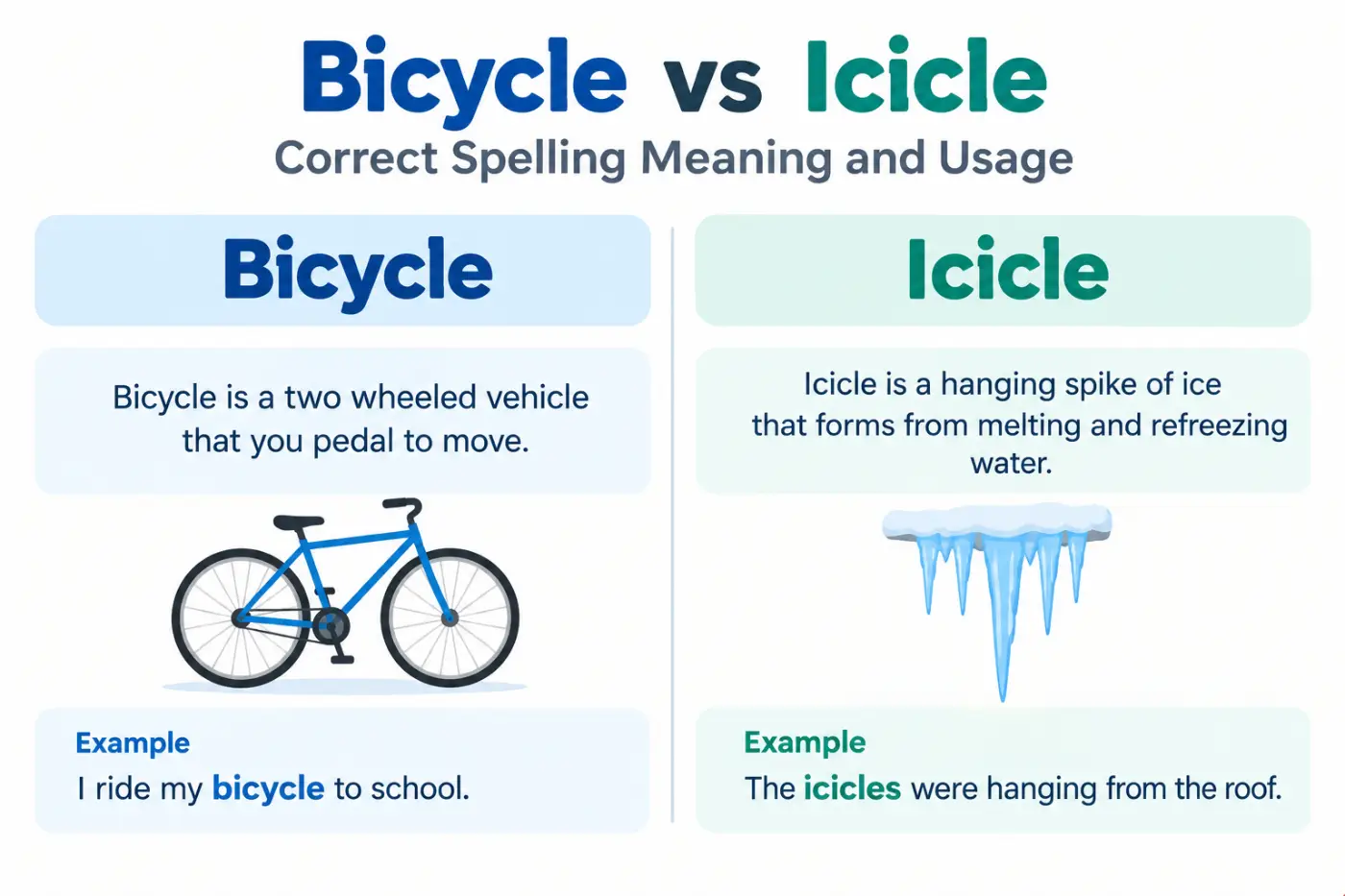
Icycle vs icicle is a common spelling question because the word sounds as if it could begin with the same sound as ice. The correct spelling is icicle. The form icycle is a common misspelling of the word and is not the standard spelling used in modern English.
The confusion makes sense when you hear the word instead of seeing it written. The first part sounds like ice, so it is easy to assume that the spelling should begin with icy. However, English spelling does not always follow the sound of a word in a simple way. The established spelling has been icicle for centuries.
In this article, you will learn what icicle means, how to pronounce it, why icycle is incorrect as the ordinary noun, how the word developed, and how native speakers use it in everyday and formal writing. You will also see practical examples and a simple memory trick that can help you avoid the mistake.
Quick Answer
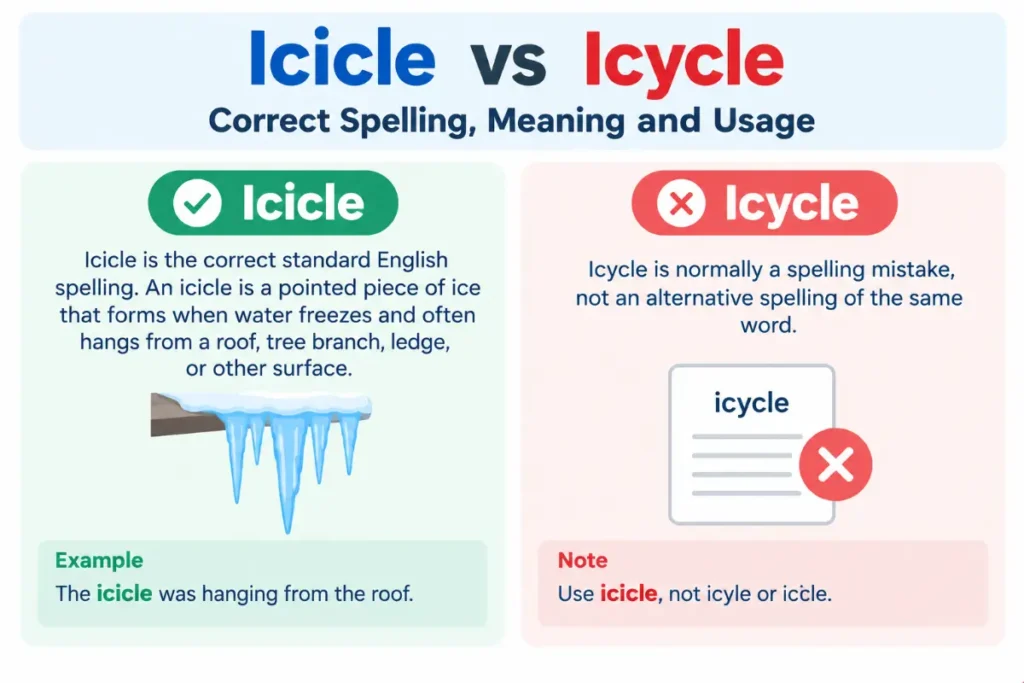
Icicle is the correct standard English spelling. An icicle is a pointed piece of ice that forms when water freezes and often hangs from a roof, tree branch, ledge, or other surface. Icycle is normally a spelling mistake, not an alternative spelling of the same word.
Comparison Table
| Form | Meaning | Part of Speech | Origin | Usage Frequency | Formality | Common Contexts | Example |
|---|---|---|---|---|---|---|---|
| Icicle | A hanging or pointed piece of ice formed from freezing water | Noun | Old English | Common | Standard | Weather, winter, science, everyday speech, literature | An icicle hung from the roof. |
| Icycle | No standard common noun meaning in modern English | Usually an error when intended as the noun | Not the established spelling of the common noun | Rare as a spelling of the noun | Not recommended | Typing errors, spelling mistakes, informal errors | The child wrote icycle instead of icicle. |
Meaning Of Icicle
An icicle is a long, narrow piece of ice that usually forms when liquid water freezes as it flows or drips from a surface. You often see icicles hanging from roofs, gutters, tree branches, windowsills, cliffs, or other exposed surfaces during freezing weather.
The word is a noun. It names the object itself, so it can appear as the subject or object of a sentence.
For example, you could say:
- The icicle melted in the afternoon sun.
- A large icicle formed beneath the roof.
- We watched the icicles grow after the storm.
- The children stayed away from the sharp icicle.
The meaning is simple, but the spelling can cause trouble because the word begins with a sound that resembles the word ice. That sound can lead writers to insert a y and create the incorrect form icycle.
Meaning Of Icycle
In ordinary modern English, icycle is not the standard spelling for the frozen object. If you write icycle when you mean a piece of hanging ice, most readers will understand your meaning from context, but they will usually recognize the spelling as an error.
This distinction matters most in schoolwork, professional writing, edited publications, formal documents, and other situations where standard spelling matters.
A spell checker may catch the error, but you should not rely only on software. A useful editor looks at the meaning and structure of the word. If you are describing a frozen formation hanging from a roof or branch, the standard noun is icicle.
The unusual form may appear in names, usernames, product names, titles, or other special contexts. A particular person or organization can choose almost any spelling for a name. That does not make the form an alternative standard spelling of the ordinary English noun.
Key Differences Explained
The difference is mainly about spelling. The two forms do not represent two standard words with different meanings.
- Spelling. The standard form is icicle. The extra y in icycle does not belong in the ordinary noun.
- Meaning. Icicle refers to a pointed or elongated piece of ice. Icycle does not have a separate standard meaning in everyday English.
- Grammar. Icicle is a countable noun. You can say one icicle, two icicles, a large icicle, or several icicles.
- Pronunciation. The correct word is pronounced with three syllables, approximately eye sih kuhl.
- Formality. Icicle works in casual conversation, school assignments, professional writing, journalism, and formal prose.
- Regional usage. Standard English varieties use icicle. There is no major American, British, Canadian, or Australian spelling difference that makes icycle preferable.
- Standard usage. Icicle is the established form. Icycle is normally treated as a misspelling when the writer means the frozen object.
Which Form Is Correct?
The correct form is icicle. The reason is not simply that one version appears more familiar. English words develop through long patterns of historical use, pronunciation, and spelling. The standard spelling of this particular noun became established as icicle rather than icycle.
The word also has a clear connection to ice. That connection can make the spelling feel confusing because icy is a familiar English word. However, icicle is its own established word, so you should learn its spelling as a complete unit. A useful rule is simple: when you mean a hanging piece of frozen water, write icicle. Do not change the spelling to icycle just because the beginning sounds similar to icy.
Why The Spelling Causes Confusion
The mistake usually comes from sound rather than meaning. When people hear icicle, the opening sound can remind them of words such as icy, ice, and icy cold. That creates a strong mental association with the letter y.
English contains many spelling patterns where the sound of a word does not tell you every letter that belongs on the page. This is especially common when a word has a long history and its modern spelling has developed over time.
The confusion can also happen during fast typing. If someone writes the word from memory, they may automatically produce icycle because it looks related to icy. The result is understandable, but it is still not the standard spelling.
Reading the correct form several times helps build stronger visual recognition. After you become familiar with icicle, the incorrect version usually starts to look unusual.
Sentence Examples
Here are ten natural examples using the standard spelling.
- An icicle was hanging from the edge of the roof.
- The warm sunlight caused the largest icicle to melt first.
- She pointed at an icicle growing from the tree branch.
- The teacher used a picture of an icicle during the winter science lesson.
- Please stay away from that icicle because it could fall.
- The old cabin had long icicles along the front roof.
- He took a photo of the colorful sunset behind the icicles.
- The newspaper reported that freezing temperatures had produced thick icicles across the region.
- The children watched an icicle slowly drip onto the frozen ground.
- In the story, the character used the shape of an icicle to describe the sharp peak of the mountain.
These examples show how naturally the noun fits into everyday, educational, professional, and descriptive writing.
Common Mistakes And Misspellings
Several spelling errors can appear around this word. Most come from sound associations or from trying to apply a familiar spelling pattern.
Writing Icycle Instead Of Icicle
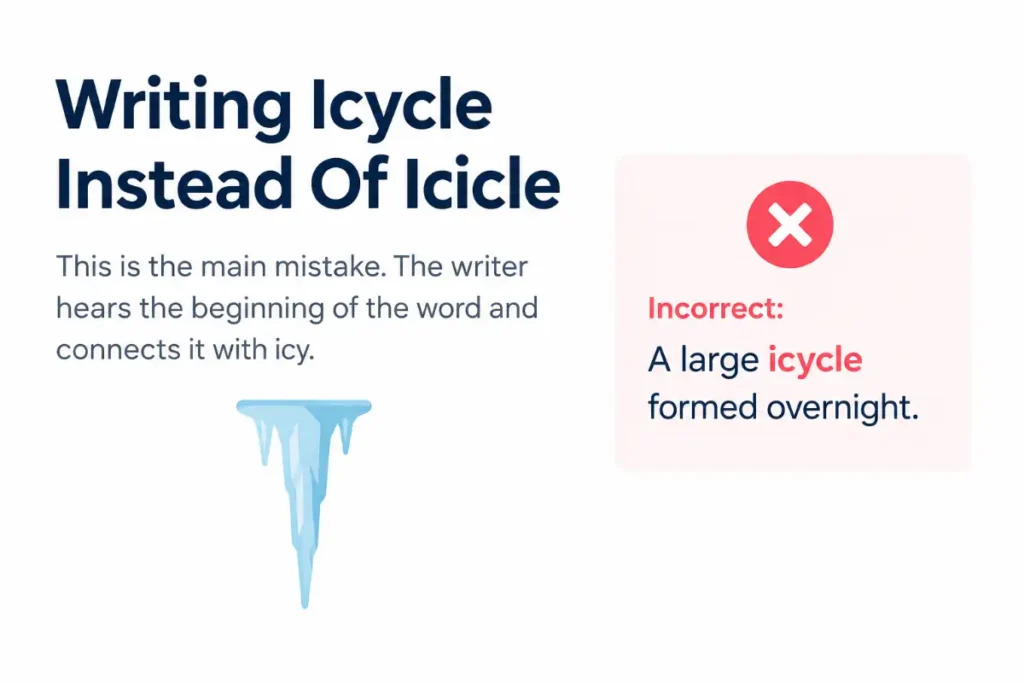
This is the main mistake. The writer hears the beginning of the word and connects it with icy.
Incorrect: A large icycle formed overnight.
Correct: A large icicle formed overnight.
The easiest fix is to remember that the standard noun begins with ici, not icy.
Writing Icical Instead Of Icicle
Some writers change the ending because words such as typical or physical have familiar adjective patterns. That does not work here.
Incorrect: The icical formation was dangerous.
Correct: The icicle was dangerous.
Icicle is a noun, not an adjective ending in ical.
Writing Icicle As Icycle In Fast Messages
Text messages and quick online posts often contain spelling mistakes because people type quickly and do not proofread. The meaning may remain clear, but the standard form is still icicle. If the writing is for school, work, publication, or a formal message, take a moment to check the spelling.
Adding An Unnecessary Y
The y can feel natural because icy is a familiar word. However, the noun does not need that letter.
Incorrect: The icycle fell from the roof.
Correct: The icicle fell from the roof.
The adjective icy and the noun icicle are related in meaning, but they are different words with different spellings.
Confusing The Noun With The Adjective Icy
Icy describes something that is covered with ice, very cold, or slippery because of ice. Icicle names a specific object.
For example, you can say:
The road is icy.
The roof has an icicle.
These words belong to the same semantic area, but they perform different grammatical jobs.
Pronunciation Guide
The standard pronunciation of icicle in American English is approximately:
IPA: /ˈaɪsɪkəl/
The word has three syllables:
i • ci • cle
An easy pronunciation guide is:
EYE sih kuhl
The main stress falls on the first syllable. The opening sound is the same general sound heard in words such as eye and ice.
The final part can be difficult for learners because the written ending does not sound exactly like a fully pronounced cle. In normal American speech, the ending is reduced and sounds close to kuhl.
The incorrect spelling icycle does not create a useful alternative pronunciation. If someone writes icycle while intending the common noun, the spelling is simply an error.
Etymology And Word Origin
Icicle is an old English word with roots reaching back to Old English. Historical forms are related to the idea of an ice formation, and the modern word developed through changes in spelling and pronunciation over the centuries.
The word is connected to the older English vocabulary associated with ice. Over time, its form settled into the spelling used in modern English.
This history also helps explain why you should not try to rebuild the spelling from the modern word icy. Modern speakers may naturally see ice and icy as related words, but the established spelling of icicle comes from its own historical development.
You do not need to memorize the full history to spell the word correctly. The practical lesson is that icicle is the inherited standard form, while icycle is a modern spelling error when used for the same object.
Regional Usage
American English
Icicle is the normal spelling in American English. It appears in everyday conversation, school materials, weather reports, journalism, literature, and general writing.
For example:
The icicles on the roof became longer overnight. There is no standard American spelling rule that changes icicle to icycle.
British English
British English also uses icicle as the standard form. The spelling does not normally change because of the variety of English being used. A British writer can use the same noun in contexts involving winter weather, buildings, trees, mountains, and frozen water.
Australian English
Australian English uses icicle as the standard spelling as well. Since naturally occurring freezing conditions vary across Australia, the word may appear less often in everyday conversation in some regions, but its spelling does not change.
Canadian English
Canadian English also uses icicle. Cold weather gives the word plenty of practical use, particularly in descriptions of winter conditions, buildings, roads, and outdoor environments. The important point is that regional English does not provide a standard version called icycle.
Grammar Rules And Part Of Speech
Icicle is a countable noun. That means you can use singular and plural forms.
The singular form is:
icicle
The plural form is:
icicles
The plural ending is pronounced in the normal way for a word ending in a consonant sound.
You can use the singular form with an article or another determiner:
- an icicle
- the icicle
- this icicle
- that icicle
- a large icicle
You can also use the plural form:
- icicles
- the icicles
- several icicles
- long icicles
- dangerous icicles
The word can appear as the subject of a sentence.
An icicle fell from the roof.
It can also appear as the object.
The boy touched the icicle.
It can follow a linking verb.
The formation was an icicle.
Because the word is a noun, you should not use it as a replacement for icy. If you want to describe a surface covered with ice, use icy.
The sidewalk is icy.
If you want to name a hanging piece of ice, use icicle.
An icicle hangs from the roof.
Real Life Usage Examples
Daily Conversation
In normal conversation, people use icicle to talk about visible ice formations.
That icicle is getting bigger.
Be careful near the doorway because a large icicle is hanging above it.
These examples sound natural because the word simply names an object that people can see.
Workplace Communication
The word may appear in workplace messages involving buildings, maintenance, safety, weather, or property management.
The maintenance team removed several large icicles from the entrance.
Please report any large icicles that form above the walkway.
In a safety notice, correct spelling matters because the message needs to look clear and professional.
Academic Writing
Students may use the word in science lessons, geography assignments, weather reports, or descriptive writing.
An icicle forms when water freezes as it moves or drips from a surface.
The photograph shows icicles forming along the edge of the glacier.
The noun is simple enough for elementary school writing but also fits naturally into more advanced academic descriptions.
News And Journalism
News writing may use icicle when reporting winter weather or safety problems.
Falling icicles damaged several vehicles outside the building.
Temperatures remained below freezing, allowing large icicles to form along exposed roofs.
The word works well in factual reporting because it identifies a specific physical feature.
Literature And Storytelling
Writers can use icicle in descriptions to create a strong winter image.
Moonlight reflected from the icicles along the cabin roof.
A row of icicles glittered above the frozen stream.
The word often works well in descriptive writing because its shape suggests sharpness, coldness, and winter weather.
Icy And Icicle
For example:
The road is icy.
Her hands were icy cold.
Icicle is a noun. It names a specific formation of ice.
For example:
An icicle formed beside the window.
This distinction explains part of the spelling confusion. Writers may know the word icy very well and unconsciously transfer its spelling pattern to icicle.
A useful memory rule is:
Icy describes. Icicle names.
If you are describing a condition, icy may be right. If you are naming a pointed piece of frozen water, icicle is the word you need.
Related And Confused Terms
Several words are closely connected to icicle. Knowing the differences can make the vocabulary easier to use accurately.
Ice
Ice is the general noun for frozen water. An icicle is a particular shape or formation of ice.
Icy
Icy is an adjective. It describes something covered with ice, containing ice, or extremely cold.
Frost
Frost is a thin layer of ice crystals that forms on cold surfaces when water vapor freezes. It is not the same thing as an icicle.
Glacier
A glacier is a large, persistent mass of ice that forms on land and moves slowly over time. An icicle is much smaller and usually forms from dripping or flowing water.
Frozen
Frozen is an adjective and can also function as a participle. It describes something that has become solid because of cold.
Snow
Snow consists of ice crystals that fall from clouds. It is different from the solid formation called an icicle.
Iceberg
An iceberg is a large piece of freshwater ice that has broken away from a glacier or ice shelf and floats in water. It is vastly different in scale from an icicle.
Drip
Drip is commonly associated with icicle formation because flowing or dripping water can freeze into an elongated shape under suitable conditions.
Understanding these related terms helps you choose precise language instead of treating every frozen formation as the same thing.
A Simple Memory Trick
The easiest way to remember the spelling is to separate the word into its familiar visual pattern:
ice + icle
Think of the beginning as ice, followed by icle.
Do not build the spelling from icy.
You can also connect the meaning directly to the image. An icicle is ice that has formed into a narrow hanging shape. The spelling begins with the familiar letters associated with ice.
Another useful trick is to write the correct word three times:
icicle
icicle
icicle
Seeing the correct form repeatedly helps build visual memory. This works especially well if you often make the same typing mistake.
When Icycle May Appear
Although icycle is not the standard spelling for the common noun, you may encounter the sequence of letters in unusual contexts.
A business, website, product, username, fictional character, or organization may choose an invented spelling. Names do not always follow ordinary dictionary spelling rules.
That does not change the standard English noun.
For example, if a company intentionally uses Icycle as its name, you should preserve that name when referring to the company. If you are writing about a piece of frozen water hanging from a roof, use icicle.
Context determines how a spelling should be interpreted.
This distinction is useful for editors because not every unfamiliar word is automatically a spelling error. A strange form can be a proper name, brand, technical term, or creative spelling. The writer’s intended meaning must always be considered.
Expert Editor Insight
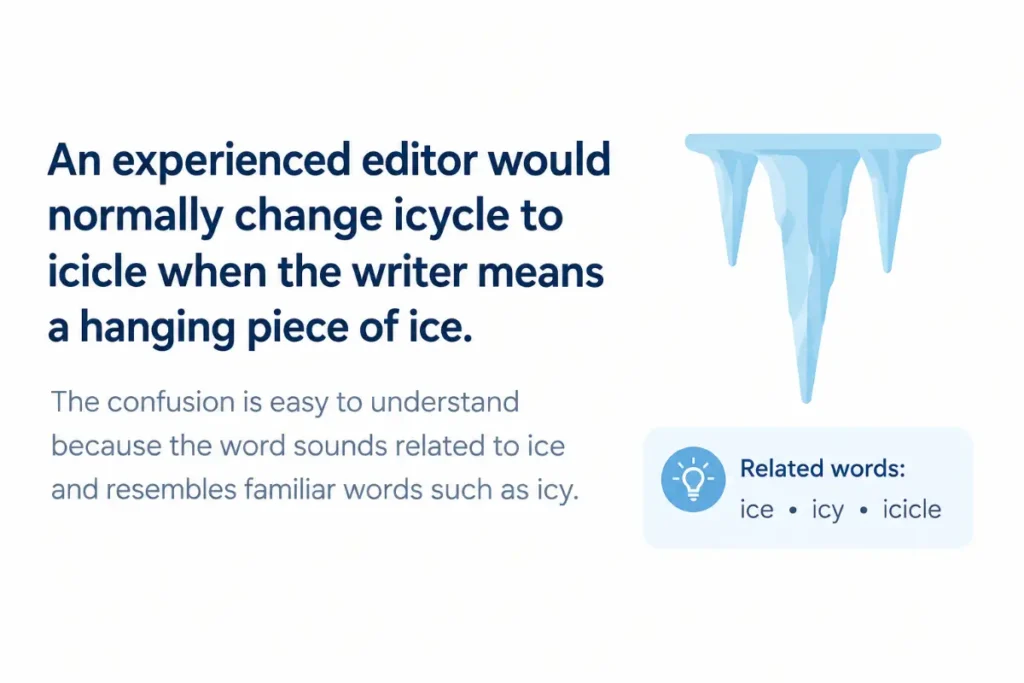
An experienced editor would normally change icycle to icicle when the writer means a hanging piece of ice. The confusion is easy to understand because the word sounds related to ice and resembles familiar words such as icy. Good editing focuses on established usage rather than simply asking if a reader can understand the intended meaning. If the context is ordinary English prose, icicle is the safe and standard choice.
How To Remember The Correct Form
If you regularly confuse the two spellings, use a three step check.
- Ask what you mean. If you mean a hanging piece of frozen water, you need the noun icicle.
- Look at the middle of the word. The standard form contains ici, not icy.
- Picture the word with ice at the beginning. The visual pattern icicle is easier to remember when you connect it with the object itself.
You do not need a complicated grammar rule. You simply need to recognize that icicle is an established word with an established spelling.
Why Standard Spelling Matters
A reader may understand icycle from context, but understanding is not the same as correctness. Standard spelling gives readers a consistent form that they can recognize quickly.
This matters in school assignments, resumes, reports, articles, workplace messages, and published material. A single spelling mistake rarely destroys meaning, but repeated errors can make writing look less polished.
Correct spelling also helps search systems, spell checkers, language tools, and readers connect your word with the intended concept. Using the standard form removes unnecessary ambiguity.
For casual messages, a typo may not matter much. For anything you want to look professional, choosing the established spelling is the better habit.
Conclusion
Icycle vs icicle has a simple answer: icicle is the correct standard spelling for a piece of ice that hangs from a surface. The form icycle is normally a misspelling when it is intended to have that meaning.
The word is a countable noun and works naturally in everyday speech, schoolwork, professional writing, journalism, and literature. Its pronunciation is approximately EYE sih kuhl, and its spelling remains the same across American, British, Canadian, and Australian English.
The easiest memory tip is to connect the word with ice, not icy. When you mean the frozen formation, write icicle. That spelling is the established form readers expect.
FAQs
Is icycle a real word?
Icycle is not the standard spelling for the common English noun that means a hanging piece of ice. You may see the form in unusual names, creative spellings, usernames, or other special contexts. In ordinary English writing, however, use icicle. If your sentence describes frozen water hanging from a roof or branch, icicle is the correct choice.
What does icicle mean?
An icicle is a narrow or pointed piece of ice that forms when water freezes as it drips or flows from a surface. Icicles commonly hang from roofs, gutters, tree branches, cliffs, and other exposed surfaces during freezing weather. The word is a countable noun, so you can say one icicle, several icicles, or a large icicle.
Which is correct, icycle or icicle?
Icicle is correct when you mean a piece of ice that forms a hanging or pointed shape. Icycle is normally a misspelling. The confusion often happens because the beginning of icicle sounds similar to words such as ice and icy. Despite that connection, the established spelling uses icicle rather than icycle.
How do you pronounce icicle?
In American English, icicle is pronounced approximately /ˈaɪsɪkəl/. It has three syllables and the main stress falls on the first syllable. An easy pronunciation guide is EYE sih kuhl. The final syllable is usually reduced in natural speech, so the word does not sound like every letter is being pronounced separately.
Can icicle start a sentence?
Yes. Icicle can easily begin a sentence because it is a noun. For example, you can write, An icicle fell from the roof. Starting a sentence with the word does not create any special grammar problem. Capitalize it normally when it appears as the first word: Icicle.
What is a synonym for icicle?
There is no perfect everyday synonym that works in every context. You can describe an icicle as a hanging piece of ice, a pointed ice formation, or a frozen projection. These expressions explain the object rather than replace the standard noun. In most situations, icicle is shorter, clearer, and more natural.
Why do people misspell icicle as icycle?
The mistake usually comes from sound and visual association. People connect the word with ice and icy, which can make the letter y feel natural. Fast typing can reinforce the mistake because the writer may spell the word from sound rather than from memory. Repeated exposure to the standard spelling makes the correct form easier to recognize.
Is icicle appropriate in formal writing?
Yes. Icicle is a standard English noun and is appropriate in formal writing, academic work, journalism, workplace communication, and professional documents. It does not have a casual or slang meaning that limits its use. If you are describing a frozen formation hanging from a roof, branch, or other surface, icicle is the correct formal term.
