
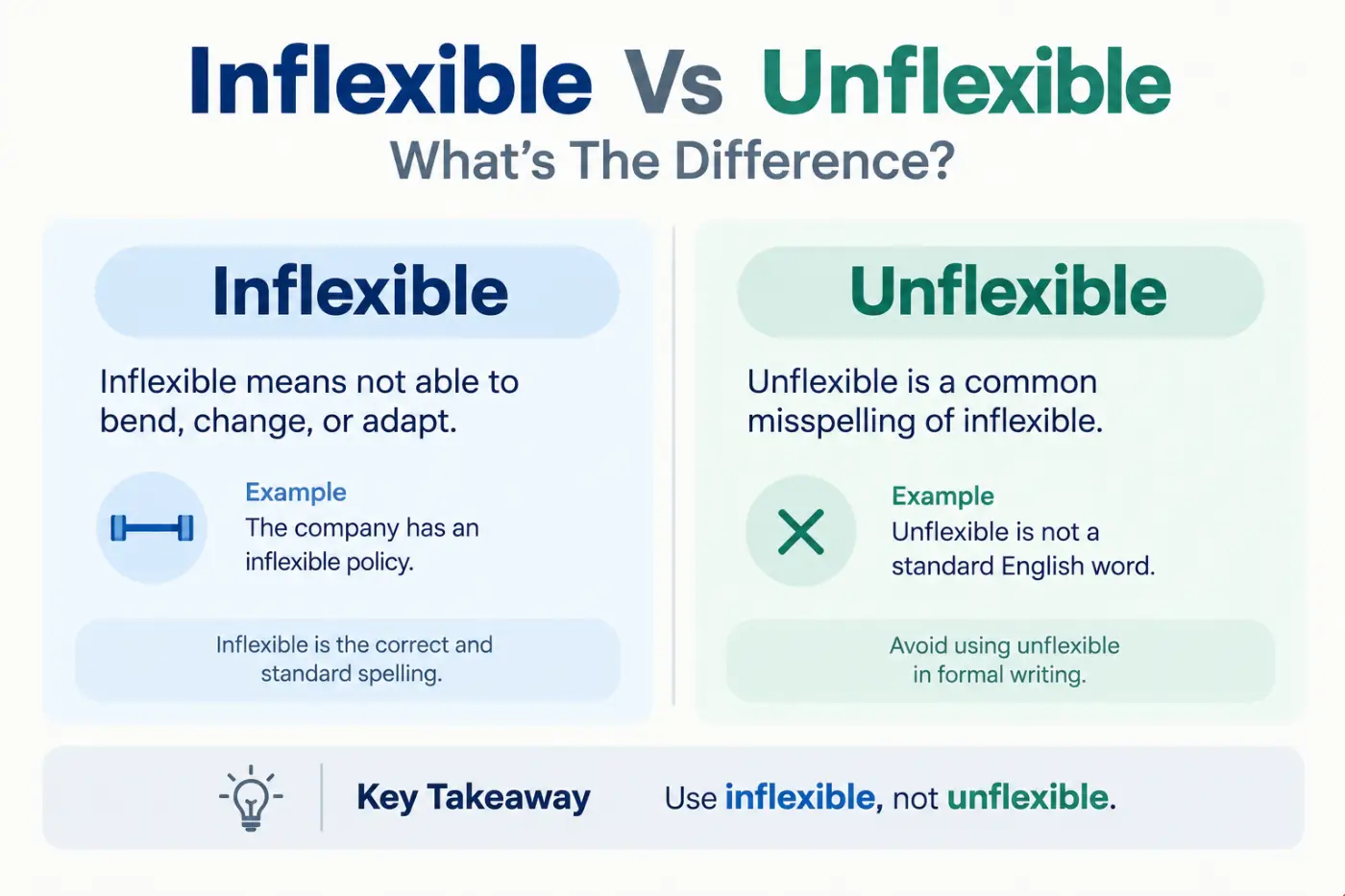
Inflexible vs unflexible whats the difference comes down to one important point: inflexible is the standard word you should use in modern English. It means unable or unwilling to bend change or adapt. Unflexible can be found in some English sources and historical texts, but it is uncommon and usually sounds unnatural to modern readers.
The confusion makes sense. English often uses the prefix un to create the opposite of an adjective. Words such as unhappy unclear unfair and uncertain follow that pattern. It is easy to look at flexible and assume that adding un creates the natural opposite. English does not always work that neatly. Some adjectives have established negative forms with prefixes such as in im il or ir.
That is what happened with flexible. The established opposite is inflexible. This article explains the spelling meaning grammar pronunciation history and practical usage so you can choose the right form without second guessing yourself.
Quick Answer
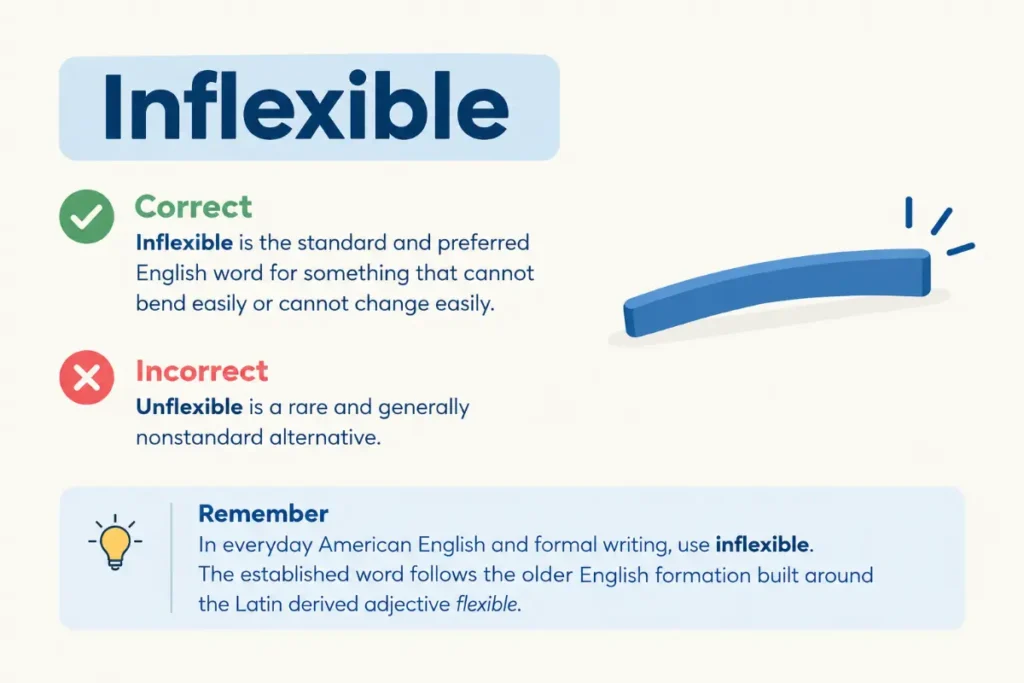
Inflexible is the standard and preferred English word for something that cannot bend easily or cannot change easily. Unflexible is a rare and generally nonstandard alternative. In everyday American English and formal writing, use inflexible. The established word follows the older English formation built around the Latin derived adjective flexible.
Inflexible Is The Standard Form
The standard word is inflexible.
It is an adjective that describes something physically rigid or something that cannot easily change. It can describe a material that does not bend or a person who refuses to change an opinion or decision.
For example:
- The plastic is too inflexible to bend around the corner.
- My manager has an inflexible policy about late submissions.
- She can be inflexible when plans change unexpectedly.
- The schedule is inflexible and cannot be moved.
The word works for both physical and abstract ideas. You can describe a rigid object as inflexible. You can also describe a strict rule a fixed schedule or an unwilling attitude as inflexible.
Is Unflexible A Real Word
Unflexible is not simply a random spelling mistake. The form has appeared in English and can still be found in some dictionaries and historical or user generated sources. However that does not make it the normal choice for modern standard English.
The practical distinction matters.
If you are writing an article for a general American audience then use inflexible.
If you are quoting an old source that contains unflexible then you can preserve the original wording.
The existence of a word in a historical or less common source does not automatically make it the preferred form for current standard usage.
Comparison Table
| Form | Meaning | Part of Speech | Origin | Usage Frequency | Formality | Common Contexts | Example |
|---|---|---|---|---|---|---|---|
| Inflexible | Not able or willing to bend change or adapt | Adjective | Latin through Old French | Common and established | Standard | Rules schedules attitudes materials | The deadline is inflexible. |
| Unflexible | Not flexible | Adjective | English un plus flexible | Rare | Nonstandard or unusual in modern use | Historical writing occasional informal usage | The term may appear in older or nonstandard writing. |
The key point is not that readers can never understand unflexible. They usually can. The issue is that modern readers expect inflexible.
Good writing often means choosing the form that feels natural to educated readers rather than choosing a form that can technically be understood.
What Inflexible Means
Inflexible has two major meanings.
The first relates to physical movement.
Something inflexible cannot bend easily. It may be stiff rigid or resistant to bending.
For example:
- The metal frame is inflexible.
- This material is too inflexible for the design.
- The pipe needs to be flexible rather than inflexible.
The second meaning relates to change or behavior.
A person can be inflexible if they are unwilling to change their position. A policy can be inflexible if it leaves little room for adjustment. A schedule can be inflexible if you cannot move the times.
For example:
- He is inflexible about the deadline.
- The company has an inflexible attendance policy.
- Her inflexible approach made the negotiation difficult.
This second meaning is especially common in modern professional English.
What Unflexible Means
Unflexible carries the intended meaning of not flexible.
That sounds logical because English often uses un to form negative adjectives.
For example:
- Unhappy means not happy.
- Unclear means not clear.
- Unfair means not fair.
- Uncertain means not certain.
So it is understandable that someone might create unflexible.
The problem is established usage.
English does not form every negative adjective by simply adding un. Many words have other established negative forms. In this case English settled on inflexible as the normal opposite of flexible.
That means a sentence such as this may be understandable but still sound unusual:
The company has an unflexible schedule.
A modern editor would normally change it to:
The company has an inflexible schedule.
That change makes the sentence sound natural and standard.
Why Inflexible Is Preferred
The main reason is simple: inflexible is the established English form.
The prefix in can mean not or the opposite of something in words derived through Latin. English uses this pattern in many familiar adjectives.
Consider these examples:
- Flexible and inflexible.
- Visible and invisible.
- Possible and impossible.
- Legible and illegible.
- Responsible and irresponsible.
- Regular and irregular.
The pattern is not perfectly predictable. You cannot safely assume that every adjective ending in a particular way will take in as its negative form. English has developed through several languages and periods so established usage matters more than a simple prefix formula.
The history of inflexible helps explain why the word feels so firmly established.
The Grammar Of Inflexible
Inflexible is an adjective.
It normally appears before a noun or after a linking verb.
Before a noun:
- The company has an inflexible policy.
- We need to change the inflexible schedule.
- The machine uses an inflexible frame.
After a linking verb:
- The policy is inflexible.
- Her position remained inflexible.
- The material became inflexible in cold temperatures.
You can also use it with adverbs.
- The rules were extremely inflexible.
- He remained completely inflexible.
- The schedule is highly inflexible.
The word can describe people systems rules plans materials attitudes and approaches.
Pronunciation Guide
In American English, inflexible is commonly pronounced:
/ɪnˈflɛksəbəl/
The word has four syllables:
in flex i ble
The main stress falls on the second syllable.
The first part sounds like the short vowel in words such as sit. The stressed syllable begins with the consonant cluster found in flex.
A simple pronunciation guide is:
in FLEX uh buhl
The final syllable is usually reduced in natural American speech.
Unflexible would normally follow a different stress pattern because of its added prefix. However pronunciation is not the main reason to choose one form over the other. Standard usage is.
Why People Write Unflexible
The spelling usually comes from a logical but unreliable word formation pattern.
A writer knows the word flexible.
They want to express the opposite.
They think:
flexible → unflexible.
That process feels natural because un is one of the most productive negative prefixes in English.
The problem is that English vocabulary contains many words whose established negative form does not use un.
For example:
- Inaccurate is standard rather than unaccurate.
- Impossible is standard rather than unpossible.
- Invisible is standard rather than uninvisible.
- Incomplete is standard rather than uncomplete.
- Inflexible is standard rather than unflexible.
Some alternative forms may appear in historical texts or specialized contexts. That does not mean they are the best choices for modern standard writing.
The Prefix In And The Prefix Un
The distinction between in and un is useful but it should not become a rigid rule.
The prefix un is common with many native English adjectives.
Examples include:
- Unhappy.
- Unfair.
- Unclear.
- Unkind.
- Uncertain.
The prefix in often appears in words that entered English through Latin or French.
Examples include:
- Inaccurate.
- Incomplete.
- Inactive.
- Invisible.
- Inflexible.
The historical development of inflexible supports this pattern. The word comes from Old French and directly from Latin inflexibilis. The Latin form combines in meaning not with flexibilis meaning pliant or yielding.
This is a useful explanation of the spelling but not a rule you should use to invent new words. Established vocabulary comes first.
The Word Flexible
Understanding flexible makes the difference much easier.
Flexible means able to bend physically or able to change and adapt.
Consider these examples:
- This wire is flexible.
- We need a flexible schedule.
- She has a flexible approach to problem solving.
- The company offers flexible working hours.
The opposite naturally becomes inflexible.
- The wire is inflexible.
- We have an inflexible schedule.
- His approach is inflexible.
- The company has an inflexible policy.
This creates a clean pair:
flexible → inflexible
That is the pairing you should remember.
Sentence Examples
Here are natural examples showing how modern English uses inflexible.
- The school has an inflexible attendance policy.
This means the school allows very little room for exceptions.
- Her work schedule is too inflexible for frequent travel.
The schedule cannot easily be adjusted.
- The metal frame is strong but inflexible.
The frame does not bend easily.
- His inflexible attitude made the discussion harder.
He was unwilling to change his position.
- The deadline is inflexible because the application closes Friday.
The deadline cannot be moved.
- We need a more flexible approach instead of an inflexible set of rules.
The sentence contrasts adaptability with rigidity.
- The old system was inflexible and difficult to update.
The system could not adapt easily to new needs.
- She is usually open to suggestions but becomes inflexible about safety rules.
The sentence shows that inflexibility can apply to one specific issue.
- An inflexible contract can create problems when circumstances change.
The contract leaves little room for adjustment.
- The material became inflexible after prolonged exposure to cold.
Here the meaning is physical rather than behavioral.
Common Mistakes
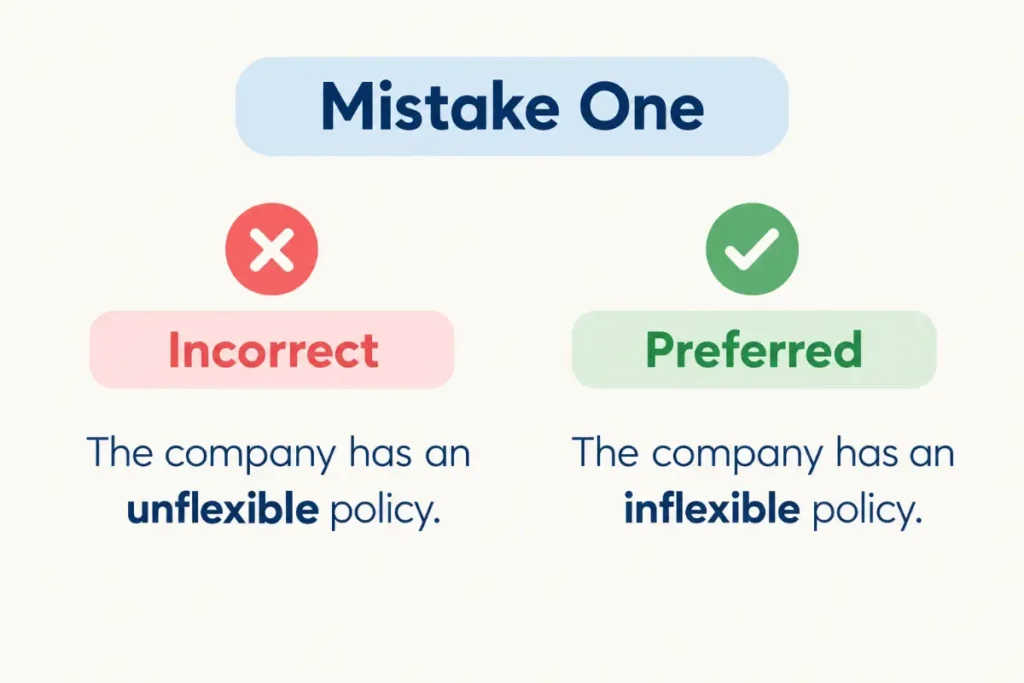
Mistake One
Incorrect:
The company has an unflexible policy.
Preferred:
The company has an inflexible policy.
The writer has applied the common un prefix to flexible. Modern standard usage favors inflexible.
Mistake Two
Incorrect:
My schedule is very unflexible.
Preferred:
My schedule is very inflexible.
The adjective should be inflexible when you mean that the schedule cannot easily change.
Mistake Three
Incorrect:
He has an unflexible attitude.
Preferred:
He has an inflexible attitude.
The meaning is clear in both versions but the second sounds natural and standard.
Mistake Four
Incorrect:
The material is unflexible.
Preferred:
The material is inflexible.
Use the established adjective when describing something that does not bend easily.
Mistake Five
Incorrect:
The manager was unflexible during negotiations.
Preferred:
The manager was inflexible during negotiations.
In professional writing especially, the established form is the better choice.
Is Unflexible Always Wrong
Calling unflexible simply wrong can be too absolute.
The form has a documented history and appears in some dictionaries and text collections.
The more useful distinction is between possible usage and preferred standard usage.
A word can exist somewhere in the language without being the normal choice for contemporary formal English.
That distinction matters for editors and writers.
If your goal is clear modern American English, choose inflexible.
If you are studying historical English, examining old texts, or discussing unusual vocabulary, you may encounter unflexible.
In almost every ordinary writing situation, though, inflexible is the safer choice.
American English Usage
American English strongly favors inflexible for standard writing.
You will see it in contexts involving workplace policies schedules deadlines rules materials attitudes and decision making.
Examples include:
- The policy is too inflexible.
- We need a less inflexible approach.
- The schedule remains inflexible.
- His position was inflexible.
Unflexible may still appear online because people create words based on familiar spelling patterns. Online appearance alone does not establish a form as preferred standard English.
For a US audience, use the established form.
British English Usage
The same basic distinction applies in British English.
Inflexible is the standard form.
There is no major British spelling change that turns inflexible into unflexible.
British and American English may differ in vocabulary pronunciation and some spelling patterns, but this is not one of the major regional differences.
For example, a British writer can say:
The timetable is inflexible.
An American writer can say:
The schedule is inflexible.
The noun differs in these examples because timetable is more common in British English while schedule is common in American English. The adjective remains inflexible.
Canadian And Australian English
Canadian and Australian English also use inflexible as the established standard form.
There is no meaningful regional spelling rule that makes unflexible preferable in these varieties.
You may encounter the unusual form in informal writing or individual usage. That does not represent a standard regional alternative.
For international professional communication, inflexible is therefore the clearest choice.
Formal And Informal Writing
Inflexible works comfortably in both formal and informal writing.
In conversation you might say:
My boss is pretty inflexible about start times.
In a formal report you might write:
The current policy is inflexible and does not account for exceptional circumstances.
The level of formality changes the surrounding language but not the spelling.
Unflexible is different. It can sound unusual even in casual writing. A reader may understand it immediately but still notice that it is not the expected form.
That is a good reason to avoid it.
Real Life Usage
Daily Conversation
People often use inflexible to describe schedules rules or personalities.
For example:
- My work schedule is inflexible this week.
- He can be inflexible when he thinks he is right.
The word fits naturally because both sentences describe limited willingness or ability to change.
Workplace Communication
Professional writing often needs precise language.
For example:
- The current deadline is inflexible because the client has already scheduled the final review.
- The company should replace its inflexible policy with a process that allows reasonable exceptions.
These examples show how the word can describe a fixed deadline and a rigid policy.
Academic Writing
In academic writing, inflexible can describe systems approaches structures and assumptions.
For example:
- An inflexible framework may fail to account for differences between groups.
- The study uses an inflexible definition that excludes several relevant cases.
The word works well because it expresses limited adaptability without sounding overly emotional.
Journalism
A journalist might describe a rigid policy or position as inflexible.
For example:
- The committee maintained an inflexible position during the negotiations.
- Critics argued that the system was too inflexible to respond to changing conditions.
The word is especially useful when describing rules or positions that allow little room for adjustment.
Storytelling
In narrative writing, inflexible can describe personality.
For example:
- Her father was strict and inflexible about household rules.
- The captain remained inflexible even as conditions changed.
The word helps convey a character who refuses to bend.
Related And Confused Terms
Several words are closely related to inflexible. They are not perfect replacements in every sentence.
Rigid
Rigid means stiff or resistant to change.
A rigid schedule is difficult to change. A rigid material does not bend easily.
It often sounds stronger than inflexible.
Unyielding
Unyielding describes someone or something that refuses to give way.
An unyielding attitude suggests strong resistance.
Intransigent
Intransigent describes someone who refuses to change a position or agree to compromise.
It is more formal and often stronger than inflexible.
Uncompromising
Uncompromising describes a person or position that will not make concessions.
It works especially well in negotiations and disagreements.
Stubborn
Stubborn is common and conversational.
It usually describes a person who refuses to change their mind.
Calling a policy stubborn would sound unusual. Calling a person stubborn is completely natural.
Rigidly
Rigidly is the adverbial form of rigid.
For example:
The rule was applied rigidly.
This emphasizes the manner of application.
Flexibility
Flexibility is the noun related to flexible.
It describes the ability to change or adapt.
For example:
The job offers considerable flexibility.
Adaptable
Adaptable describes something or someone that can adjust easily to new conditions.
It is often a better positive alternative when you want to emphasize the ability to respond to change.
Inflexible And Rigid Are Not Always Identical
These words overlap but they are not interchangeable in every context.
Rigid often emphasizes lack of movement or strict structure.
Inflexible can emphasize an inability or unwillingness to adapt.
Compare these sentences:
The metal is rigid.
The manager is inflexible.
The first sentence describes physical stiffness.
The second describes behavior and attitude.
You could say the manager has a rigid approach, but that wording can sound more severe or structured. Inflexible focuses more directly on the refusal or inability to adapt.
Choosing the right synonym makes writing more precise.
Inflexible And Unyielding Are Not Always Identical
Unyielding often suggests strong resistance.
For example:
The workers remained unyielding during the negotiation.
Inflexible is broader.
For example:
The schedule is inflexible.
You would not normally call a schedule unyielding.
That is why synonyms should not be treated as interchangeable labels. Good writing depends on context.
Word Origin
The history of inflexible gives a useful explanation for its spelling.
The word dates to the late fourteenth century. It came into English through Old French and directly from Latin inflexibilis, meaning something that cannot be bent. The Latin formation combines in meaning not or opposite with flexibilis meaning pliant or yielding.
The modern relationship is therefore logical:
flexible describes something that bends or adapts.
inflexible describes something that does not bend or adapt.
The spelling is not a modern invention created by adding a random prefix. It reflects a much older word formation.
Why The Prefix Rule Can Mislead You
English learners often learn that un means not.
That rule is useful but incomplete.
You cannot simply attach un to every adjective and assume the result is standard English.
For example:
- Happy becomes unhappy.
- Fair becomes unfair.
- Clear becomes unclear.
But:
- Possible becomes impossible.
- Visible becomes invisible.
- Flexible becomes inflexible.
The best approach is to learn established word pairs instead of generating negative forms mechanically.
This saves time and prevents awkward wording.
An Easy Memory Trick
Use this pair:
Flexible and inflexible.
Think of them as a matched set.
If the positive word is flexible then its standard opposite is inflexible.
You can also connect the word to the idea of bending.
A flexible branch bends.
An inflexible branch does not bend easily.
The same idea works for abstract situations.
A flexible schedule can change.
An inflexible schedule cannot easily change.
That physical image makes the meaning easier to remember.
How Editors Handle The Form
An experienced editor will usually change unflexible to inflexible when editing standard American English.
The editor is not simply checking spelling. They are checking established usage.
This distinction matters because spell checkers do not always give the full linguistic picture. A rare form may appear in a dictionary or pass through a writing tool without being the best choice for the audience.
A professional editor asks a more useful question:
What wording would a typical educated reader expect here?
For this pair, the answer is inflexible.
That choice improves clarity and removes an unnecessary distraction.
A Better Way To Proofread
When you see unflexible in your writing, stop and check the meaning.
If you mean not flexible, change it to inflexible in standard writing.
Then check the surrounding sentence.
You may also have a stronger alternative.
Instead of:
The rules are inflexible.
You might write:
The rules are strict.
If you mean that the rules cannot change, inflexible works well.
If you mean that the rules allow no exceptions, rigid may work better.
The goal is not simply to replace one word. The goal is to choose the word that communicates the exact idea.
When To Use Flexible Instead
Sometimes the best solution is not inflexible at all.
If the sentence sounds overly negative, rewrite it using flexible or another positive construction.
Instead of:
The schedule is not inflexible.
Write:
The schedule is flexible.
Instead of:
The policy is not unflexible.
Write:
The policy is flexible.
Clear positive wording is usually easier to read.
This is especially useful in workplace communication. Saying that a schedule is flexible tells the reader exactly what they can expect.
A Simple Editing Rule
Use this three step check.
- Ask if you mean able to change or bend.
Use flexible.
- Ask if you mean unable or unwilling to change or bend.
Choose inflexible.
- Avoid unflexible in standard modern writing unless you have a specific reason to reproduce or discuss unusual usage.
That rule handles almost every everyday situation.
Key Takeaways
- Inflexible is the standard form.
- Unflexible is rare and generally not the preferred form in modern standard English.
- Inflexible means unable or unwilling to bend change or adapt.
- Inflexible is an adjective.
- Flexible and inflexible form the standard opposite pair.
- The word can describe physical objects rules schedules policies attitudes and people.
- The spelling comes from an established Latin based word formation rather than a simple modern addition of un.
- American British Canadian and Australian English all use inflexible as the standard form.
- If you are writing professionally, choose inflexible.
- When proofreading, replace unflexible with inflexible unless you have a specific reason to preserve unusual or historical wording.
Conclusion
Inflexible vs unflexible whats the difference has a straightforward answer. Inflexible is the standard English word, while unflexible is a rare alternative that most modern writers should avoid and Inflexible means unable or unwilling to bend change or adapt, and it works naturally for objects schedules rules policies attitudes and people.
The confusion comes from a reasonable spelling pattern. English often uses un to create opposites, but it does not use that pattern for every adjective. Flexible already has an established opposite in inflexible.
For a simple memory trick, keep flexible and inflexible together as a pair. If you mean not flexible, write inflexible. That choice will sound natural to modern American readers and will keep your professional academic and everyday writing clear.
FAQs
Is unflexible a correct English word?
Unflexible has appeared in English and is recorded in some lexical sources with the meaning not flexible. However it is rare and is not the normal standard choice in modern American English. For everyday writing school work business communication and professional content, use inflexible.
Which is correct inflexible or unflexible?
Inflexible is the standard and preferred form. It means not able or willing to bend change or adapt. Unflexible may appear in unusual or historical usage, but most modern readers expect inflexible. If you are writing for a general audience, inflexible is the clear choice.
What does inflexible mean?
Inflexible means unable to bend easily or unable or unwilling to change. It can describe physical objects such as materials and abstract things such as rules schedules policies opinions and attitudes. For example, an inflexible schedule allows little opportunity to change the planned times.
How do you pronounce inflexible?
In American English, inflexible is commonly pronounced /ɪnˈflɛksəbəl/. It has four syllables with the main stress on the second syllable. A simple learner guide is in FLEX uh buhl. The final vowel sounds are reduced in normal conversational speech.
Why do people say unflexible?
People often create unflexible by applying the common negative prefix un to flexible. That logic seems reasonable because English has many words such as unhappy and unclear. However, English does not form every opposite with un. The established opposite of flexible is inflexible.
Is inflexible formal or informal?
Inflexible works in both everyday and formal English. You can use it to describe a person’s attitude in conversation or a policy in a professional report. The surrounding wording determines the level of formality. The word itself is standard and widely understood.
What is a synonym for inflexible?
Useful synonyms include rigid strict unyielding uncompromising intransigent and stubborn. The best choice depends on context. Rigid often describes structure. Stubborn commonly describes people. Intransigent and uncompromising are stronger choices for positions that resist agreement.
Is inflexible the opposite of flexible?
Yes. Flexible describes something that can bend change or adapt easily. Inflexible describes something that cannot easily bend change or adapt. This opposition works for both physical and abstract meanings. A flexible schedule can change while an inflexible schedule allows little adjustment.
