
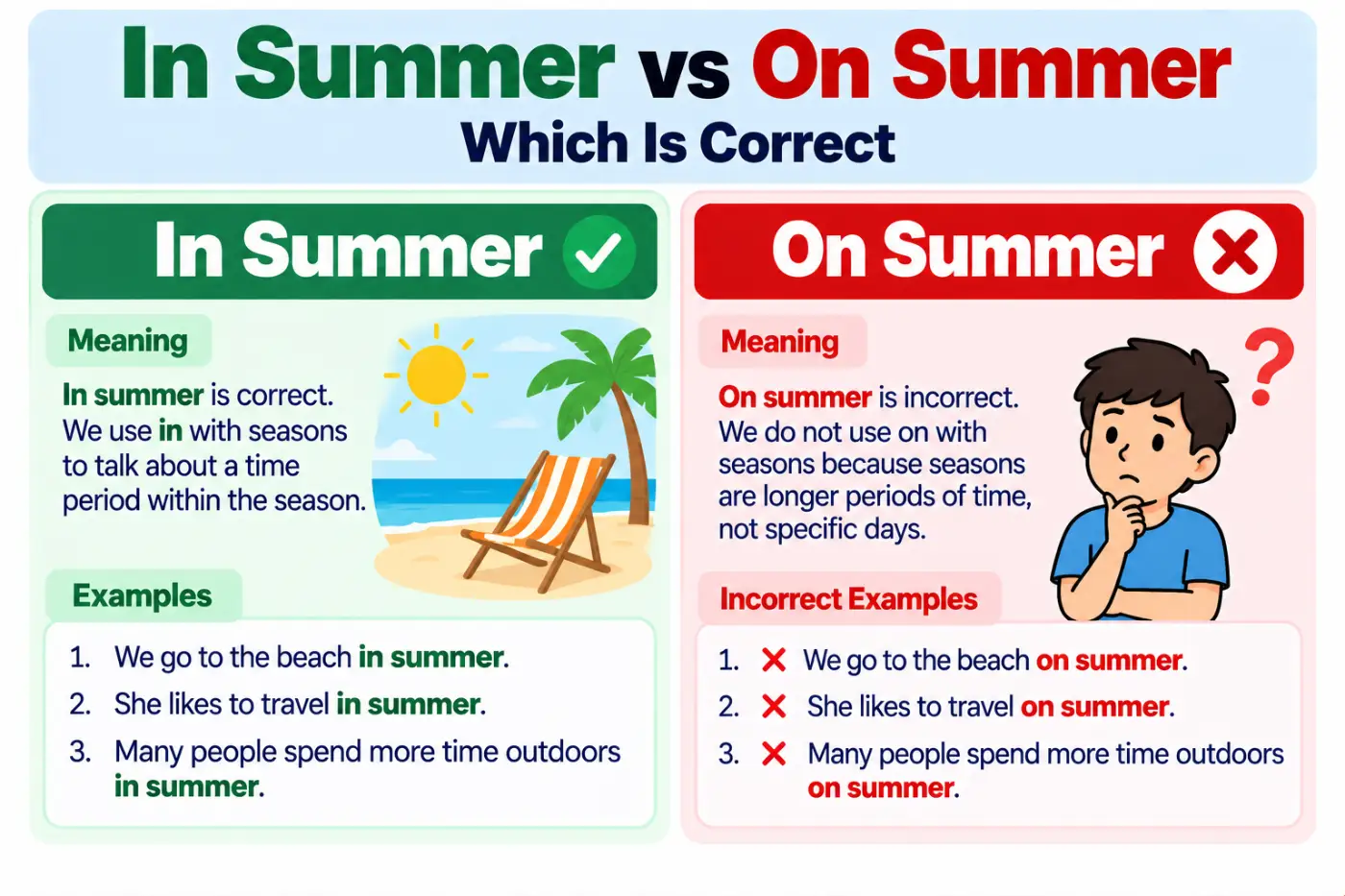
If you’re unsure about in summer vs on summer, the standard choice for talking about the summer season is in summer. You can say I love swimming in summer or We usually travel in summer. The preposition on doesn’t normally go directly before summer when you mean the season.
The confusion happens because English uses different prepositions for different kinds of time expressions. We usually use in with longer periods such as months seasons and years. We use on with particular days and dates such as Monday July 4 or a summer afternoon. That small distinction makes a big difference.
Once you understand the basic pattern, choosing the right preposition becomes much easier. This guide explains the grammar behind the choice, shows natural examples from everyday and formal English, explains related expressions such as on a summer day and during summer, and covers common mistakes that can make otherwise good writing sound unnatural.
Quick Definition
Use in summer when you mean the summer season as a general period of the year. Use on with a specific day or date connected with summer such as on a summer morning or on July 10. On summer by itself is not the normal standard expression for the season.
Quick Answer
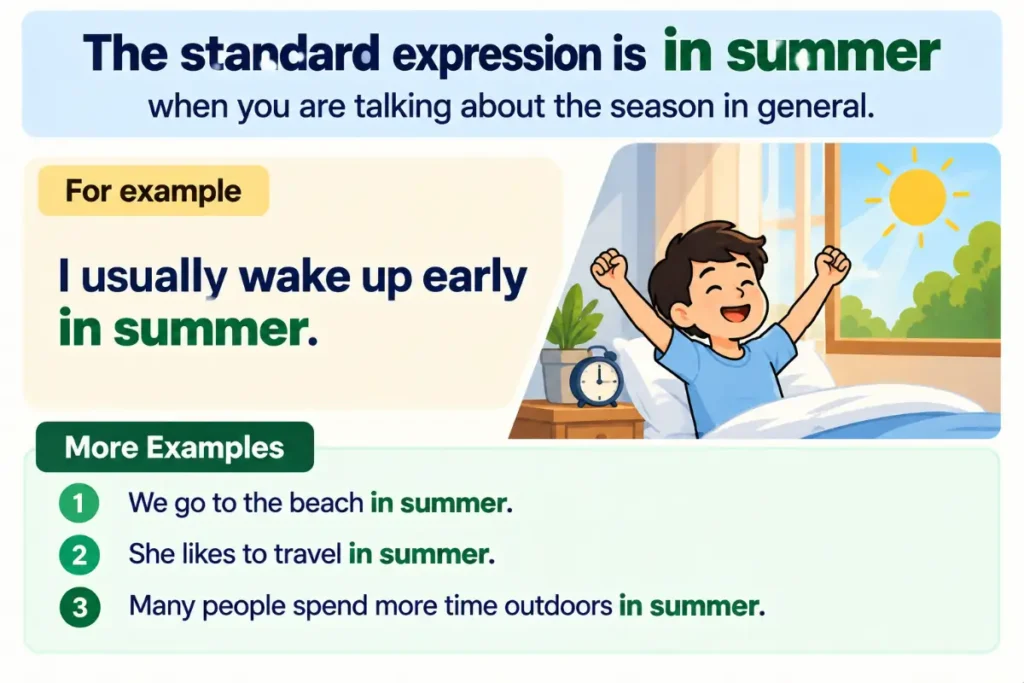
The standard expression is in summer when you are talking about the season in general.
For example:
I usually wake up early in summer.
You can use on when you identify a particular day or part of a day.
We went hiking on a summer morning.
So the basic rule is simple. Use in for the summer season. Use on for a specific day or date.
Comparison Table In Summer Or On Summer
| Expression | Meaning | Grammar | Typical Use | Formality | Natural Example |
|---|---|---|---|---|---|
| In summer | During the summer season | Prepositional phrase | General seasonal time | Neutral | We visit our grandparents in summer. |
| On summer | Not normally used alone for the season | Prepositional phrase | Usually requires another noun or a special expression | Nonstandard when used alone | We do not normally say We travel on summer. |
| On a summer day | During a particular summer day | Prepositional phrase | Specific day | Neutral | We met on a summer day. |
| On a summer morning | During a particular morning in summer | Prepositional phrase | Specific part of a day | Neutral | I saw him on a summer morning. |
| During summer | Throughout or at some point in the summer season | Prepositional phrase | General seasonal time | Neutral and formal | Sales increase during summer. |
The key point is that on usually needs a more specific time reference in these constructions. The season alone is normally paired with in.
Meaning And Definition
Meaning Of In Summer
In summer means during the summer season.
It can describe something that happens regularly every summer or something that happens at some point during a particular summer.
For example:
Flowers bloom in summer.
This sentence makes a general statement about the season.
You could also say:
We stayed in California in summer.
Here the expression refers to the period of summer when the stay took place.
The phrase is common in both everyday speech and formal writing. American English often uses in the summer as well.
For example:
We go swimming in summer.
We go swimming in the summer.
Both are grammatical. The first is slightly more general and compact. The second includes the definite article and is also very natural.
In American English, in the summer is especially common in ordinary conversation.
Meaning Of On Summer
On summer is not normally used by itself to mean during the summer season.
A sentence such as:
I travel on summer.
sounds incorrect to a native English speaker.
The problem is not the word summer itself. The problem is the relationship between the preposition and the time expression.
English normally uses in for a season.
We say:
in spring
in summer
in fall
in winter
We use on when the time expression identifies a particular day.
For example:
on a summer day
on a hot summer afternoon
on the first day of summer
on June 21
The noun summer can therefore appear after on when another word makes the time more specific.
That distinction is worth remembering because it explains why on summer can sometimes appear in a sentence without making the entire sentence wrong. The surrounding words change the grammatical structure.
The Main Grammar Rule
English divides time expressions into broad categories. Prepositions help show the size or specificity of the time period.
In commonly introduces longer periods.
In 2026
In July
In summer
In the morning
On commonly introduces particular days and dates.
On Monday
On July 4
On my birthday
On a summer morning
At commonly introduces exact times and certain fixed expressions.
At 8 a.m.
At noon
At night
This pattern is not a mathematical formula. English contains many fixed expressions and exceptions. Still, it gives you a strong working rule for everyday writing.
When you think of summer as a season, use in.
When you think of a particular summer day, use on.
Why In Works With Seasons
A season covers a stretch of time rather than a single point or named day.
Summer can include many weeks and several months depending on the calendar system and location. Because it represents a broad period, English commonly uses in.
Consider these examples.
We usually travel in summer.
The weather gets hotter in summer.
Children often spend more time outdoors in summer.
The days feel longer in summer.
In each sentence, the speaker is talking about the season as a whole or about a general period within it.
The same pattern appears with the other seasons.
Birds return in spring.
Leaves change color in fall.
Snow is common in winter.
The structure feels natural because the season functions as a broad time period.
Why On Works With Specific Summer Days
On is associated with particular days and dates.
That is why you can say:
We went to the beach on a summer day.
The phrase does not mean summer as a whole. It identifies one particular day that happened during summer.
You can make the reference even more specific.
We went to the beach on a hot summer afternoon.
She met her friends on a warm summer evening.
They moved into the house on the first day of summer.
The phrase after on gives the reader a specific time reference.
That is the important difference. The word summer can appear after on, but it usually needs a noun or another expression that identifies the particular day or event.
In Summer And In The Summer
Both forms are correct.
In summer is concise and general.
In the summer is also natural and very common in American English.
Compare these sentences:
I love hiking in summer.
I love hiking in the summer.
There is no major difference in meaning. The second version can sound slightly more conversational in American English.
The article the often appears when speakers treat summer as a specific seasonal period.
For example:
We visited Florida in the summer.
This can refer to a particular summer or to summer as the season in which the activity usually happens.
In many contexts, the two expressions are interchangeable.
In Summer And During Summer
During summer is also correct.
It emphasizes the time period in which something happens.
For example:
The store gets busy during summer.
We offer special classes during summer.
Many students work during summer.
The difference between in summer and during summer is usually small.
In summer often sounds more natural for general seasonal statements.
During summer can emphasize the duration or time span.
Compare:
I exercise more in summer.
I exercise more during summer.
Both work. The first is simpler and more natural for everyday speech.
Key Differences Explained
- Season versus specific day. Use in for the summer season and on for a particular day connected with summer.
- General versus specific. In summer usually gives a broad seasonal reference. On a summer day points to a particular day.
- Standard usage. In summer is the normal prepositional expression for the season.
- Article choice. In the summer is also correct and especially common in American English.
- Context matters. On summer may appear inside a longer expression but normally does not work alone as a substitute for in summer.
- Meaning changes with structure. Compare in summer with on a summer morning. The second phrase identifies a more specific period.
- Punctuation does not change the rule. The choice of preposition depends on the time expression rather than sentence punctuation.
- The pattern applies to other seasons. We commonly say in spring, in fall, and in winter too.
Which Form Is Correct?
For the summer season itself, in summer is correct.
If you are writing in American English, in the summer is also extremely natural.
The form on summer should not normally replace either expression.
The reason comes from the basic English system of time prepositions. In commonly introduces months seasons years and other broad periods. On generally introduces specific days dates and day based expressions.
That is why these sentences work:
We travel in summer.
We travel in the summer.
We travel on Saturday.
We traveled on a summer Saturday.
The last sentence combines both ideas. Saturday identifies the day while summer gives additional information about the season.
Sentence Examples
Here are natural examples that show how native speakers use these expressions.
- I usually spend more time outdoors in summer.
- The city becomes much busier in the summer.
- We often visit our relatives in summer.
- Many children learn to swim during summer.
- The garden looks beautiful in the summer.
- We went for a long walk on a summer evening.
- She started her new job on a warm summer morning.
- They got married on a sunny summer day.
- The family usually takes a vacation in summer.
- Electricity use often rises during the summer.
Now compare these incorrect or unnatural constructions.
I usually travel on summer.
Better:
I usually travel in summer.
We go swimming on summer.
Better:
We go swimming in summer.
The weather is hot on summer.
Better:
The weather is hot in summer.
The problem in these examples is the preposition. The sentence needs a seasonal expression rather than a day based expression.
Common Mistakes
Using On Before The Season
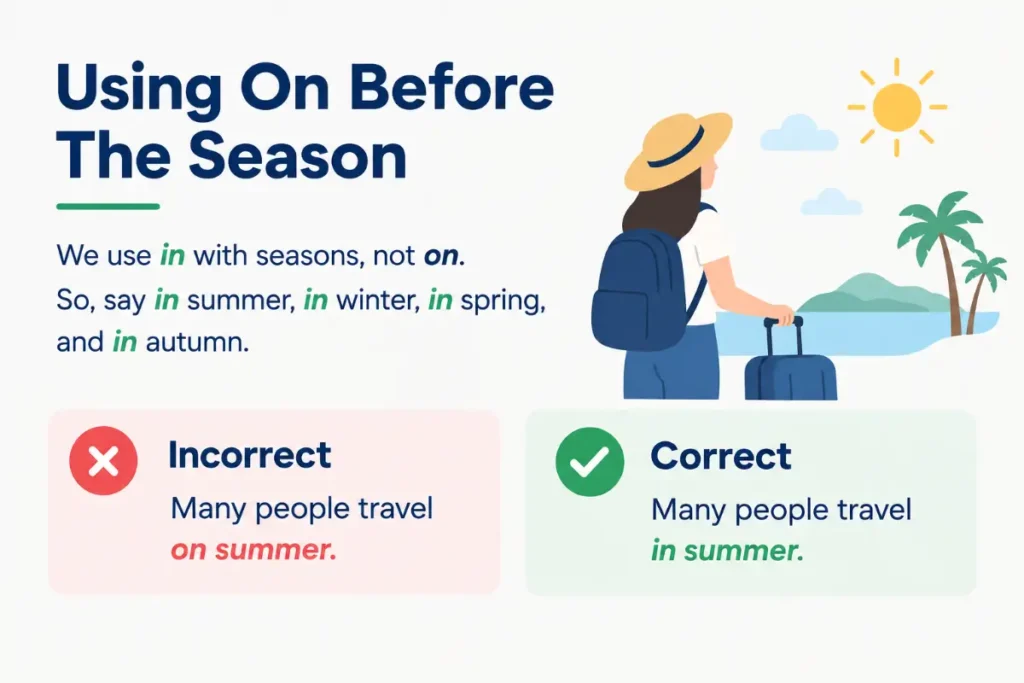
Incorrect:
Many people travel on summer.
Correct:
Many people travel in summer.
The mistake usually happens because learners know that English uses on for time expressions but apply the rule too broadly.
Removing The Article Incorrectly
Incorrect:
I visited them on the summer.
Correct:
I visited them in the summer.
The issue here involves both the preposition and the normal seasonal construction.
Confusing A Season With A Day
Incorrect:
We met in a summer day.
Correct:
We met on a summer day.
The phrase identifies one particular day, so on works naturally.
Using On With A Month
Incorrect:
We arrived on July.
Correct:
We arrived in July.
A month is a broad period, so English normally uses in.
But:
We arrived on July 15.
Now the reference is a specific date, so on is correct.
Using At With The Season
Incorrect:
We travel at summer.
Correct:
We travel in summer.
At normally works with exact times and certain fixed expressions. A season is not normally treated as an exact point in time.
Pronunciation Guide
The pronunciation of summer is straightforward in American English.
It is commonly represented as /ˈsʌmər/.
You can think of it as:
SUM er
The first syllable receives the main stress.
The phrase in summer therefore sounds approximately like:
in SUM er
The phrase in the summer adds the unstressed word the before the season.
One pronunciation issue can arise with the word summer itself. Some learners may try to pronounce every written letter distinctly. In natural English, the final r sound varies by accent. American English is generally rhotic, so the r is heard clearly compared with many British accents.
The preposition is also important in spoken English. Native speakers tend to say the entire phrase smoothly rather than stressing every word.
Etymology And Word Origin
The word summer has a long history in English and related Germanic languages. It comes from an Old English form associated with the warm season and is related to words found in other Germanic languages.
The preposition in also has a very old history in English. Its basic spatial meaning developed into broader uses for time. That is why English can use the same preposition for being inside a place and being within a period.
For example:
The keys are in the box.
The flowers bloom in summer.
The meanings are different, but the underlying idea of being within something remains useful as a way to understand the time expression.
The preposition on also developed from an older spatial relationship and became widely used with surfaces and particular days or dates.
Understanding these older patterns can make modern usage easier to remember, but you don’t need to study historical linguistics to use the expressions correctly.
Regional Usage
American English
American English commonly uses in the summer and in summer. The version with the article is especially natural in everyday conversation.
For example:
We usually go camping in the summer.
You can also hear:
We usually go camping in summer.
The first version may sound more conversational to many American speakers.
On summer by itself is not the normal American English expression for the season.
British English
British English also uses in summer and in the summer. Both forms are standard.
British speakers may use in summer more readily in certain general statements, but the meaning remains clear in both forms.
Specific day expressions still use on.
On a summer evening we walked along the river.
Australian English
Australian English follows the same basic pattern. Speakers use in summer or in the summer for the season and on with particular days or dates.
Because seasons occur at different times of year in Australia compared with the Northern Hemisphere, the calendar context changes. The preposition does not.
Canadian English
Canadian English also follows the same general pattern. In summer and in the summer are standard choices for the season.
A specific day still takes on.
We went hiking on a summer Saturday.
There is no major regional rule that changes the basic distinction.
Grammar Rules And Part Of Speech
The words in and on are prepositions. When they combine with a noun such as summer they create a prepositional phrase.
In:
We travel in summer.
The phrase in summer functions as an adverbial time phrase. It tells the reader when the action happens.
In:
We traveled on a summer morning.
The phrase on a summer morning also functions as a time expression.
The key grammatical difference comes from the type of time reference.
Broad Time Periods
Use in with many broad periods.
in summer
in July
in 2026
in the afternoon
Specific Days
Use on with specific days.
on Monday
on Friday morning
on July 4
on my birthday
on a summer day
Exact Times
Use at with many exact times.
at noon
at 7 p.m.
at midnight
This gives you a useful three part framework.
In for broad periods.
On for days and dates.
At for exact times.
English has exceptions and fixed expressions, but this framework handles a large number of ordinary time expressions.
Sentence Position And Punctuation
The phrase in summer can appear at different points in a sentence.
At the beginning:
In summer, we spend more time outside.
In the middle:
We, in summer, often spend more time outside.
This middle position is grammatically possible but sounds unnecessarily interrupted. It is usually better to keep the time phrase at the beginning or end.
At the end:
We spend more time outside in summer.
The final position is very natural.
When a short introductory time phrase begins a sentence, a comma can improve readability.
In summer, we often eat dinner outside.
However, punctuation depends on sentence structure and style. The important point is that the comma does not determine the choice between in and on.
Real Life Usage Examples
Daily Conversation
I love going to the beach in summer because the water feels warm.
We usually stay up later in the summer.
These sound natural in casual American conversation.
Email And Workplace Communication
Our office receives more visitors in summer.
Please expect longer processing times during the summer months.
In workplace writing, in summer and during the summer both work well. The choice depends on the sentence and the level of emphasis you want to place on the time period.
Academic Writing
Plant growth generally increases in summer because temperature and daylight conditions change.
The study examined water consumption during the summer season.
Academic writing often uses during the summer because it can emphasize the period being studied.
News Writing
Tourist numbers usually rise in summer.
The town experienced heavy traffic on a summer holiday weekend.
Journalists use both broad seasonal references and specific day based expressions. The preposition changes with the time reference.
Literature And Storytelling
In summer, the old garden seemed to come alive.
On a quiet summer evening, they sat beside the lake.
The second construction creates a more specific scene because it identifies a particular type of evening.
Related And Confused Terms
During Summer
During summer means at some point or throughout the summer period. It can emphasize duration.
Many businesses hire extra staff during summer.
In The Summer
This is another standard way to refer to the season.
We visit our grandparents in the summer.
It is especially common in American English.
On A Summer Day
This means on one particular day during summer.
We met on a summer day in June.
On A Summer Morning
This identifies a particular morning.
She left home on a summer morning.
During The Summer Months
This phrase focuses on the months that make up the summer period.
Sales increase during the summer months.
Over The Summer
This often refers to something happening throughout or at some point during the summer.
I worked on the project over the summer.
By Summer
By summer means no later than the summer period.
We hope to finish the project by summer.
This does not mean during summer. It gives a deadline.
Until Summer
Until summer means continuing up to the point when summer begins or arrives.
The program will continue until summer.
These expressions are related but they don’t mean exactly the same thing.
In Summer Versus During Summer
Both expressions are useful, but they can carry slightly different emphasis.
In summer is often used for general statements.
Birds are more active in summer.
During summer can highlight the period in which an event takes place.
The company hires seasonal workers during summer.
The difference is subtle. In many sentences you can use either without changing the core meaning.
A good writing habit is to choose the shorter expression when it sounds natural. Use the longer form when you want to emphasize the time span.
In Summer Versus Over The Summer
Over the summer often suggests an activity that develops across the summer period.
I read five books over the summer.
The sentence suggests a period stretching across the season.
By contrast:
I read more in summer.
This sounds like a general habit.
The distinction is useful in everyday writing.
In summer often describes a recurring seasonal pattern.
Over the summer often describes what happened during one particular summer period.
On A Summer Day Versus In Summer
These expressions are both correct because they describe different levels of time.
I like walking in summer.
This refers broadly to the season.
I like walking on a summer day.
This refers to a particular type of day.
The same pattern works with other parts of the day.
We eat outside in summer.
We eat outside on summer evenings.
The second sentence can refer to particular evenings or evenings as a recurring day based period.
Common Questions About The Preposition
A useful way to test your sentence is to ask what kind of time you mean.
If you mean the whole season or a general seasonal period, choose in.
If you mean a specific day or date, choose on.
If you mean an exact time, choose at.
For example:
We travel in summer.
We travel on July 15.
We leave at 8 a.m.
This simple question can solve many preposition problems without requiring you to memorize dozens of isolated expressions.
Expert Editor Insight
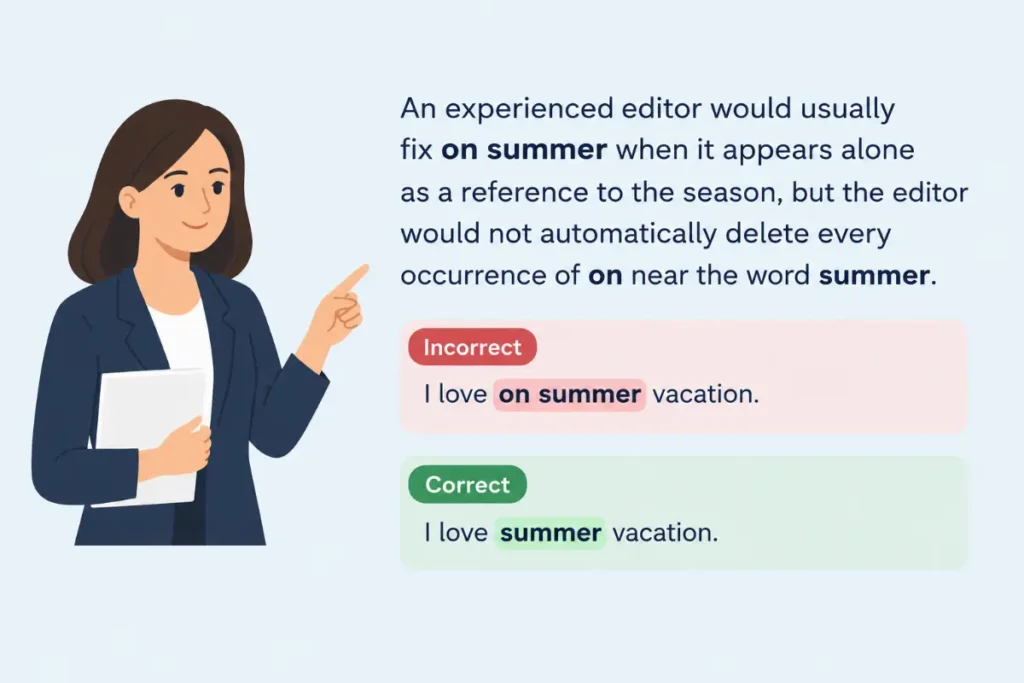
An experienced editor would usually fix on summer when it appears alone as a reference to the season, but the editor would not automatically delete every occurrence of on near the word summer. Context matters. On a summer morning, on a summer day, and on the first day of summer are perfectly natural because the phrase refers to a specific day or day based period. The best editing habit is to identify the exact time reference first and then choose the preposition. That approach is more reliable than memorizing a single phrase.
Conclusion
In summer vs on summer has a clear answer when you mean the season. Use in summer or in the summer for a general seasonal reference. Use on when you identify a particular day or date such as on a summer day or on July 10. The difference comes from how English organizes time expressions.
The easiest rule is to match the preposition with the size of the time period. Seasons months and years commonly take in, while specific days and dates commonly take on. Exact times often take at.
A simple editing trick can save you from many mistakes. Ask yourself whether you mean a season or a specific day. If it is the season, choose in. If it is a particular day, choose on. That small check will keep your time expressions natural and clear.
FAQs
Is in summer grammatically correct?
Yes. In summer is grammatically correct and is the standard way to refer to the summer season as a general period. You can say We travel in summer or Flowers bloom in summer. American English also commonly uses in the summer. Both forms are standard, so you can choose the version that fits the sentence and your preferred style.
Is on summer correct?
On summer by itself is not normally correct when you mean the summer season. English generally uses in with seasons. However, on can appear with a more specific expression such as on a summer day, on a summer morning, or on the first day of summer. The added words make the time reference specific.
Which is correct in summer or on summer?
In summer is correct when you mean during the summer season. On summer is not the normal expression for the season by itself. Use on when you refer to a specific day or date connected with summer. For example, We travel in summer is correct, while We traveled on a summer day is also correct.
Can I say in the summer?
Yes. In the summer is completely correct and very common in American English. The article the does not make the expression incorrect. You can say I work outside in summer or I work outside in the summer. Both sentences communicate the same basic seasonal idea, although the version with the article can sound more conversational.
Why do we use in with summer?
English commonly uses in for broad periods such as seasons months and years. Summer represents a stretch of time rather than one particular day. That is why we say in summer. The same pattern appears in expressions such as in winter, in July, and in 2026. The preposition reflects the broad time reference.
Can I use on with the word summer?
Yes, but usually not with summer alone when you mean the season. You can say on a summer day, on a summer evening, or on the first day of summer. In each example, on introduces a specific day or day based period. The structure after the preposition determines the correct usage.
Is during summer better than in summer?
Both are correct. In summer is often shorter and works well for general seasonal statements. During summer can place more focus on the period itself. For example, I exercise more in summer and I exercise more during summer are both natural. Choose the version that sounds smoother in your sentence.
Is in summer formal English?
Yes. In summer is standard English and works in formal writing. You can use it in essays reports academic work and professional documents. In the summer is also standard and may sound more conversational in American English. The choice is mainly stylistic. Neither form is considered an error when used to refer to the season.
