
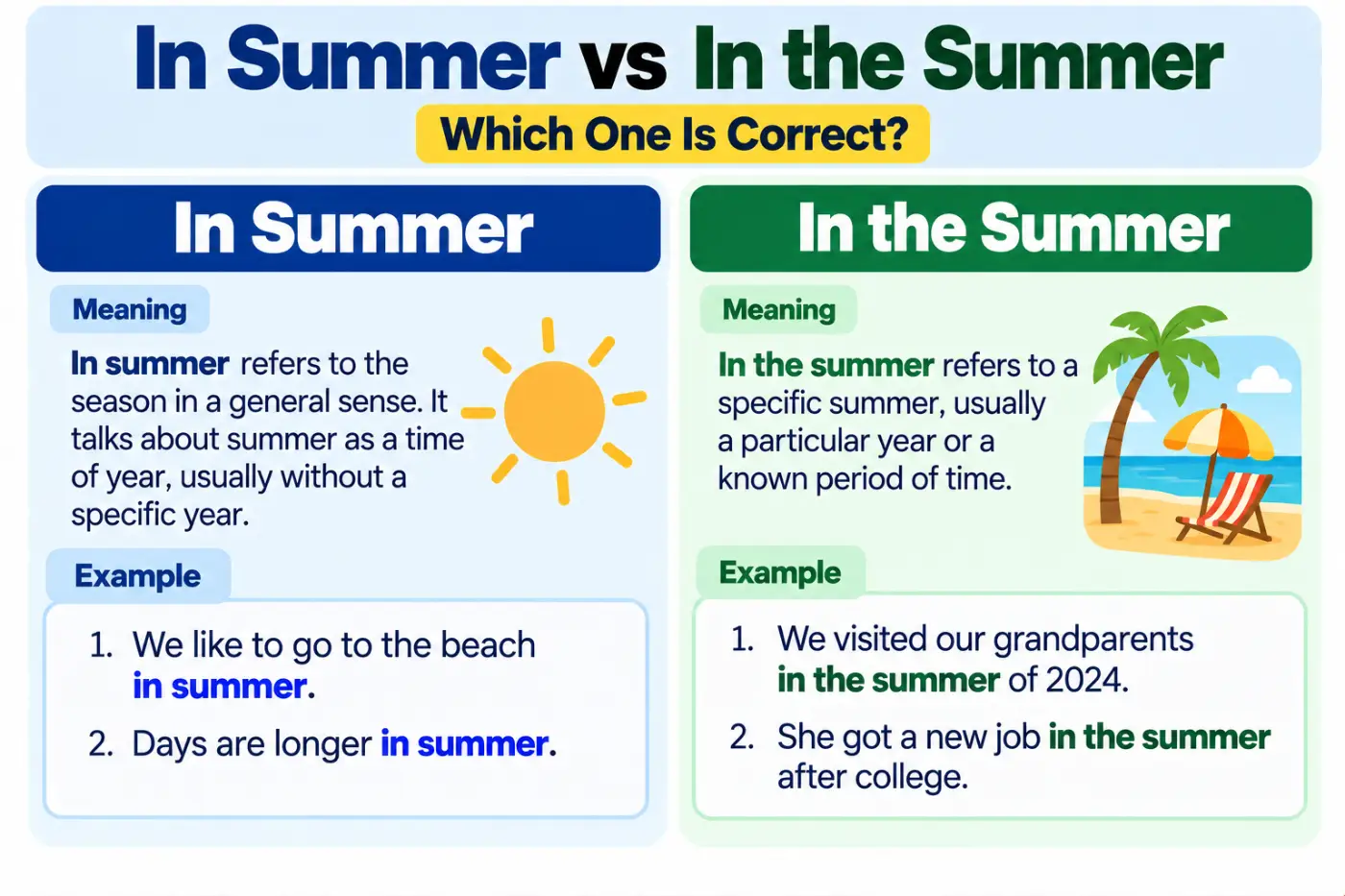
The question of in summer vs in the summer often comes up because English speakers use both expressions. The short answer is that both can be correct. The difference usually depends on whether you are talking about summer as a general season or referring to a particular summer or a specific period.
For example, you can say, I like swimming in the summer. You can also hear, I like swimming in summer. The first version is especially natural in American English, while the second is common in British and other varieties of English. Neither construction automatically makes the sentence grammatically wrong.
The real issue is context. The article, or lack of an article, changes the way the season is framed. Once you understand that summer can function as a general season name or as a particular period, the choice becomes much easier. You’ll learn the core grammar rule, regional differences, pronunciation, sentence patterns, common mistakes, and practical examples for school, work, conversation, and formal writing. You’ll also see when the word the adds meaning and when it simply reflects a regional preference.
Quick Definition
Both forms can be correct. In American English, in the summer is generally the more natural choice when talking about the season as a recurring period. In summer is also grammatical and is especially common in British English and some other varieties. Context and regional style determine the most natural choice.
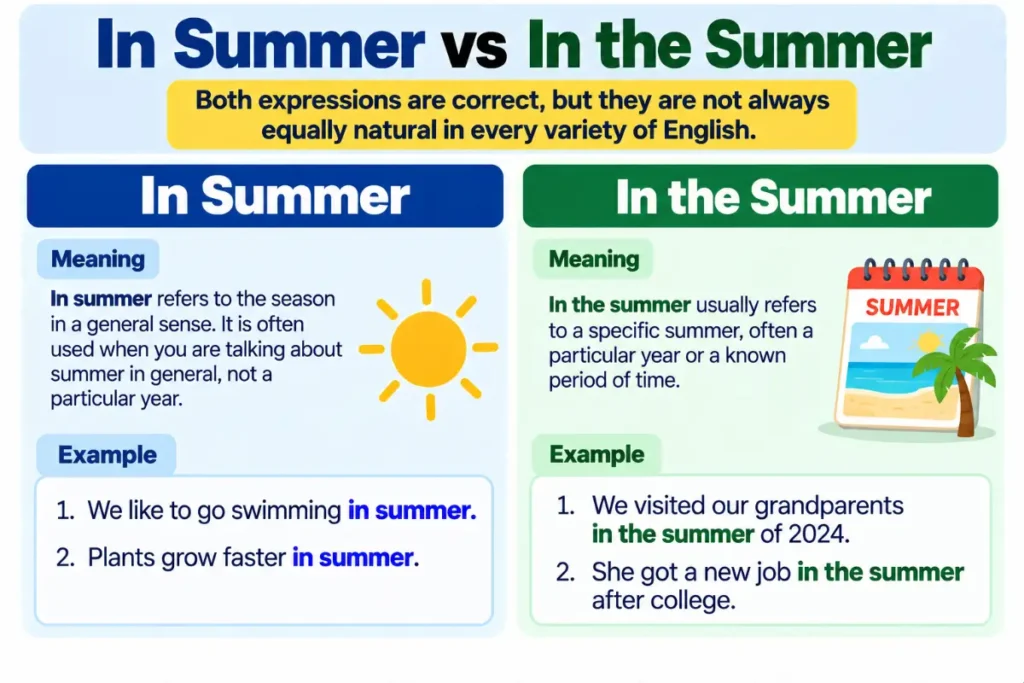
Quick Answer
Both expressions are correct, but they are not always equally natural in every variety of English.
American English commonly uses the summer when referring to the season in general.
Example:
I usually travel in the summer.
British English often uses summer without the article in the same kind of sentence.
Example:
I usually travel in summer.
The important point is that summer is a season name, and English has different patterns for using season names with and without the article. American and British usage differ more in preference than in basic grammar.
Comparison Table
| Expression | Basic Meaning | Part of Speech | Grammar Pattern | Usage Frequency | Formality | Common Contexts | Example |
|---|---|---|---|---|---|---|---|
| In the summer | During the summer season | Prepositional phrase | in + the + season noun | Very common in American English | Neutral | Conversation, school, work, general writing | We visit the lake in the summer. |
| In summer | During summer as a season | Prepositional phrase | in + season noun | Common in British English and other varieties | Neutral to formal | Conversation, literature, general statements | We visit the lake in summer. |
The two expressions often communicate the same basic time period. The main difference is the use of the definite article and the regional preference surrounding it.
Meaning And Definition
Meaning Of Summer
Summer is a noun that names one of the four seasons of the year. In the Northern Hemisphere, it generally refers to the warmest season between spring and fall.
The word can appear in several grammatical patterns.
I love summer.
This sentence treats summer as a general concept or season.
I love the summer.
This version treats the season as a defined period and is also standard English.
We went to Florida last summer.
Here no article appears because last already identifies the time period.
We stayed in Florida during the summer.
Here the article appears before summer because the phrase identifies the season as a defined period.
These patterns show why a simple rule such as always use the or never use the does not work.
Meaning Of In The Summer
In the summer means during the summer season. It is especially common in American English and sounds completely natural in everyday conversation.
For example:
I go swimming in the summer.
The speaker is talking about a general seasonal habit. The sentence does not necessarily point to one particular year.
You can also use the phrase for a specific summer when context identifies it.
We moved to California in the summer of 2024.
Here the summer is clearly connected to a particular year.
The article the helps frame summer as a defined seasonal period.
Meaning Of In Summer
In summer also means during the summer season. It is particularly common in British English and is also found in other English varieties.
For example:
Many tourists visit the coast in summer.
The sentence describes a general seasonal pattern. There is no need to identify one particular year.
The expression can also appear in formal or literary writing.
The hills become dry in summer.
This style can sound concise and natural, especially in British English.
The absence of the does not change the basic meaning. It often reflects regional usage and style.
Key Differences Explained
- The article. The most visible difference is the word the. One expression includes the article while the other does not.
- Regional preference. American English commonly favors the version with the article. British English often uses the season name without it in general statements.
- General meaning. Both expressions can describe something that happens during the summer season as a recurring pattern.
- Specific meaning. The article can help identify a particular seasonal period when the surrounding context makes it specific.
- Formality. Neither expression is inherently formal or informal. However, the version without the article can sound more concise or literary to some American readers.
- Grammar. Both constructions are grammatically valid. The choice depends on context and regional convention.
- Writing style. Writers should follow the variety of English they are using consistently.
- Meaning is often unchanged. In many everyday sentences, the two expressions communicate essentially the same idea.
The key lesson is simple. Don’t treat one form as an incorrect spelling or grammar mistake. They represent different article patterns that English speakers use naturally.
Which Form Should You Use?
If you are writing for a primarily American audience, in the summer is usually the safest and most natural choice for a general statement.
For example:
I usually visit my family in the summer.
This sounds completely natural to most American readers.
If you are writing in British English, in summer is often a natural choice.
For example:
I usually visit my family in summer.
The important distinction is audience and context. American English does not prohibit in summer, and British English does not prohibit in the summer. Both varieties use both constructions, but their preferences can differ.
For international writing, clarity matters more than forcing one form. If your audience is primarily American, consistency with American usage will generally make your writing feel more familiar. If your audience follows British English, the article free form may sound more natural.
When To Use The Article
The definite article the often appears when English speakers conceptualize a season as a defined period.
Consider:
The weather is pleasant in the summer.
The phrase identifies a familiar seasonal period.
The article can also be especially useful when the season has a modifier.
We moved there in the summer of 2022.
She worked there during the summer months.
The summer of 2022 clearly identifies a particular period. The noun is no longer just a broad seasonal concept. It points to a defined summer.
Another example is:
The summer before college changed my plans.
Here the phrase identifies a particular summer through the description that follows it.
This is a useful pattern for learners. When additional information makes the season specific, the article often fits naturally.
When The Article Can Be Omitted
English can omit the article when a season is treated as a general time or recurring period.
For example:
Birds migrate in winter.
Flowers bloom in spring.
Many people travel in summer.
These patterns are particularly common in British English.
However, American English speakers may naturally choose the article.
Birds migrate in the winter.
Flowers bloom in the spring.
Many people travel in the summer.
Both styles can be grammatical. The difference often reflects dialect and style rather than a difference in the underlying idea.
The same general pattern can apply to other season names.
American English Usage
American English commonly uses the definite article with season names when talking about the season generally.
You will often hear and read:
I love the summer.
We go camping in the summer.
The days are longer in the summer.
I usually take a vacation in the summer.
This pattern is deeply familiar to American speakers.
American English also drops the article in several established expressions.
Last summer was extremely hot.
Summer vacation starts next week.
Summer is my favorite season.
In these examples, other words or the grammatical structure already identify the meaning.
The choice therefore depends on the construction rather than a simple rule that American English always requires the.
British English Usage
British English commonly allows season names to appear without an article when making general statements.
For example:
I enjoy walking in summer.
The countryside looks beautiful in spring.
Many people travel abroad in summer.
This pattern is perfectly standard in British English.
British speakers also use the article when context calls for a more specific or defined reference.
The summer of 2020 was unusually difficult.
We spent the summer in Spain.
The distinction is therefore not that British English rejects the article. Instead, British English often has a stronger preference for article free season names in general statements.
Australian English
Australian English uses both patterns. Usage can vary depending on region, speaker, context, and exposure to other English varieties.
The article free form is familiar in Australian English, particularly in general seasonal statements.
Many Australians also use the article in everyday speech.
The summer is often associated with outdoor activities and holidays.
Because both patterns occur naturally, Australian writers should focus on consistency and audience rather than treating one form as universally correct.
Canadian English
Canadian English also uses both constructions. Because Canadian English shares features with both American and British English, speakers may encounter both patterns regularly.
The version with the article is familiar in Canadian English, particularly in everyday North American style.
The article free version is also understood and appears in formal, literary, and British influenced contexts.
For a Canadian audience, either can work depending on the intended style and context.
Grammar Rules And Part Of Speech
The word summer is a noun. In expressions such as in the summer and in summer, the word functions as the object of the preposition in.
The entire phrase functions as a prepositional phrase that usually provides information about time.
Consider:
We visit our grandparents in the summer.
The phrase in the summer tells us when the action takes place.
The same applies to:
We visit our grandparents in summer.
The grammatical structure is almost identical. The main difference is the presence or absence of the definite article.
Sentence Position
The phrase can appear at the beginning or end of a sentence.
In the summer, we usually travel to the coast.
We usually travel to the coast in the summer.
Both sentences are grammatical.
When a time phrase appears at the beginning, a comma often helps separate it from the main clause.
In the summer, we spend more time outside.
When the phrase appears at the end, no comma is normally needed.
We spend more time outside in the summer.
General Statements
Season phrases often describe recurring habits.
I go hiking in the summer.
The sentence does not necessarily describe one specific year. It describes something the speaker generally does during that season.
Specific Summers
When a particular year or event identifies the season, the grammar can change.
We moved there in the summer of 2021.
That sentence points to one particular summer.
Similarly:
The summer after graduation was unforgettable.
The phrase after graduation specifies the summer.
Why The Article Causes Confusion
The word the is one of the hardest small words for English learners because its use depends heavily on context.
Learners often expect every noun to follow one fixed article rule. English does not work that way.
A season can be viewed as a general concept.
Summer can be very hot.
It can be viewed as a recurring period.
We travel in the summer.
It can also be identified as a particular period.
The summer of 2021 was unusually busy.
This flexibility explains why learners see different patterns in books, websites, movies, and conversations.
Regional exposure adds another layer. Someone who learns British English may become accustomed to in summer. Someone who learns American English may hear in the summer much more often.
Neither learner is necessarily making a grammar mistake.
Common Mistakes
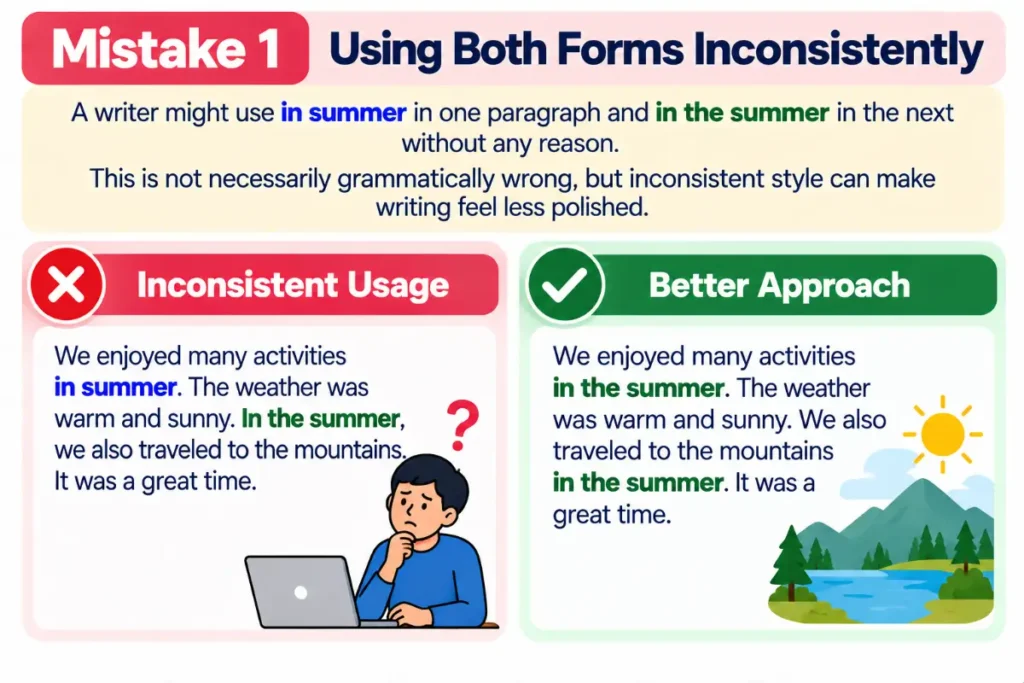
Mistake 1 Using Both Forms Inconsistently
A writer might use in summer in one paragraph and in the summer in the next without any reason.
This is not necessarily grammatically wrong, but inconsistent style can make writing feel less polished.
Choose the pattern that fits your target variety and keep it consistent when the meaning is the same.
Mistake 2 Assuming One Form Is Always Wrong
Some learners are taught that one expression is correct and the other is incorrect.
That rule is too broad.
Both patterns are established English usage. Regional preference and context influence the choice.
Mistake 3 Adding The After Last
The expression last summer normally does not need the article.
Correct:
I visited my grandparents last summer.
Not:
I visited my grandparents last the summer.
The word last already identifies the time period.
Mistake 4 Adding The After Next
We also normally say next summer without the article.
Correct:
I’ll see you next summer.
The word next already identifies the period.
Mistake 5 Treating Every Season The Same Way
English article usage can vary with the season, construction, dialect, and context.
For example:
I love summer.
I love the summer.
Both can work.
The best choice depends on what you mean and how your variety of English normally handles season names.
Sentence Examples
Here are natural examples using the version with the article.
- I usually wake up early in the summer.
- We spend more time outdoors in the summer.
- My family visits the beach in the summer.
- The city becomes crowded in the summer.
- I like reading outside in the summer.
- Many students look for summer jobs during the summer.
- The weather is usually warmer in the summer.
- We often travel to see relatives in the summer.
- She plans to take a photography course in the summer.
- The park attracts thousands of visitors in the summer.
Now consider examples without the article.
- Many birds migrate in summer.
- The town attracts tourists in summer.
- Flowers grow quickly in summer.
- The days are long in summer.
- We often eat outside in summer.
These examples show that the article free pattern is not an error. It is a normal part of English usage.
Real Life Usage Examples
Daily Conversation
I usually go swimming in the summer.
We spend most weekends outdoors in summer.
The first example sounds especially natural in American conversation. The second can sound more British or concise depending on the speaker.
Email And Workplace Communication
Our office will have reduced hours in the summer.
The company usually hires temporary staff in summer.
Both versions can work in professional communication. The choice should match the style of the organization and its intended audience.
Academic Writing
Plant growth tends to increase in the summer months.
Some species reproduce more actively in summer.
Academic writers often choose whichever construction fits the surrounding sentence and regional style.
News Writing
Tourist numbers usually rise in the summer.
Demand for outdoor products increases in summer.
Journalists may use either form depending on the publication’s style.
Literature And Storytelling
The town felt completely different in the summer.
In summer, the fields turned golden under the afternoon sun.
Literary writing often uses both patterns because rhythm and style can influence article choice.
Pronunciation Guide
The pronunciation of the two phrases is straightforward because the main difference is the presence of the.
In The Summer
A common American pronunciation is approximately:
in thuh SUM er
The main stress falls on summer.
The word the often has a weak pronunciation in connected speech. Instead of a strong thee sound, speakers commonly use a relaxed thuh sound before a consonant.
In Summer
This is pronounced approximately:
in SUM er
Again, the main stress falls on summer.
The difference between the two phrases is therefore easy to hear in careful speech, but the weak pronunciation of the article can make it less noticeable in fast conversation.
The pronunciation does not determine which version is grammatically correct. Context and dialect do.
Etymology And Word Origin
The word summer has Old English roots. It developed from the Old English word sumor, which referred to the warm season.
The word is part of a much older Germanic family and has related forms in several Germanic languages.
The basic meaning has remained remarkably stable. Modern English speakers still use summer to identify the warm season of the year.
The article difference is not about the history of the word itself. It comes from English grammar and the way different varieties use articles with season names.
The phrase structure has therefore evolved through normal patterns of English usage rather than through a special rule attached to the word summer.
Related And Confused Terms
In Spring
English speakers use both in spring and in the spring. The same regional and contextual pattern often applies.
In Winter
Both in winter and in the winter occur in standard English.
In Fall
American English commonly uses in the fall. British English usually prefers autumn and may use in autumn.
In Autumn
This expression is standard and especially common in British English and other varieties that use autumn instead of fall.
Last Summer
Last summer refers to the summer immediately before the current period. It normally does not take the article.
Next Summer
Next summer refers to the upcoming summer. It normally appears without the article.
During The Summer
During the summer is another natural way to describe an activity or event taking place in that season. It often sounds slightly more explicit than in the summer.
Throughout The Summer
Throughout the summer emphasizes that something continues across most or all of the season.
These related expressions help show that article choice depends on the complete phrase rather than the word summer alone.
In Summer And In The Summer In Formal Writing
Both forms can appear in formal writing. The best choice depends on the variety of English and the style of the publication.
For American academic writing, in the summer will often sound familiar and natural.
Example:
The researchers collected samples in the summer.
In British academic writing, in summer can be equally natural.
Example:
The researchers collected samples in summer.
Neither sentence needs to be changed simply because the writing is formal.
The bigger issue is consistency. If a document follows American English conventions, keep the style consistent. If it follows British English conventions, follow that pattern.
A formal writer should also consider clarity. If the sentence refers to a specific summer, adding identifying information is more useful than worrying about the article alone.
For example:
The researchers collected samples in the summer of 2023.
That sentence gives the reader a precise time reference.
How Context Changes The Meaning
Context can make the article more meaningful.
Compare these sentences:
I love summer.
I love the summer.
The first treats summer as a general concept or season. The second can place more attention on the experience of the season as a defined period.
Now compare:
We travel in summer.
We travel in the summer.
Both can describe a recurring habit.
Then consider:
We traveled in the summer of 2022.
Now the phrase clearly refers to a particular summer.
The article is not acting alone. Other words in the sentence can establish specificity.
This is a broader English grammar lesson. Articles often work together with context rather than following a simple one word equals one rule system.
Expert Editor Insight
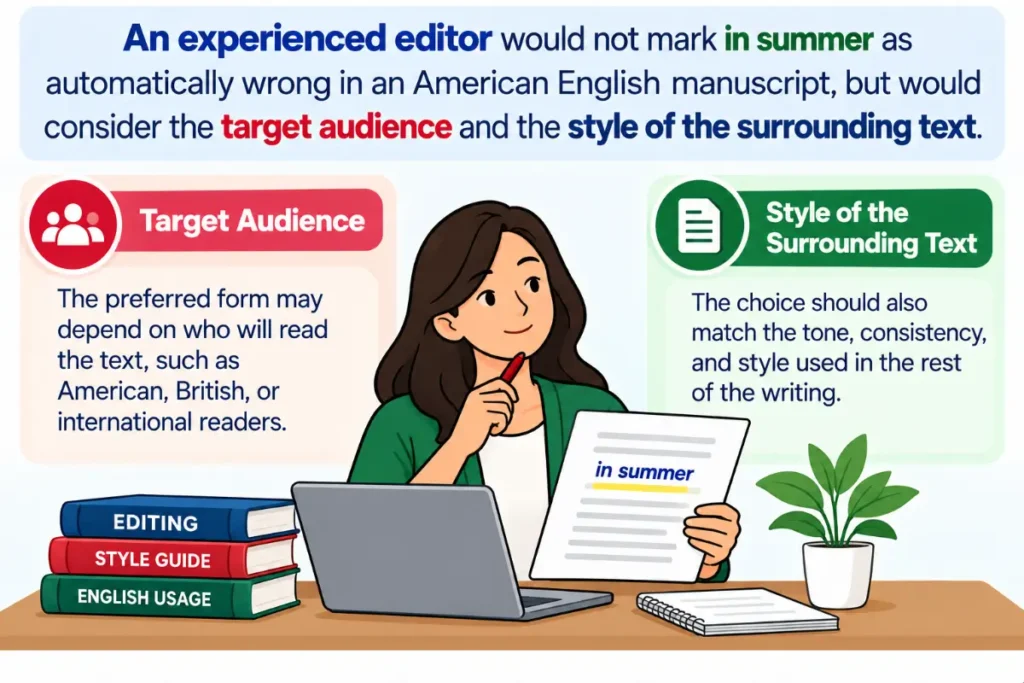
An experienced editor would not mark in summer as automatically wrong in an American English manuscript, but would consider the target audience and the style of the surrounding text. In American prose, in the summer often sounds more conversational and familiar for general seasonal statements. In British prose, in summer is extremely natural. Editing tools may suggest changes based on a selected language setting, but those suggestions should be treated as style guidance rather than absolute grammar rules. The best editing decision comes from context, audience, and consistency.
Conclusion
in summer vs in the summer can both be correct. The main difference is the article and the English variety being used. American English commonly favors in the summer for general statements about the season, while British English often uses in summer. Neither form should automatically be labeled a grammar error.
Context also matters. A phrase such as in the summer of 2024 clearly points to a specific period, while both forms can describe recurring seasonal activities. Expressions such as last summer and next summer normally appear without the article because those words already identify the time.
For American writing, a practical choice is to use in the summer for general seasonal statements and keep your style consistent. If you are following British English, in summer may sound more natural. The key is not to memorize one rigid rule. Focus on audience, context, and clarity.
FAQs
Is in summer grammatically correct?
Yes. In summer is a standard English expression. It means during the summer season and is particularly common in British English and other varieties. American English also uses it, although many American speakers prefer in the summer for general seasonal statements. The absence of the article does not automatically make the phrase incorrect.
Is in the summer grammatically correct?
Yes. In the summer is completely grammatical and very common in American English. It usually means during the summer season. For example, I visit my family in the summer describes a recurring seasonal habit. The phrase can also refer to a particular summer when the surrounding context identifies it.
Which expression is more common in American English?
American English commonly favors in the summer when discussing the season in general. For example, I usually travel in the summer sounds very natural to American speakers. However, in summer is still understandable and grammatical. The difference is mainly one of regional preference and style rather than a strict right or wrong rule.
Do British speakers use in the summer?
Yes. British speakers use both forms. However, in summer is particularly common when referring to the season generally. For example, Many people travel in summer is a natural British English sentence. The article can still appear when context makes the season more specific, such as in the summer of 2024.
Should I use the article before summer?
It depends on your meaning, dialect, and writing style. American English often uses the article in general statements, while British English frequently omits it. If you are writing for a US audience, in the summer will usually sound familiar. If you are following British English, in summer may fit more naturally.
Do I say in summer or during summer?
Both can be grammatical, but during summer is less common than during the summer in many varieties. During the summer clearly means throughout or at some point within that seasonal period. In summer and in the summer are often more natural for general statements about seasonal habits or events.
Do last summer and next summer need the article?
No. English normally says last summer and next summer without the article. Last and next already identify the relevant time period. For example, I traveled last summer and I’ll travel next summer are standard. Adding the article before these expressions usually creates an unnecessary or incorrect construction.
Is the summer more formal than summer?
Not necessarily. The article does not automatically make the expression more formal. In the summer is simply very common in American English. In summer is also standard and may sound more concise or literary to some readers. Formality depends much more on the complete sentence, vocabulary, context, and writing style.
