
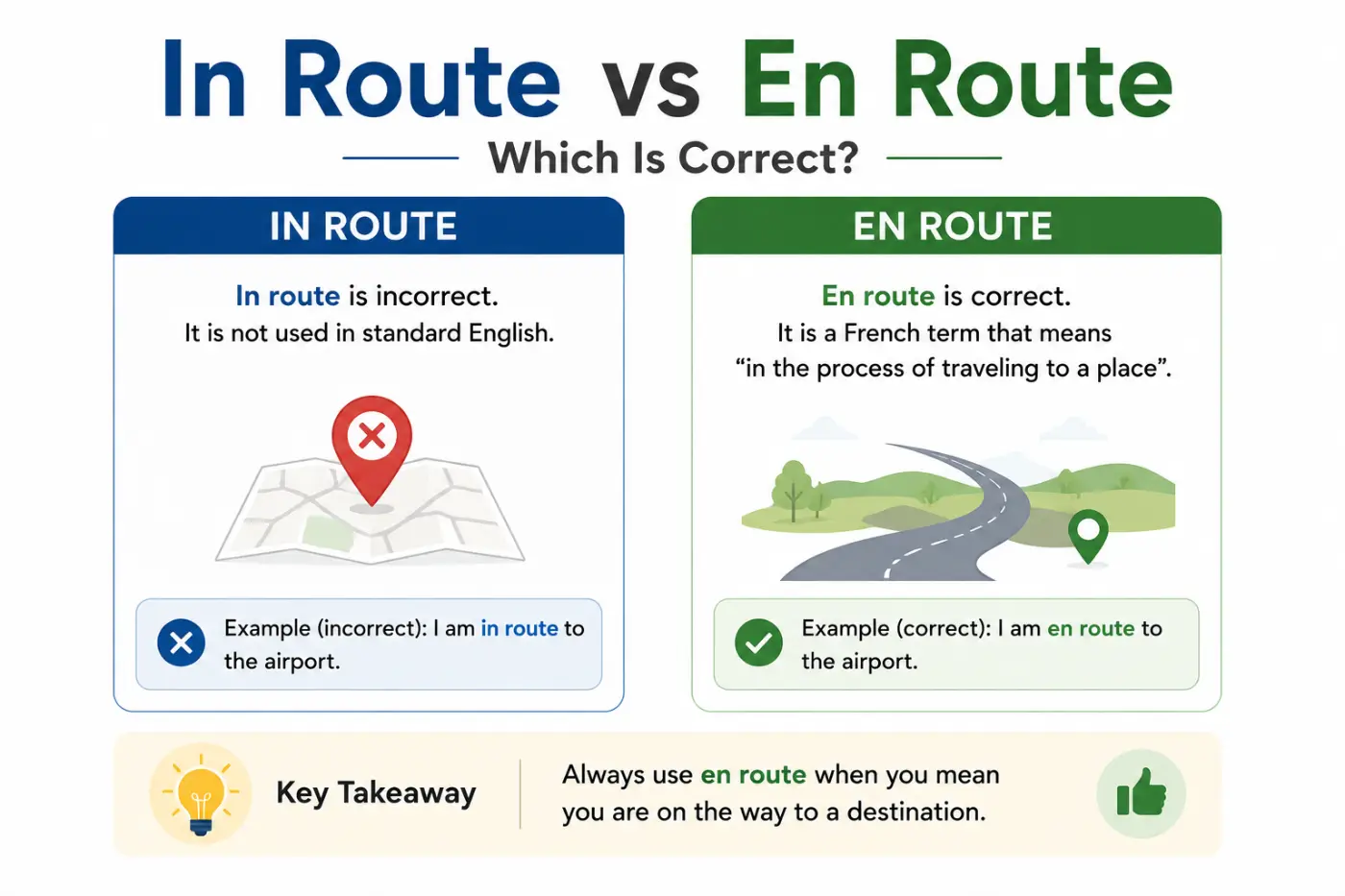
in route vs en route is a common English usage question because the two expressions look close in meaning but don’t have the same status in standard English. The established expression is en route, which means on the way to a destination or while traveling toward a place. In most standard English writing, in route isn’t the usual expression for this meaning.
The confusion makes sense because English often uses the preposition in with phrases that describe location or movement. You can be in transit, in motion, or in the car, so in route may seem logical. However, en route comes from French and has been used in English as a fixed expression for being on the way.
Once you know that distinction, the choice becomes straightforward. This guide explains the meaning, grammar, pronunciation, history, regional usage, common mistakes and natural alternatives. You’ll also see how to use the expression in everyday conversation, work messages, academic writing, news reports, and formal communication.
Featured Snippet Quick Definition
En route is the standard expression meaning on the way or traveling toward a destination. It comes from French and functions as an adverbial phrase in English. In route is sometimes used informally or as a variation influenced by phrases such as in transit, but en route is the established choice in standard English.
Quick Answer
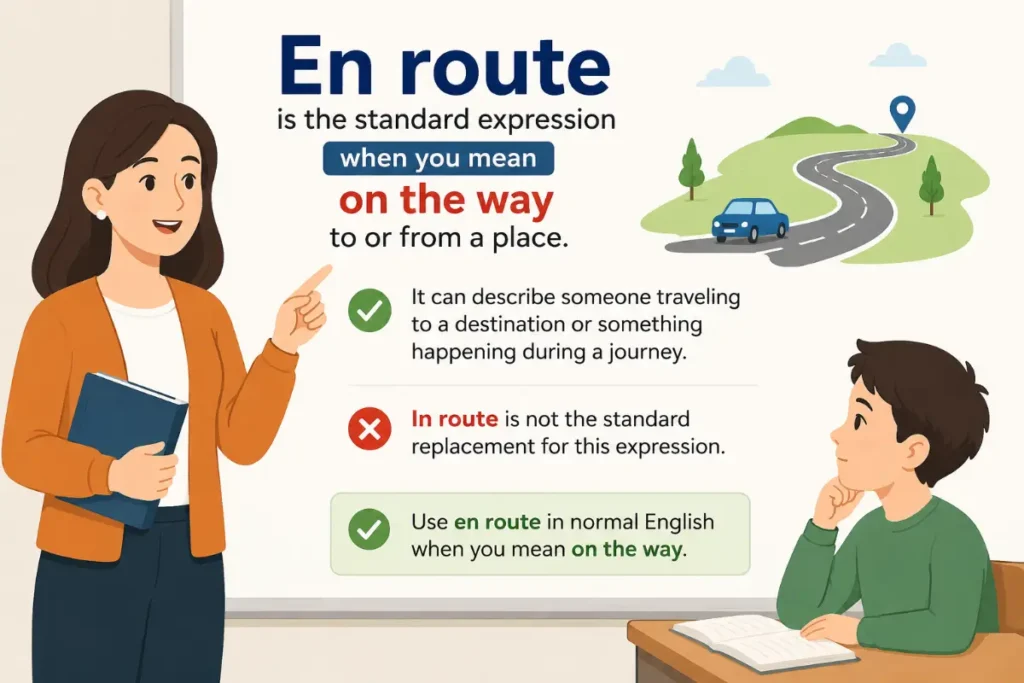
The standard expression is en route. It means on the way to a destination.
For example, you can write, We are en route to the airport. You can also say, The package is en route to your home.
In route may appear in informal speech or writing, but it isn’t the established expression for this meaning. If you’re writing an email, report, article, school assignment, or professional message, en route is the safer standard choice.
Comparison Table In Route And En Route
| Expression | Meaning | Part of Speech | Origin | Usage Frequency | Formality | Common Contexts | Example |
|---|---|---|---|---|---|---|---|
| En route | On the way to a destination | Adverbial phrase | French | Common | Neutral to formal | Travel, logistics, news, business, everyday writing | We are en route to the airport. |
| In route | Usually intended to mean on the way | Prepositional phrase in nonstandard or less established usage | English formation influenced by similar expressions | Less established for this meaning | Informal or nonstandard | Casual speech and occasional informal writing | The driver is in route to the warehouse. |
The difference isn’t about two equally standard phrases with slightly different meanings. For ordinary English usage, en route is the established expression.
Meaning And Definition
Meaning Of En Route
En route means on the way to a particular destination. It can describe a person traveling somewhere, a vehicle moving toward a location, or something being transported.
For example:
The ambulance is en route to the hospital.
This means the ambulance is currently traveling toward the hospital.
You can also use the phrase when the destination is understood from context.
We’re en route now.
Here the speaker means they are already traveling toward the intended destination.
The expression can describe a journey that is underway but not yet complete. It focuses on the period between departure and arrival.
This makes it useful in travel updates, delivery messages, emergency services, transportation reports, and ordinary conversation.
Meaning Of In Route
In route is generally used by people who intend to express the same idea as en route. It can arise naturally because English has many established expressions beginning with in.
For example, we say:
The package is in transit.
The driver is in the vehicle.
The machine is in motion.
These familiar patterns can make in route seem perfectly logical. Yet language isn’t always built from perfectly predictable formulas. En route entered English as an established French expression and has retained its traditional form.
That doesn’t mean every appearance of in route is meaningless. Context can occasionally produce a literal construction where in modifies a noun such as route. For example, a technical or descriptive sentence might use in route in a special structural sense. However, that is different from using in route as a direct replacement for en route.
If you simply mean on the way, use en route.
Key Differences Explained
- Standard usage. En route is the established expression for on the way. In route isn’t the usual standard form for that meaning.
- Meaning. En route describes movement toward a destination. In route is generally used by writers who are trying to express the same idea but are following a different English pattern.
- Origin. En route comes from French. Its form reflects its historical origin rather than the usual English preposition pattern.
- Grammar. En route functions as an adverbial phrase. It can describe what someone or something is doing during a journey.
- Pronunciation. En route is commonly pronounced approximately like on ROOT in American English, although pronunciation can vary.
- Formality. En route works well in both ordinary and formal English. It isn’t limited to academic writing.
- Context. You can use it for people, vehicles, packages, emergency services, flights, deliveries, and many other forms of travel.
- Spelling. En route consists of two words. The phrase retains the French spelling and does not normally become enroute in standard English.
Which Form Is Correct
En route is the established standard expression when you mean on the way or traveling toward a destination.
The phrase is borrowed from French. In French, en route has the basic sense of on the way or on the road. English adopted the expression and kept its original two word form.
This is a good example of why English can’t always be learned by swapping prepositions according to logic alone. You might reasonably expect English to use in because other movement expressions do. But common usage has settled on en route.
Dictionary treatment also supports this distinction. Major English dictionaries recognize en route as a standard expression meaning on the way. That established usage makes it the natural choice in edited English.
If you want a simple rule, use this one.
If you mean on the way, write en route.
How To Use En Route In A Sentence
En route usually appears after the subject and verb or near the end of a sentence.
For example:
We are en route to Dallas.
The firefighters were en route to the scene.
The package is currently en route.
It can also appear at the beginning of a sentence when you want to emphasize the journey.
En route to the conference, we stopped for coffee.
Here the phrase describes what happened during the trip to the conference.
You can also place it inside a longer sentence.
The team stopped twice while en route to the tournament.
The phrase remains connected to the journey rather than the final destination itself.
Sentence Examples
Here are ten natural examples using the standard expression.
- We are en route to the airport now.
- The delivery truck is en route to your neighborhood.
- She called me while she was en route to work.
- The rescue team was already en route when the weather changed.
- Your order is en route and should arrive tomorrow.
- We stopped for lunch en route to the beach.
- The flight crew received the message while en route to Chicago.
- He sent a quick text to say that he was en route.
- The students visited several historic sites en route to the capital.
- The ambulance was en route to the hospital within minutes.
These examples show that the phrase works in many settings. It isn’t restricted to formal travel announcements.
Common Mistakes And Misspellings
Using In Route For On The Way
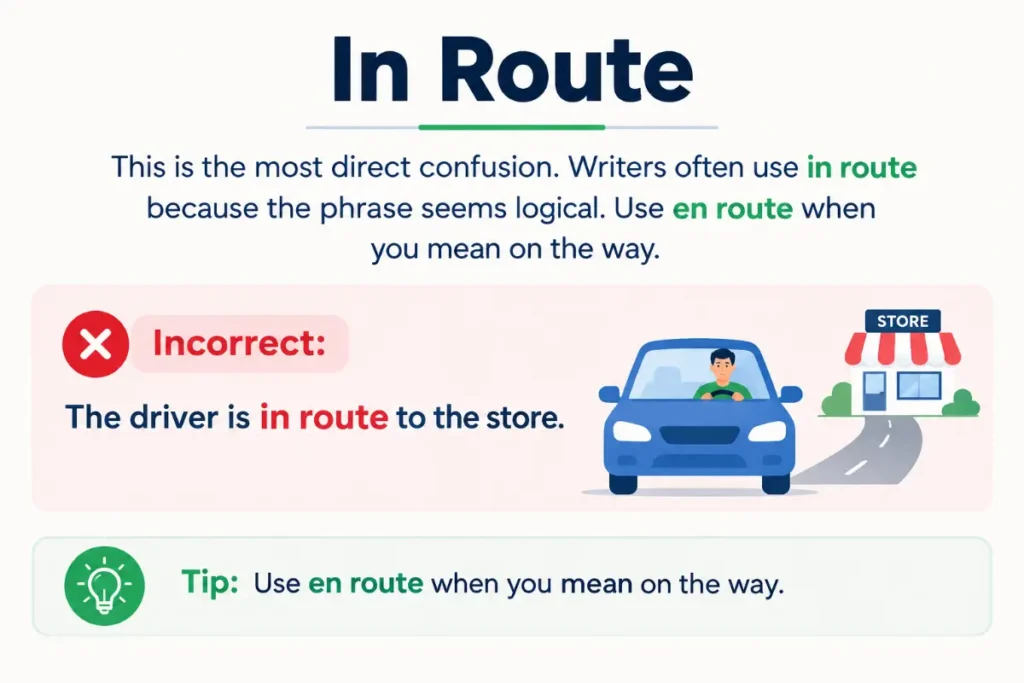
The most common problem is choosing in route because it sounds like other English phrases.
Less standard for this meaning: The driver is in route to the store.
Standard: The driver is en route to the store.
The correction is simple. Replace in route with en route when you mean traveling toward a destination.
Writing Enroute As One Word
Some writers combine the two words.
Incorrect in standard usage: We are enroute to the office.
Standard: We are en route to the office.
The expression is normally written as two words.
Using Inroute
Inroute is another spelling created by combining the words and changing the structure.
Standard English uses en route.
Treating En Route As A Verb
En route doesn’t function as a standalone verb.
You shouldn’t write:
We en route to Boston.
Instead, use a verb that describes the journey.
We are en route to Boston.
The verb are provides the grammatical structure while en route tells us about the state of travel.
Using It When No Journey Exists
En route describes movement toward a destination. It isn’t simply a fancy word for nearby or present.
For example, saying The book is en route to the table would make sense only if the book is actually being moved toward the table.
The phrase needs a journey or movement context.
Pronunciation Guide
In American English, en route is commonly pronounced approximately /ˌɑːn ˈruːt/.
A simple pronunciation guide is:
on ROOT.
The second word receives the stronger stress.
The pronunciation can vary by speaker and region. Some speakers use a pronunciation closer to the French source, while others use a fully anglicized pronunciation.
For ordinary American English, on ROOT is a useful approximation.
One reason learners may hesitate over the expression is that its spelling doesn’t look completely English. The French origin explains why the spelling and pronunciation can feel less predictable than familiar English phrases.
The phrase should still be treated as a normal part of English vocabulary.
Etymology And Word Origin
En route comes directly from French. The French expression combines en, meaning in or on, with route, meaning road or route.
The underlying idea is being on the road or on the way.
English has borrowed many expressions from French over centuries, especially in areas connected with law, food, art, government, fashion, and everyday vocabulary. En route is one of the French expressions that remained recognizable in English.
The phrase began appearing in English usage centuries ago and developed into a familiar expression for travel or movement toward a destination.
Its French origin explains why English speakers don’t normally change en into in simply to match other English expressions. Borrowed expressions often retain parts of their original structure after becoming established in another language.
The word route itself also entered English through French and ultimately traces farther back through Latin. That shared history makes the phrase feel natural once you recognize route as the noun at its center.
Regional Usage
American English
En route is standard American English. It appears in everyday conversation, travel announcements, workplace messages, logistics, news writing, and formal documents.
Americans often use it naturally in sentences such as We’re en route or The package is en route. In casual speech, on the way is usually simpler and more common.
For example:
I’m en route to the office.
I’m on my way to the office.
Both communicate the same basic idea, but the second sounds more conversational.
British English
British English also uses en route as the standard expression for being on the way. The meaning is essentially the same as in American English.
British speakers may also use on the way in ordinary conversation. The choice often depends on tone and context rather than regional grammar.
There isn’t a major British alternative spelling that replaces en route.
Australian English
Australian English uses en route in the same general way. It can appear in travel writing, journalism, professional communication, and ordinary speech.
On the way remains a natural everyday alternative. En route may sound slightly more formal in relaxed conversation.
Canadian English
Canadian English also recognizes en route as the standard expression. Its meaning and basic grammatical use remain consistent with American and British English.
The main variation you may notice is stylistic. A casual speaker may prefer on the way, while a formal report may use en route.
Grammar Rules And Part Of Speech
En route functions as an adverbial phrase in English.
That means it gives information about an action or situation. It commonly tells us that someone or something is traveling toward a destination.
Consider:
The driver is en route to the warehouse.
The phrase describes the driver’s current state of travel.
The package arrived safely.
The package was en route for two days.
In the second sentence, en route gives information about the period during which the package was traveling.
The expression can appear in several positions.
After A Linking Verb
The team is en route to the stadium.
The package is en route.
This is one of the most common patterns.
After A Noun Phrase
The passengers were delayed while en route to New York.
Here the phrase describes what the passengers were doing during their journey.
At The Beginning Of A Sentence
En route to the airport, we stopped for gas.
The opening phrase establishes the travel context before the main action.
At The End Of A Sentence
The rescue team was traveling en route to the damaged area.
This structure is possible, although writers often place the phrase closer to the verb or use on the way instead.
Punctuation With En Route
When en route appears naturally within a sentence, it usually doesn’t require special punctuation.
For example:
We are en route to the station.
When it begins a sentence as an introductory phrase, a comma can make the structure clear.
En route to the station, we received a phone call.
The comma separates the introductory phrase from the main clause.
The phrase itself doesn’t need quotation marks or italics in ordinary English writing. Although it has French origins, it is well established in English and doesn’t need special treatment simply because of its origin.
En Route Versus On The Way
On the way is the most natural everyday alternative to en route.
Compare these sentences:
I’m en route to the store.
I’m on the way to the store.
Both mean that the speaker is traveling toward the store.
The difference is mainly tone. On the way sounds more conversational and is extremely common in everyday speech. En route can sound slightly more polished or formal, especially in written communication.
That doesn’t mean en route is overly formal. You can easily use it in a text message.
I’m en route. See you in ten minutes.
Still, if you’re speaking casually with a friend, I’m on my way may feel more natural.
En Route Versus In Transit
En route and in transit overlap but aren’t identical.
En route emphasizes movement toward a destination.
The package is en route to Chicago.
In transit emphasizes that something is currently being transported or moved.
The package is in transit.
The first sentence tells us where the package is going. The second focuses on the fact that the package is moving through the delivery system.
In logistics, both expressions are useful. Choose en route when the destination or direction matters.
En Route Versus On The Road
On the road usually suggests that someone is traveling, especially by vehicle.
We’re on the road to Denver.
En route is broader.
The flight is en route to Denver.
The package is en route to Denver.
The ambulance is en route to Denver.
The phrase can describe movement that doesn’t involve driving.
Real Life Usage Examples
Daily Conversation
I’m en route to your house. I’ll be there soon.
We grabbed some coffee en route to the movie theater.
In everyday speech, these sentences are perfectly natural. Still, on my way may be more common in very casual conversation.
Email And Workplace Communication
The shipment is en route to the distribution center.
Our technician is en route and should arrive shortly.
These examples work well in professional communication because they give a clear status update.
Academic Writing
The researchers collected additional observations en route to the field station.
The expedition team documented several changes in vegetation en route to the study site.
Academic writing can use the phrase when describing travel during research or fieldwork.
News Writing
Emergency crews were en route to the area after receiving reports of flooding.
The aircraft was en route to its destination when the crew reported a technical issue.
Journalistic writing often uses the phrase because it communicates movement clearly and efficiently.
Literature And Storytelling
They were en route to the old village when the storm began.
She noticed the mountain peaks while en route to the coast.
In storytelling, the expression can help move a scene from one location to another without lengthy explanation.
Related And Confused Terms
On The Way
On the way is the closest everyday alternative. It means traveling toward a destination or moving during a journey.
On The Road
On the road usually suggests travel by vehicle or a person who is traveling.
In Transit
In transit describes something being transported or moved. It often appears in shipping and logistics.
Underway
Underway means in progress or already moving. It can describe travel but also applies to events and processes.
In Motion
In motion means moving rather than stationary. It has a broader meaning than en route.
Heading To
Heading to is a conversational expression for moving toward a destination.
I’m heading to work.
Bound For
Bound for means traveling toward a particular destination.
The train is bound for Boston.
On The Journey
On the journey refers to being engaged in travel. It can also have a broader figurative meaning involving progress toward a goal.
These expressions overlap, but they aren’t interchangeable in every sentence. En route is especially useful when you want a concise way to say that someone or something is on the way to a destination.
When To Choose A Simpler Alternative
Good writing isn’t about using the most sophisticated phrase available. Sometimes on the way is the better choice.
Consider a text message.
I’m on my way.
That sounds natural and direct.
Now consider a delivery update.
Your order is currently en route to the local distribution center.
The second sentence has a professional tone that fits the context.
You can also use heading to in casual communication.
I’m heading to the airport now.
The best expression depends on the situation, the audience, and the tone you want.
Expert Editor Insight
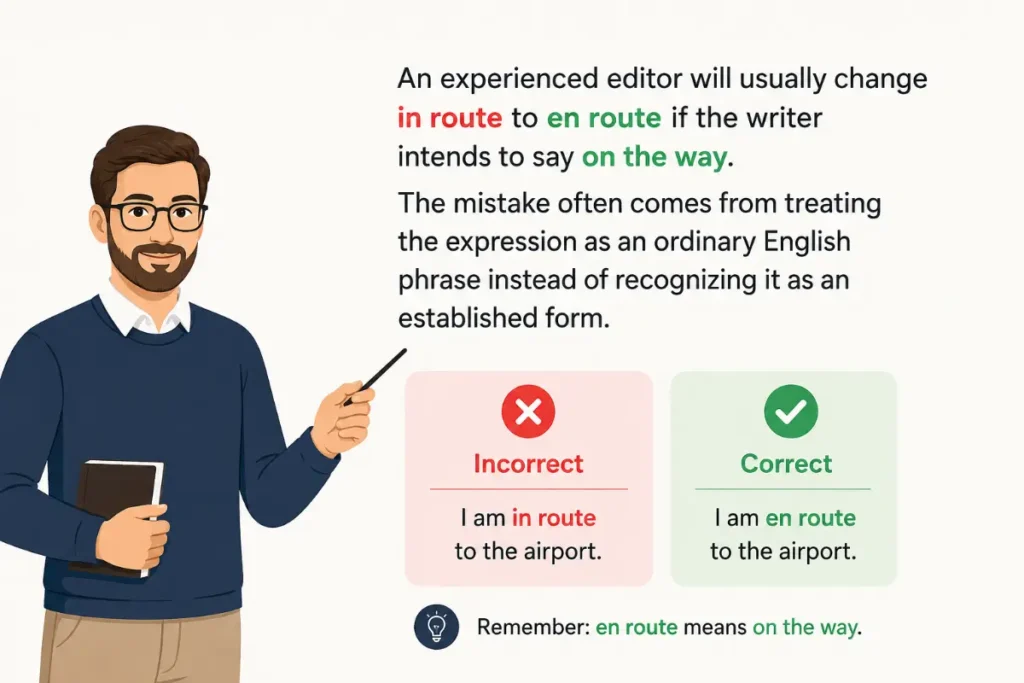
An experienced editor would usually keep en route when the meaning is on the way because it is the established expression and needs no replacement in standard writing. The main confusion comes from English speakers applying the familiar preposition in to a phrase that has a different historical structure. Editors also check the spelling carefully because en route is written as two words. If the audience is very casual, on the way may be clearer and more conversational, but that is a style choice rather than a correction.
Conclusion
in route vs en route has a clear answer when you mean on the way to a destination. En route is the established standard expression. It describes a person, vehicle, package, flight, or other moving thing that is traveling toward a destination. In route can appear in informal usage, but it isn’t the usual standard choice for this meaning.
The phrase comes from French and has kept its two word form in English. That history explains why the expression doesn’t follow the same pattern as familiar phrases such as in transit. If you’re writing for work, school, publication, or any polished setting, en route is the reliable choice.
A simple editing trick is to replace the phrase mentally with on the way. If that is the meaning you want, write en route. Remember that it has two words and you’ll avoid the most common mistakes.
FAQs
Is in route grammatically correct?
In route can appear in English, but it isn’t the established expression when you mean on the way to a destination. Standard edited English normally uses en route for this meaning. If you’re writing a professional message, school assignment, article, report, or formal document, choose en route. In route may reflect informal usage or influence from phrases such as in transit.
What does en route mean?
En route means on the way to a destination. It describes someone or something that is traveling or being transported toward a particular place. For example, The package is en route to Chicago means the package is currently traveling toward Chicago. The phrase can describe people, vehicles, deliveries, flights, emergency crews, and other forms of movement.
Is en route one word or two?
En route is normally written as two words. The expression comes from French and retains its established two word form in English. Writing enroute as one word is not the standard spelling. If you mean on the way, use en route with a space between the two words.
How do you pronounce en route?
In American English, en route is commonly pronounced approximately like on ROOT. The second part receives the stronger stress. Some speakers may use a pronunciation that stays closer to French, while others use an English pronunciation. Both can be heard, but on ROOT is a useful pronunciation guide for ordinary American English.
Can you use en route in formal writing?
Yes. En route is fully suitable for formal writing. You may see it in business communication, news reports, academic descriptions, transportation updates, and professional documents. It can also appear in casual messages. The phrase is established enough that it doesn’t need quotation marks or special formatting simply because it originated in French.
What is another word for en route?
The closest everyday alternative is on the way. Other related expressions include heading to, on the road, in transit, underway, and bound for. The best choice depends on the context. On the way is especially natural in casual American English, while en route works well when you want a concise expression that fits both professional and everyday writing.
Why do people say in route?
People may say in route because English contains many familiar expressions that begin with in, including in transit, in motion, and in the car. The phrase therefore feels logical even though the established expression is en route. This is a common type of language pattern confusion where speakers build a phrase from a familiar grammatical model rather than from the conventional expression.
Is en route only used for travel?
En route is mainly associated with physical movement toward a destination, but it can sometimes be used figuratively. For example, a writer might describe a project as en route to completion. However, the clearest and most established use involves actual travel or transportation. In ordinary writing, use it primarily when someone or something is moving toward a destination.
