
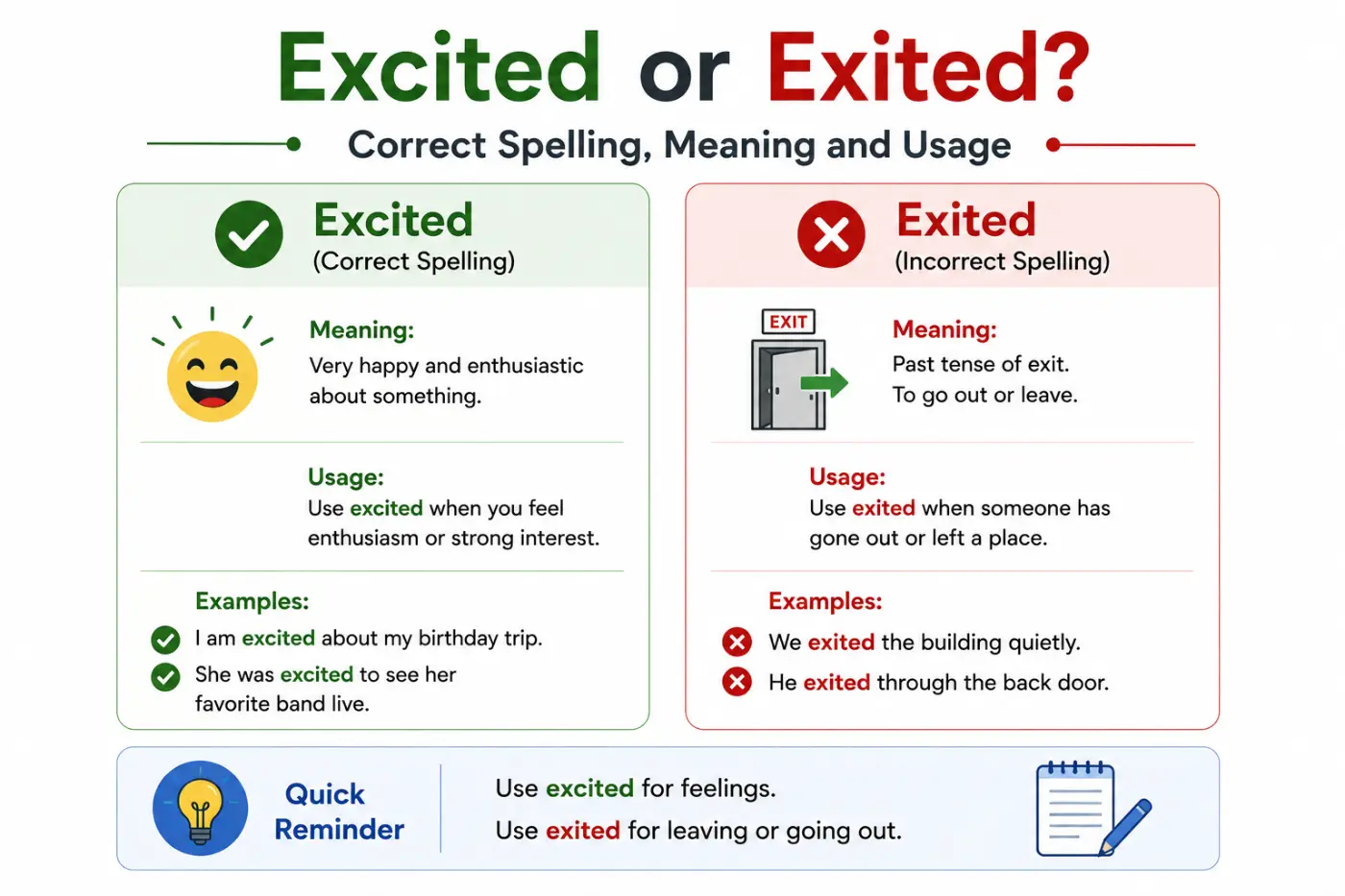
The difference between excited vs exited comes down to one letter but the meanings are completely different. Excited means very happy, eager, or enthusiastic about something. Exited means left a place or went out of something. If you say I am excited about the trip, you are looking forward to it. If you say I exited the building, you mean you left it.
These words cause confusion because they look and sound very similar. They also share the same ending and differ mainly in the letters after the initial sound. For someone typing quickly or learning English, that small spelling difference can easily lead to the wrong word.
The good news is that the distinction is easy once you connect each word with its meaning. This guide explains the definitions, grammar, pronunciation, spelling, common mistakes, regional usage, and real life examples. You’ll also get a simple memory trick that can help you choose the right word without stopping to think about it.
Quick Definition
Excited is an adjective that describes a person who feels very happy, eager, enthusiastic, or emotionally energized about something. Exited is the past tense and past participle of the verb exit, meaning to leave a place or situation. The two words look similar but have different meanings and grammatical roles.
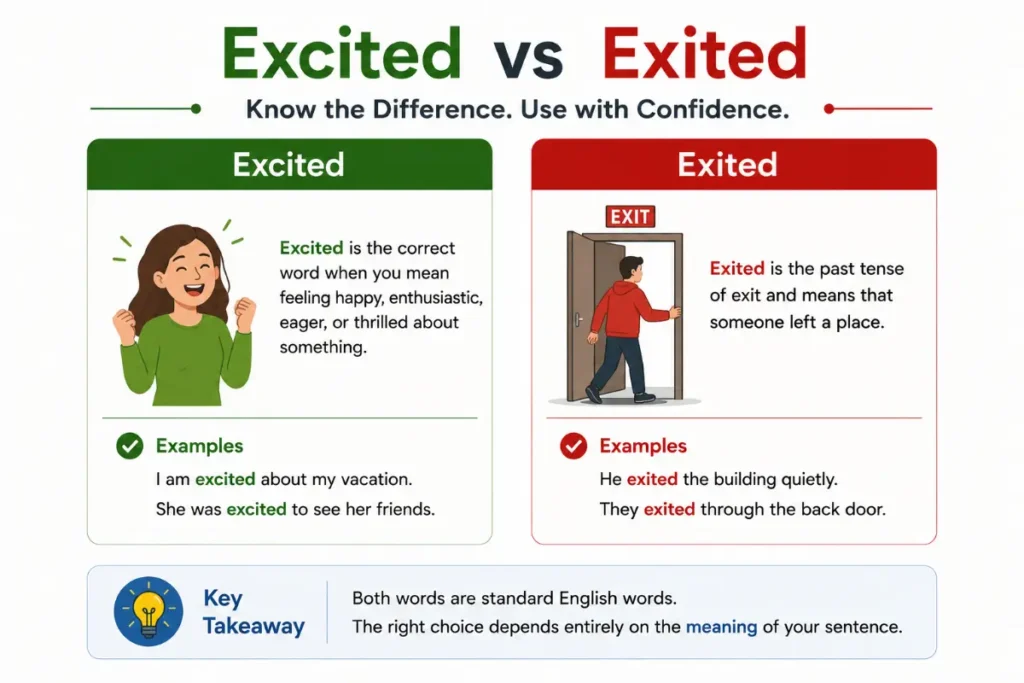
Quick Answer
Use excited when you mean happy, eager, enthusiastic, or looking forward to something.
Use exited when you mean left a place or went out. For example, I am excited about the concert means you’re looking forward to it. I exited the theater means you left the theater.
Comparison Table excited vs exited
| Form | Meaning | Part of Speech | Origin | Usage Frequency | Formality | Common Contexts | Example |
|---|---|---|---|---|---|---|---|
| Excited | Feeling very happy, eager, or enthusiastic | Adjective | Related to Latin excitare through French and English | Very common | Neutral | Feelings, plans, events, conversations, school, work | I’m excited about the trip. |
| Exited | Left or went out of a place or situation | Verb form | From Latin exitus through French and English | Common | Neutral | Buildings, rooms, vehicles, websites, programs, situations | She exited the room quietly. |
Meaning and Definition
Meaning of Excited
Excited describes a strong feeling of happiness, enthusiasm, eagerness, or anticipation. When you’re excited, you’re looking forward to something or reacting with strong positive energy.
For example:
I’m excited about my birthday.
She’s excited to start college.
They were excited about the new project.
The word describes an emotional state. It tells the reader how someone feels rather than where someone went.
Excited can describe people and sometimes animals or groups.
The children were excited about the school trip.
The dog became excited when it saw its owner.
In everyday American English, excited is extremely common. People use it for both major events and small moments.
I’m excited for dinner tonight.
I’m excited about the weekend.
The word doesn’t always mean extreme happiness. It can simply show strong interest or anticipation.
Meaning of Exited
Exited is the past tense and past participle of exit. It means someone or something left a place or moved out of an area.
For example:
He exited the building.
The passengers exited the train.
She exited the room.
The driver exited the highway.
Here, exited describes an action rather than an emotion. The person or thing moved away from a location.
The verb can also appear in technology.
The user exited the application.
She exited the website.
The program exited unexpectedly.
In these examples, exited means the person or program left a digital environment.
The key idea is simple. Excited describes a feeling. Exited describes leaving.
The Core Difference Between the Two Words
The easiest way to understand the distinction is to focus on the action or feeling behind the word.
Excited answers a question such as: How do you feel?
Exited answers a question such as: What did you leave?
Consider these two sentences.
I’m excited about the vacation.
I exited the airport.
The first sentence describes emotion. The second describes movement.
This distinction works in most situations. If someone is looking forward to an event, use excited. If someone has left a room, building, vehicle, website, or other location, use exited.
A simple comparison can make this even clearer.
She was excited when the movie started.
She exited the theater after the movie.
In the first sentence, she has a feeling. In the second, she performs an action.
Spelling Differences
The spelling difference is small but meaningful.
Excited is spelled:
E X C I T E D.
Exited is spelled:
E X I T E D.
The word excited contains c after ex. Exited does not.
This difference comes from their different base words.
Excited comes from excite.
Exited comes from exit.
Adding the past tense ending ed gives:
Excite + ed = excited.
Exit + ed = exited.
This is one of the best ways to remember the spelling. Instead of trying to memorize two complete words separately, remember the base words first.
Excite relates to emotion and enthusiasm.
Exit relates to leaving.
Once you see the connection, the spelling becomes much easier.
Grammar and Part of Speech
The two words also differ grammatically.
Excited as an Adjective
Excited is commonly used as an adjective. It describes someone’s emotional condition.
I’m excited.
He looks excited.
They were excited.
The children are excited.
It can also appear with an infinitive.
I’m excited to meet you.
She’s excited to begin her new job.
We’re excited to visit California.
Another common structure uses about.
I’m excited about the concert.
He’s excited about his new car.
They’re excited about the opportunity.
You can also use for in everyday American English.
I’m excited for the weekend.
She’s excited for the trip.
This form is very common in casual speech. In some formal contexts, excited about may sound more traditional or precise, but both structures occur naturally in American English.
Exited as a Verb
Exited is the past tense of the verb exit.
Present tense:
I exit the building.
Past tense:
I exited the building.
Past participle:
I have exited the building.
The verb can take a direct object in some contexts.
The passengers exited the bus.
The workers exited the building.
It can also appear without a direct object when the context is clear.
The audience exited quietly.
The visitors exited through the rear door.
Because exit is a verb, exited describes something that happened. It doesn’t describe someone’s emotional state.
How Pronunciation Helps
The pronunciation of these words is similar enough to create confusion, especially for English learners.
Excited is commonly pronounced:
/ɪkˈsaɪtɪd/
A simple pronunciation guide is:
ik SYE tid.
The stress falls on the second syllable.
Exited is commonly pronounced:
/ˈɛɡzɪtɪd/
A simple guide is:
EG zit id.
The first sounds are different enough in careful speech to help distinguish them.
Excited begins with a sound close to ik.
Exited begins with a sound close to egz.
However, natural speech can move quickly, and unfamiliar accents can make the distinction harder to hear. That’s why spelling and meaning remain more reliable than pronunciation alone.
If you’re learning English, practice these sentences aloud.
I’m excited about the party.
She exited the party early.
The contrast becomes much easier to hear when you say the two sentences together.
Why These Words Are So Easy to Confuse
The confusion isn’t surprising. Both words begin with ex and end with ited. Their visual structure is almost identical.
There is also a common pattern in English where one small letter changes the meaning of an entire word. This happens with many word pairs.
For example:
Accept and except.
Advice and advise.
Affect and effect.
Then and than.
In the same way, excited and exited belong to a group of words that require attention to one small spelling detail.
Typing makes the problem even easier to create. When someone writes quickly, the c in excited may disappear. The result is exited, which happens to be a real English word. That makes the error harder for automatic spellcheckers to catch.
This is an important point. If you accidentally type exited instead of excited, a basic spellchecker may not flag it because exited is correctly spelled. The problem is meaning, not spelling.
That’s why proofreading needs more than checking red underlines.
Common Mistakes and Misspellings
Using Exited for an Emotion
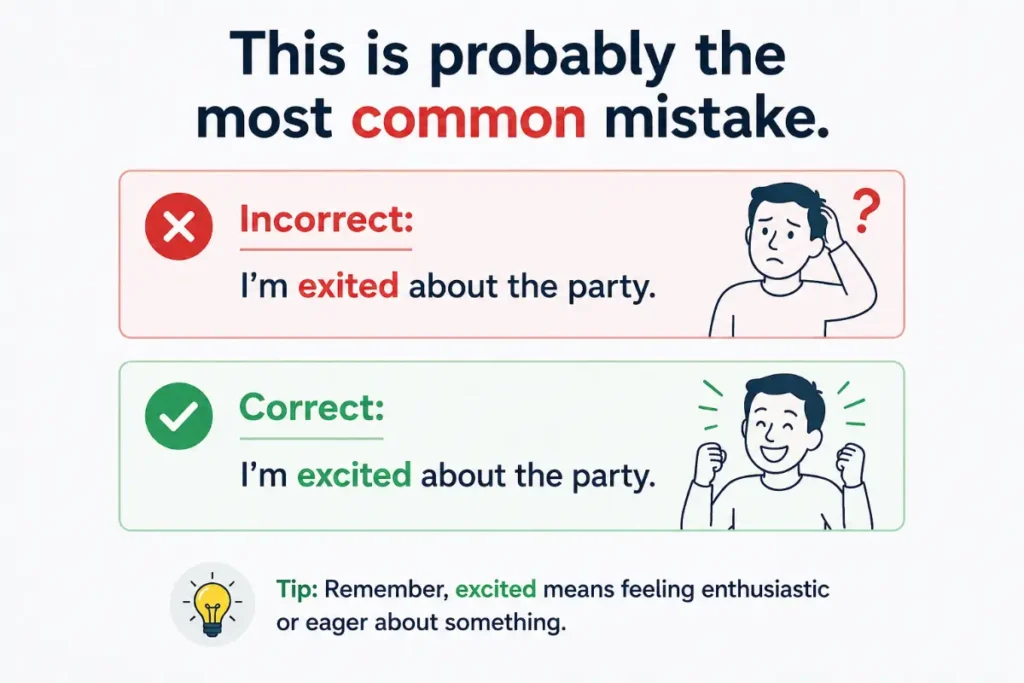
Incorrect:
I’m exited about the concert.
Correct:
I’m excited about the concert.
The writer means they are looking forward to the concert. The correct adjective is excited.
Using Excited for Leaving
Incorrect:
She excited the room.
Correct:
She exited the room.
The intended meaning is that she left the room. The verb exit gives you exited.
Forgetting the C
A frequent typing error is writing exited when the intended word is excited.
The best correction method is to identify the base word. If the base word is excite, keep the c.
Confusing Excited and Exciting
These words are related but they aren’t interchangeable.
I am excited about the movie.
The movie is exciting.
Excited describes the person who feels the emotion. Exciting describes something that creates that feeling.
Confusing Excited and Nervous
Excited usually suggests positive anticipation, but context can affect the emotion.
I’m excited about the interview.
This can mean the speaker is eager for the opportunity. It doesn’t automatically mean they feel completely calm.
The meaning comes from the context.
Sentence Examples With Excited
- I’m excited about visiting New York next month.
- She was excited to receive the good news.
- The kids are excited about their summer vacation.
- I’m really excited to see what happens next.
- He looked excited when he opened the package.
- We’re excited about starting the new school year.
- My sister is excited for her first day at college.
- The team was excited after winning the game.
- I’m excited to share the results with everyone.
- They were excited about meeting their favorite singer.
Notice how each sentence describes a feeling of enthusiasm, anticipation, or happiness.
Sentence Examples With Exited
- She exited the building through the main door.
- The passengers exited the plane one row at a time.
- He exited the room after the meeting ended.
- We exited the highway at the next ramp.
- The customer exited the website without completing the purchase.
- The students exited the classroom quietly.
- The actor exited the stage after the final scene.
- She exited the vehicle and walked toward the entrance.
- The application exited unexpectedly.
- The visitors exited the museum before closing time.
In all these examples, exited refers to leaving or moving out.
A Simple Memory Trick
Use the C test.
If you’re talking about a feeling, think of excite.
If you’re talking about an exit, think of exit.
Excite gives you excited.
Exit gives you exited.
You can also remember this sentence:
I am excited before I exit.
This sentence puts both words together and gives each one a clear role.
Before the event, you might feel excited.
After the event, you might exit the building.
Another useful trick is to ask yourself one question.
Am I describing a feeling or a departure?
If it’s a feeling, choose excited.
If it’s a departure, choose exited.
That quick mental check works well in school writing, emails, text messages, and everyday conversation.
Real Life Usage Examples
Daily Conversation
In everyday conversation, excited usually appears when people talk about plans, events, news, or personal goals.
I’m excited about the weekend.
She’s excited to meet her cousins.
Exited appears when someone talks about leaving.
He exited the restaurant early.
We exited through the back door.
The surrounding words usually make the intended meaning obvious.
Email and Workplace Communication
Excited is common in professional communication when someone expresses enthusiasm.
I’m excited to join the team.
We’re excited about the upcoming project.
Exited is more practical and descriptive.
The employee exited the office at 5 p.m.
The customer exited the application before completing the form.
In workplace writing, context matters. The same spelling mistake can completely change the meaning of a sentence.
Academic Writing
Academic writing often uses excited when discussing emotional responses or motivation.
The students were excited about the research project.
Participants reported feeling excited about the new activity.
Exited may appear in descriptions of movement or experimental procedures.
The participants exited the room after completing the task.
The subjects exited the testing area through a designated door.
The words are perfectly acceptable in academic writing when the meaning calls for them.
News and Journalism
News reports may use excited when describing reactions to events.
Fans were excited about the team’s return.
Residents were excited about the opening of the new center.
Exited may describe people leaving a location.
The passengers exited the station after the service resumed.
Several people exited the building after the announcement.
Literature and Storytelling
Writers often use excited to show a character’s emotional response.
Maya was excited when she saw the envelope.
The children were excited as the lights came on.
Exited can describe physical movement.
He exited the room without saying a word.
The stranger exited through the narrow doorway.
Storytelling often relies on context, so choosing the correct word helps readers understand the scene immediately.
Related and Confused Terms
Exciting
Exciting describes something that creates excitement.
The game was exciting.
The person feels excited.
The event is exciting.
The distinction is similar to other adjective pairs such as boring and bored.
Thrilled
Thrilled means extremely pleased or excited.
She was thrilled to receive the award.
It usually expresses stronger emotion than ordinary excited.
Enthusiastic
Enthusiastic means showing strong interest, energy, or eagerness.
He’s enthusiastic about the new project.
It often works well in professional and academic contexts.
Eager
Eager means very interested and ready to do something.
She’s eager to start her new job.
Eager often focuses on willingness and anticipation.
Nervous
Nervous describes worry, uncertainty, or anxiety. Someone can feel nervous and excited at the same time.
I’m excited but nervous about the interview.
This sentence shows why context matters.
Exit
Exit is the base verb related to exited. It means to leave.
Please exit through the front door.
Remembering this base word makes exited easier to identify.
Enter
Enter is closely related to the opposite action of exit. It means to go into a place.
She entered the room and later exited it.
Leave
Leave is a common everyday alternative to exit.
He left the building.
He exited the building.
Leave usually sounds more natural in casual conversation, while exit can sound more direct or formal depending on the context.
Excited and Exciting Are Not the Same
A separate source of confusion comes from the words excited and exciting.
The difference is based on who experiences the emotion.
Excited describes the person or animal experiencing the feeling.
I’m excited about the trip.
Exciting describes the thing that creates the feeling.
The trip sounds exciting.
Compare these examples.
The football match was exciting.
The fans were excited.
The movie was exciting.
We were excited to watch it.
This pattern is worth learning because it appears throughout English.
The same idea applies to many adjective pairs.
I’m bored.
The movie is boring.
I’m interested.
The book is interesting.
I’m surprised.
The result is surprising.
Learning these patterns helps you use excited naturally rather than simply memorizing a definition.
Regional Usage
American English
American English uses excited and exited as standard words with the same basic meanings described above. Excited is extremely common in conversations about plans, events, achievements, and personal experiences. Exited is common when describing movement away from buildings, vehicles, roads, programs, or digital environments.
There is no special American spelling that changes the distinction.
British English
British English also uses both words as standard English forms. The meanings remain the same. A British speaker can say I’m excited about the trip or She exited the building with no difference in basic meaning.
Some expressions may vary by region, but this word pair doesn’t have a major British spelling difference.
Australian English
Australian English uses excited for enthusiasm and exited for leaving. The distinction remains the same in everyday and formal writing.
Canadian English
Canadian English also maintains the same distinction. Writers use excited to describe enthusiasm and exited as the past form of exit.
The important point is that this isn’t a regional spelling issue. English varieties may differ in many areas, but excited and exited retain their separate meanings across major English speaking varieties.
Formal and Informal Usage
Both words are acceptable in formal and informal English.
Excited is natural in casual speech.
I’m excited for the concert.
It also works in professional writing.
We’re excited to announce the new program.
Exited is also standard.
The passengers exited the aircraft.
The user exited the application.
In casual conversation, Americans often prefer leave over exit.
I left the office.
That sounds very natural.
I exited the office.
This is also grammatical, but it can sound more formal, technical, or deliberate depending on context.
The distinction is about style rather than correctness.
When Excited Can Sound Too Strong
Excited is common, but writers should still choose words that match the situation.
For example:
I’m excited to see you.
This sounds warm and natural.
I’m thrilled to see you.
This expresses stronger enthusiasm.
I’m pleased to see you.
This sounds calmer and may suit a formal situation.
In professional writing, excited can be perfectly appropriate, especially when announcing a new project or opportunity. Still, using the same emotional word repeatedly can make writing feel less precise.
An experienced writer chooses language based on the strength of the feeling and the tone of the situation.
When Exited Is More Natural Than Left
Exit and leave overlap, but they aren’t always equal in tone.
Leave is the everyday choice.
She left the room.
Exit can sound more formal or technical.
She exited the room.
Exit is especially natural in instructions.
Please exit through the rear door.
It also works well in technical contexts.
The program exited with an error.
The user exited the application.
This makes exited useful beyond physical locations. It can describe leaving a digital system or process too.
What Spellcheckers Can and Cannot Catch
Grammar and spelling tools are useful, but they don’t understand every meaning perfectly.
Suppose you write:
I’m exited about my vacation.
The spelling of exited is correct. The problem is that the sentence needs excited.
A simple spelling checker may not identify this as an error because both words exist in English.
This is called a real word error in practical editing. The word itself is spelled correctly, but it doesn’t fit the intended meaning.
Human proofreading remains useful because meaning depends on context.
When you see exited in a sentence, ask yourself if the person actually left somewhere. If not, you may need excited instead.
This is a good example of why editing involves more than correcting spelling. Good proofreading checks meaning, grammar, context, and word choice together.
Expert Editor Insight
An experienced editor would treat these as a meaning problem rather than simply a spelling problem. Both words are legitimate English forms, so a basic spellchecker may accept either one. The fastest editing test is to identify the base word. If the sentence comes from excite, use excited. If it comes from exit, use exited. This approach is more dependable than relying only on visual similarity or automatic correction.
Final Takeaway
excited vs exited becomes easy once you focus on meaning instead of appearance. Excited describes enthusiasm, happiness, or anticipation. Exited describes the action of leaving a place, vehicle, system, or situation. Both are correct English words, so the issue isn’t simply spelling. The right choice depends on what you want to say.
A useful memory trick is to connect excited with excite and exited with exit. If you’re talking about a feeling, use excited. If you’re talking about leaving, use exited. When proofreading, ask yourself one quick question: am I describing an emotion or a departure? That simple check can prevent the mistake in schoolwork, emails, professional writing, and everyday messages.
FAQs
What is the difference between excited and exited?
Excited describes a feeling of happiness, enthusiasm, or anticipation. Exited is the past tense of exit and means left or went out of a place or situation. For example, I’m excited about the trip describes an emotion, while I exited the building describes an action. The two words differ by one letter but have completely different meanings.
Is excited a verb or an adjective?
Excited is commonly used as an adjective that describes a person’s emotional state. It can appear after linking verbs such as be, seem, look, and feel. For example, She is excited and He looks excited both describe emotion. The related verb is excite, as in The news excited the children.
Is exited a real English word?
Yes. Exited is a real English word and is the past tense and past participle of exit. It means left or went out. For example, The passengers exited the plane means the passengers left the plane. This makes the confusion especially easy because exited isn’t a spelling error. It becomes incorrect only when the intended meaning is enthusiasm or anticipation.
How do you pronounce excited?
Excited is commonly pronounced /ɪkˈsaɪtɪd/. A simple guide is ik SYE tid. The strongest stress falls on the second syllable. The c contributes to the sound at the beginning of the word. Practicing excited and exited in complete sentences can help you hear the difference more clearly and connect each pronunciation with its meaning.
Can you say I am excited for something?
Yes. I’m excited for the weekend and I’m excited for the trip are common expressions in American English. You can also say I’m excited about the trip or I’m excited to see you. The choice depends on the sentence. Excited for is especially common in casual conversation and everyday communication.
What is a synonym for excited?
Depending on context, useful synonyms include enthusiastic, eager, thrilled, delighted, and enthusiastic. The best choice depends on the strength and type of emotion. Eager often focuses on anticipation. Thrilled expresses very strong happiness. Enthusiastic emphasizes energy and interest. Excited is more general and works naturally in both casual and professional communication.
Why do people confuse excited and exited?
People confuse these words because they look almost identical and share several letters. They also sound similar in fast speech. Another reason is that both are legitimate English words, so automatic spelling tools may not catch a mistaken choice. The best solution is to focus on meaning. Ask if the sentence describes a feeling or someone leaving a place.
Is excited appropriate in formal writing?
Yes. Excited is appropriate in many forms of formal writing, including professional emails, announcements, reports, and business communication. For example, We’re excited to begin the project is perfectly natural. Still, formal writing should match the strength of the word to the situation. In some contexts, pleased, eager, or enthusiastic may provide a more precise tone.
